
Gym Lighting: Sports Halls, Fitness Gyms and School Gymnasiums
How to light gyms with LED: lux levels for sports halls and fitness areas, high bays vs linear fittings, glare control for ball sports, impact protection, layouts and controls.
Key points
- Sports halls for basketball and volleyball need about 200 lux for training, 500 lux for club competition and 750 lux for national matches (EN 12193).
- Fitness gyms and weight rooms are usually lit to 300–500 lux with comfortable, low-glare light.
- Players look up, so fittings need glare control and should sit beside rather than above main playing lines.
- Ball-impact protection (IK08 or higher, or guards) is standard in sports halls and school gyms.
“Gym” covers very different spaces: a school gymnasium with basketball and volleyball, a club sports hall for competitions, a commercial fitness gym with weights and treadmills, and a home gym in a garage. The lighting needs differ, but all share the same goals: enough light, even light, no glare when looking up, and fittings that survive balls and vibration.
Light levels
From EN 12193 for indoor sports halls (basketball, volleyball, handball, badminton):
| Class | Use | Horizontal illuminance | Uniformity |
|---|---|---|---|
| III | Training, school sport, recreation | 200 lux | 0.5 |
| II | Club and league competition | 500 lux | 0.6 |
| I | National and international competition | 750 lux | 0.7 |
Badminton and table tennis often need more light at higher classes because the ball or shuttle is small and fast. Televised events need vertical illuminance for cameras, set by the broadcaster.
| Fitness area | Typical level |
|---|---|
| Cardio and weights | 300–500 lux |
| Studios (yoga, spin) | 300 lux, dimmable |
| Changing rooms | 200 lux |
| Reception | 300 lux |
Fitting types
| Space | Ceiling | Typical fitting |
|---|---|---|
| Sports hall | 7–12 m | LED high bays with anti-glare optics |
| School gym | 6–9 m | High bays or linear high bays with guards |
| Fitness gym | 3–4 m | Linear fittings, panels, downlights |
| Studios | 3–4 m | Dimmable downlights, linear coves |
| Home or garage gym | 2.5–3.5 m | Linear fittings or LED tubes |
Our LED high bays are used in sports halls with reflectors and covers; for halls that need asymmetric throw from the sides, our modular sports floodlights offer 140° × 80° and 155° × 80° optics.
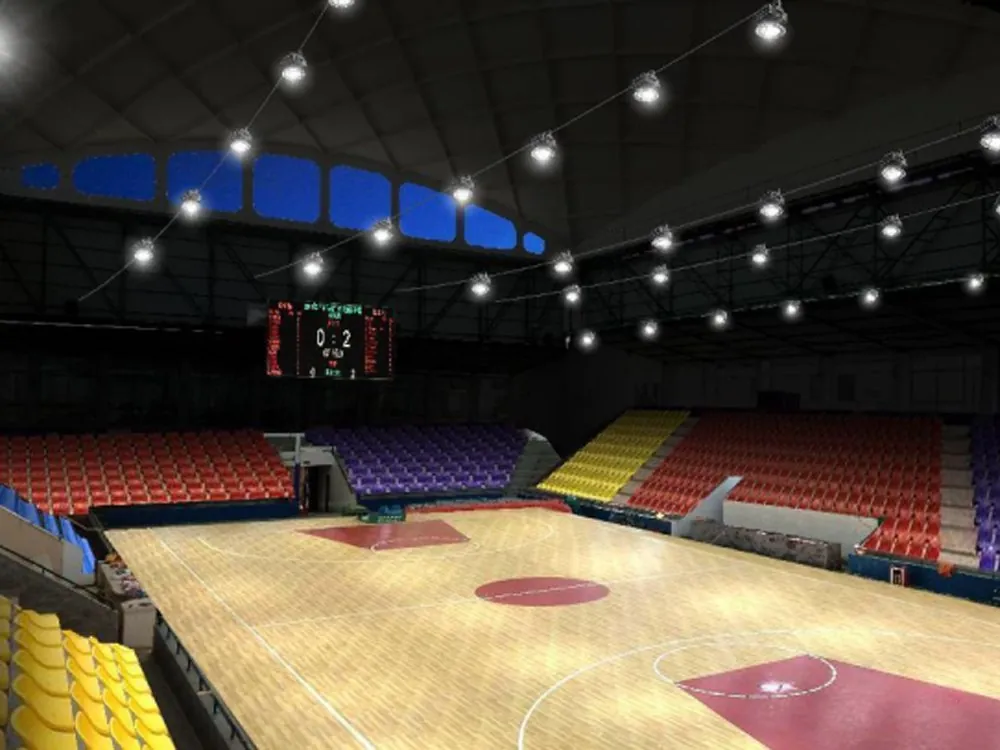
We have lit basketball arenas and a sports training hall in Hunan with fittings mounted high above the courts.
Glare: the most important detail
Players look up at balls and shuttles. A bright fitting in the line of sight makes them lose the ball.
- Mount high, usually at the roof structure
- Use optics with good cut-off, or diffusers and anti-glare rings
- Avoid fittings directly over main playing lines, especially for badminton and volleyball; place them in rows beside the courts
- Light walls and ceiling so the room is not a dark box with bright points
- Consider asymmetric floodlights from the sides for halls used mainly for one sport
Uniformity and layout
More, smaller fittings give more even light than a few large ones. A typical school hall of 34 × 20 m with a 9 m ceiling might use around 30–40 high bays of 150 W for 300–500 lux, laid out in rows along the length. Check your own hall with the method in how many LED high bay lights do I need, or run the high bay calculator and then adjust the layout so no fitting sits over a main playing line.
Impact and vibration
- IK08 or higher impact resistance, or wire guards
- Safety cables on suspended fittings
- Robust brackets that do not loosen with vibration from balls and roof movement
- Polycarbonate covers rather than glass where balls can hit
Flicker and cameras
Sports are filmed for coaching, streaming and social media. Flicker invisible to the eye shows up as banding in video, especially in slow motion. Choose flicker-free drivers; for broadcast-level events, ask for a flicker percentage suited to high-speed cameras.
Colour
- 4000–5000K for sports halls: bright, neutral and good for cameras
- Ra 80 or higher; Ra 90 where broadcast or colour matters
- 3000–4000K for studios and changing areas
- Dimmable for studios and multi-use halls
Controls
| Control | Benefit |
|---|---|
| Scene switching | Training, competition and cleaning levels |
| Occupancy sensors | Changing rooms, corridors, stores |
| Daylight sensors | Halls with roof lights or windows |
| Time schedules | School and club timetables |
A hall that switches between 200 lux for training and 500 lux for matches saves a lot compared with full light all the time.
Fitness gyms
Commercial fitness gyms need comfortable rather than sports-level light:
- Avoid bright fittings directly above benches, where people lie looking up
- Linear and indirect lighting reduces glare
- Mirrors double the effect of bad positioning; check reflections
- Accent lighting on walls and branding makes spaces feel premium
Home and garage gyms
Two to four linear LED fittings at 4,000–5,000 lm each light a typical garage gym. Keep fittings off the area above a bench press, and add light on walls for mirrors. See our parking garage and garage lighting guide for garage layouts.
Converting from metal halide
Old sports halls with 250–400 W metal halide high bays can switch to 100–200 W LED high bays with instant start, no warm-up between sessions and no lamp colour shift. See the HPS and metal halide conversion chart.
Multi-use halls
School and community halls host sport by day, assemblies and exams in the afternoon and events at night. A lighting system with scenes covers all of these: full light for sport, lower and warmer light for events, and a cleaning level. Add separate stage or end-wall lighting if the hall has a stage, and make sure emergency lighting covers the whole floor for large audiences.
Common mistakes
- Fittings directly above badminton or volleyball courts, where players look up
- Large, very bright fittings spaced far apart, giving uneven light
- No ball guards, leading to broken diffusers within months
- Cool, harsh light in fitness areas that should feel welcoming
Ordering
Send hall dimensions, ceiling height, sports played and level of play, and any camera or broadcast needs. We will propose fittings, a layout and the expected light levels.
Sources
Frequently asked questions
How much light does a gym need?
For a multi-sport hall, about 200 lux for training and school use, 500 lux for club competition and 750 lux for televised or national matches. Fitness and weight rooms are usually lit to 300–500 lux.
What are the best lights for a gym?
For sports halls with ceilings above about 6 m, LED high bays with wide or asymmetric optics and anti-glare covers. For fitness gyms with lower ceilings, linear fittings, panels or downlights with low glare.
How do you stop glare in a sports hall?
Mount fittings high, use optics that cut off light at high angles, avoid placing fittings directly above main playing lines, and add indirect light on walls and ceilings so the contrast with the bright fittings is lower.