
Tennis Court Lighting: Lux Standards, Pole Layout and LED Floodlights
How to light a tennis court with LED: lux levels by class, pole positions and heights, how many floodlights, glare and spill control, indoor courts, costs and what to ask suppliers.
Key points
- EN 12193 sets about 200 lux for recreational outdoor tennis (Class III), 300 lux for club play (Class II) and 500 lux for top-level matches (Class I).
- Most single outdoor courts use 6–8 poles of 8–10 m along the long sides, outside the playing area.
- Asymmetric sports floodlights let fittings sit nearly flat, which keeps glare out of players' eyes and light off neighbours.
- A single court at 300 lux typically needs roughly 3–4 kW of LED floodlights, depending on optics and layout.
A well-lit tennis court can be used for four or five more hours a day, which changes the economics of clubs, schools and hotels. Good lighting also has to stay out of players’ eyes at every angle of a serve and out of neighbours’ windows. LED floodlights with asymmetric optics have made both much easier.
Court dimensions
- Playing area (doubles): 23.77 × 10.97 m
- Recommended total area including run-off: about 36.6 × 18.3 m (120 × 60 ft)
- Lighting covers the whole total area, because players run well beyond the lines
Light levels
From EN 12193:
| Class | Use | Outdoor | Indoor | Uniformity |
|---|---|---|---|---|
| III | Recreational, school | 200 lux | 300 lux | 0.6 |
| II | Club, league | 300 lux | 500 lux | 0.7 |
| I | National, international | 500 lux | 750 lux | 0.7 |
Televised events need vertical illuminance for cameras and follow broadcaster requirements.
Pole layouts
| Layout | Poles | Use |
|---|---|---|
| 4 poles (corners) | 4 | Low budget, recreational; uneven light |
| 6 poles (3 per side) | 6 | Common for club courts |
| 8 poles (4 per side) | 8 | Better uniformity, competition |
| Shared poles between courts | Varies | Multi-court sites; fewer poles per court |
Poles stand along the long sides, outside the fence and away from the baseline area, so players do not look into lights when serving or lobbing. For multiple courts side by side, poles between courts serve both.
Pole height
- 8 m (26 ft): recreational, single courts with low neighbours
- 9–10 m (30–33 ft): club courts, better uniformity
- 12 m and above: large complexes, competition
Higher fittings can be aimed flatter, which reduces glare and spill.
How many floodlights
A first estimate with the lumen method:
Lumens needed = target lux × area ÷ (utilisation factor × maintenance factor)
For a single outdoor court at 300 lux over 36.6 × 18.3 m (670 m²), with a utilisation factor of about 0.6 for good asymmetric optics and a maintenance factor of 0.8:
300 × 670 ÷ (0.6 × 0.8) ≈ 420,000 lm
At about 120 lm/W that is roughly 3.5 kW: for example 8 poles with one 400–500 W fitting each, or 12 fittings of 300 W. At 200 lux, roughly two thirds of that. A photometric calculation with the real fitting data confirms the count and uniformity.
Optics: why asymmetric matters
Symmetric floodlights must be tilted up to throw light across the court, which sends glare into players’ eyes and light into the sky. Asymmetric sports optics throw light forward while the fitting stays nearly horizontal:
- Less glare for players looking up
- Less spill over the fence and into neighbours’ gardens
- Better uniformity across the court
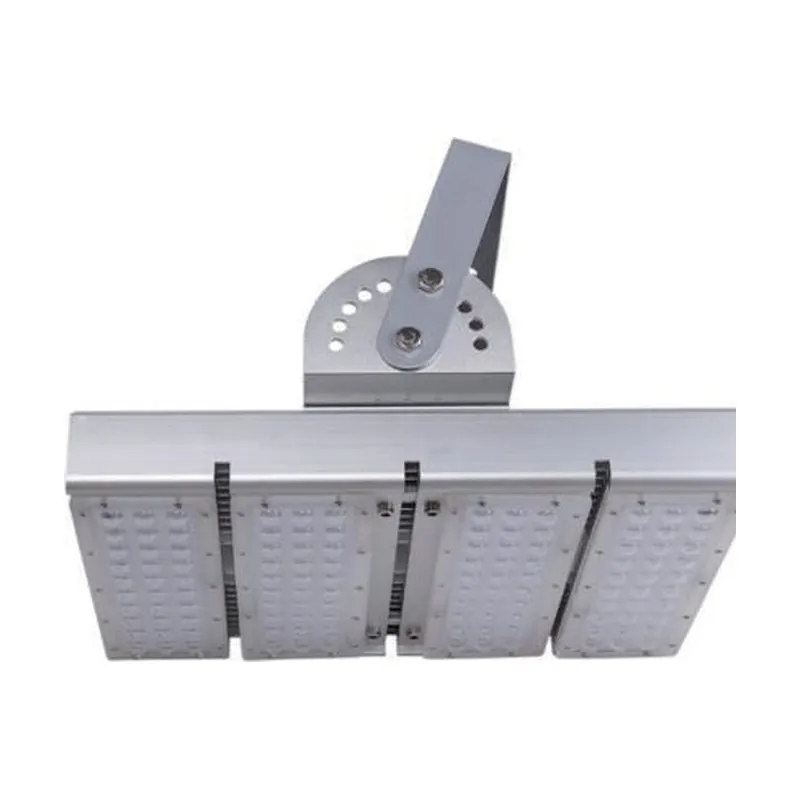
Our modular LED sports floodlights (50–300 W) have asymmetric 140° × 80° optics with a 30° offset, or 155° × 80°, designed for tennis, basketball and five-a-side courts.
Glare and spill control
- Keep fittings at 0–10° tilt where possible
- Add shields or visors on the back side
- Avoid poles behind baselines
- Check light at neighbouring windows in the design
- Use 4000–5000K but avoid excessive brightness above Class requirements
Indoor courts
Indoor tennis needs higher levels (300–750 lux) and very good glare control, because players look up at the ball against the ceiling. Fittings are mounted along the sides of the court rather than above it, with indirect light on a light-coloured ceiling. LED high bays with wide optics and diffusers or asymmetric linear fittings are typical. See our gym lighting guide for sports halls in general.
Controls
- Coin, card or app-operated switching for public and club courts
- Timers that turn lights off at a set time
- Two levels: training and match
- Instant on: LED needs no warm-up, so lights can be switched per booking
Switching per booking saves a lot over leaving all courts lit all evening.
Converting from metal halide
Many courts still have 1,000–1,500 W metal halide floodlights. LED replacements at 400–600 W per position usually give the same or more light with better uniformity. Check that existing poles and crossarms can carry the new fittings; LED is usually lighter. See the LED stadium lights guide for larger sports facilities.
Cost drivers
| Item | Notes |
|---|---|
| Floodlights | Set by lux class and optics |
| Poles and foundations | Often the largest cost for new installations |
| Cabling and distribution | Trenching around courts |
| Controls | Timers, booking systems |
| Installation | Cranes, electricians |
| Design | Photometric study, permits |
Retrofits on existing poles are much cheaper than new installations.
Maintenance
LED floodlights on tennis courts need little attention: clean the glass once a year, check aiming after storms and confirm that timers and booking systems switch correctly. Keep a record of aiming angles so fittings can be reset after maintenance. Check pole bases and anchor bolts for corrosion every few years, especially at coastal clubs.
Multi-sport courts
Courts marked for tennis and pickleball, or tennis and basketball, should be lit for the most demanding sport and level of play. Check that poles and fittings do not sit in the run-off of any of the marked courts.
Ordering
Send the court layout, number of courts, level of play, any existing poles and the distance to neighbours. We will propose floodlights, a pole layout and a photometric estimate.
Sources
Frequently asked questions
How many lux does a tennis court need?
For outdoor courts, about 200 lux for recreational play, 300 lux for club and league play and 500 lux for top competition (EN 12193 Classes III, II and I). Indoor courts need more: about 300, 500 and 750 lux.
How tall should tennis court light poles be?
Typically 8–10 m (26–33 ft) for a single court, set along the long sides outside the fence. Higher poles give better uniformity and less glare but cost more.
How much does it cost to light a tennis court?
It depends on the level of play, pole heights and local installation costs. Fittings for a single club court are a smaller part of the total; poles, foundations, cabling and installation often cost as much or more. Get a photometric design and a full quotation.