
1000W LED Stadium Light: Lumens, Coverage and When to Use It
What a 1000 W LED stadium light delivers: lumens, the area it lights at 200 to 1,000 lux, mounting heights and beam angles, what it replaces, and how many you need for common sports fields.
Key points
- At 130 lm/W, a 1000 W LED stadium light gives about 130,000 lumens, enough for roughly 250 m² at 200 lux or 50 m² at 1,000 lux on a field.
- 1000 W fittings suit poles and masts of about 18–35 m; on lower poles, 400–600 W fittings give more even light.
- A 1000 W LED fitting typically replaces a 1,500–2,000 W metal halide floodlight.
- Beam angle matters as much as wattage: narrow beams for long throws to the far side, wider beams for the near side.
1000 W is the workhorse size of LED floodlight for football pitches, athletics tracks, baseball outfields, ports and high masts. It is powerful enough to throw light across a full-size pitch from the side and light enough to put several on one pole. This guide shows what one 1000 W fitting really delivers and how many a field needs.
From watts to lumens
| Efficacy (complete luminaire) | Lumens from 1000 W |
|---|---|
| 110 lm/W | about 110,000 lm |
| 130 lm/W | about 130,000 lm |
| 150 lm/W | about 150,000 lm |
High-CRI versions for television broadcasting have lower efficacy, so check the version you are buying.
How much area one fitting lights
The lumen method gives the area one fitting can light:
Area = lumens × utilisation factor × maintenance factor ÷ target lux
On a sports field lit from the sides, a utilisation factor of about 0.5 is a fair first estimate: some light falls outside the field and some is lost to overlap. With a maintenance factor of 0.8 and 130,000 lm:
| Target (horizontal) | Typical use | Area per 1000 W fitting |
|---|---|---|
| 200 lux | Training, recreational play | about 260 m² |
| 300 lux | Club matches, school fields | about 170 m² |
| 500 lux | Higher-level club and regional matches | about 100 m² |
| 750 lux | Semi-professional | about 70 m² |
| 1,000 lux and above | Professional, televised | about 50 m² or less |
Televised sport also sets vertical illuminance towards the cameras, which raises the number of fittings well beyond these figures.
How many for common fields
| Field | Area | Level | 1000 W fittings (estimate) |
|---|---|---|---|
| Full-size football pitch, 105 × 68 m | 7,140 m² | 200 lux training | about 28 |
| Same pitch | 500 lux matches | about 70 | |
| Athletics track and infield | about 13,000 m² | 300 lux | about 75 |
| Little League baseball field | about 2,900 m² | 540 / 320 lux | about 21 |
| Container yard on 30 m masts | 10,000 m² | 50 lux | about 8–10 |
These are planning numbers that a full lighting calculation then refines. For the lux levels by level of play and the pole layouts, see our LED stadium lights guide and baseball field lighting.
Mounting height and beam angle
| Mounting height | Suits 1000 W? | Beam |
|---|---|---|
| Under 15 m | Usually too strong; use 400–600 W | Wide (60°) |
| 15–25 m | Yes, the common case for pitches | 25–40° far side, 60° near side |
| 25–35 m | Yes, stadiums and high masts | 25° for long throws |
| Above 35 m | Yes, or 1500 W | Narrow |
The aiming rule of thumb: keep the main beam’s aiming angle within about 60–65° of vertical, so that the bright face is not in players’ or neighbours’ eyes. On a typical pitch, fittings aimed at the far touchline use narrow beams, those aimed at the near half use wider ones. Mixing beam angles on the same pole is normal.
For masts in ports and yards, see the high mast lighting guide.
What a 1000 W LED replaces
| Old floodlight | Power with ballast | LED replacement |
|---|---|---|
| 1,000 W metal halide | about 1,080 W | 400–600 W |
| 1,500 W metal halide | about 1,600 W | 800–1,000 W |
| 2,000 W metal halide | about 2,100 W | 1,000–1,200 W |
Beyond the energy saving, LED floodlights start and restart instantly, which allows switching off between sessions, and can dim to training levels. Metal halide lamps lose a large part of their output over their life, so LED fittings with the same initial lumens deliver more light in practice.
Energy and running cost
Take the full-size pitch lit to 200 lux for training with about 28 fittings of 1000 W: 28 kW connected. If the same pitch used 1,500 W metal halide floodlights, which draw about 1,600 W with ballast, the same number of positions would draw about 45 kW.
At 600 hours a year (two evenings a week) the LED pitch saves about 10,000 kWh a year. More important on many sites, LED can be switched to training levels (for example half the fittings, or all dimmed to 50%) and switched off between sessions without a warm-up, which metal halide cannot do. For clubs that rent pitches by the hour, that control often saves more than the efficacy itself.
What to check in a 1000 W stadium light
- Measured lumens and efficacy, and the CRI if you need it for broadcasting
- Beam options (for example 25°, 40°, 60°, 90°) and asymmetric optics
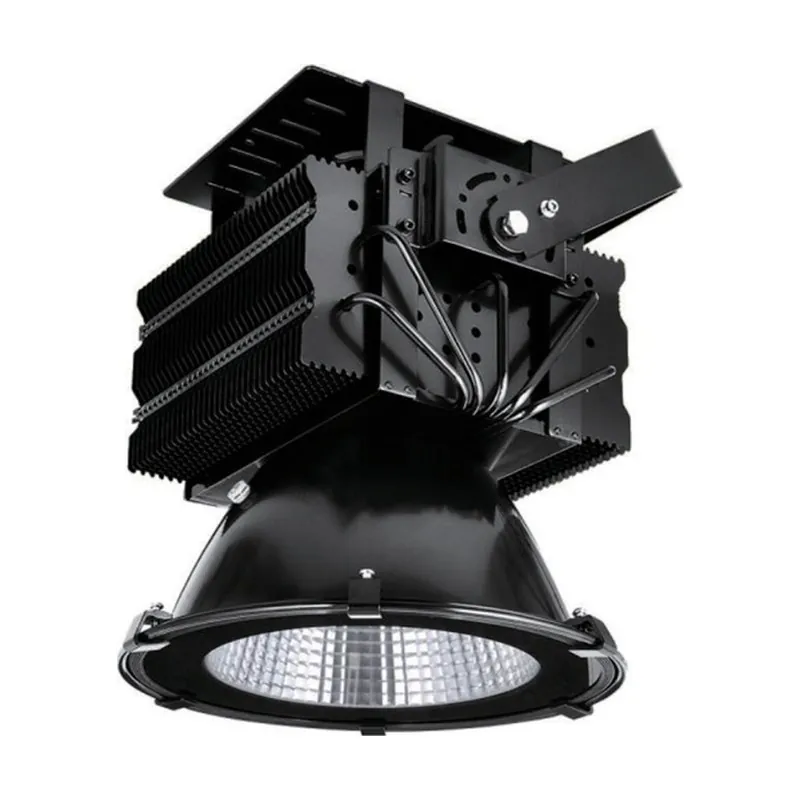
- Cooling: heat pipes or heavy fins keep LEDs cool at this power
- Weight and wind area, which the pole or mast must carry
- Driver location: on the fitting or remote in a box at the pole base for easier maintenance
- Glare control: visors and the luminaire’s intensity above 70°
- Corrosion protection for coastal and port use: salt-spray tested hardware
Our 1000 W floodlights
Our heat-pipe stadium and port floodlights are made in sizes from 200 W to 1,500 W, including 1,000 W, with 25°, 40°, 60° and 90° reflectors, IP67 and up to more than 130 lm/W on the port version. For smaller courts and training pitches, the modular sports floodlight covers 50–300 W. Send us the field size, level of play and pole positions, and we will estimate the fittings and aiming.
Sources
Frequently asked questions
How many lumens does a 1000W LED stadium light produce?
Typically about 110,000–150,000 lumens, depending on efficacy. At 130 lm/W it is about 130,000 lumens. Compare the measured luminaire lumens in the photometric report, not the LED chip rating.
How much area does a 1000W LED stadium light cover?
On a sports field with a utilisation factor of about 0.5 and a maintenance factor of 0.8, about 260 m² at 200 lux (training), 170 m² at 300 lux, 100 m² at 500 lux and 50 m² at 1,000 lux.
What does a 1000W LED floodlight replace?
Usually a 1,500 W or 2,000 W metal halide floodlight, which draws about 1,600–2,100 W with its ballast. The LED fitting also starts instantly and can be dimmed.