
Soccer Field Lighting: Lux Classes, Pole Layouts and LED Floodlight Counts
How to light a soccer or football field with LED: lux by level of play, 4, 6 and 8-pole layouts, pole heights, floodlight counts for full-size and small-sided pitches, spill control and costs.
Key points
- EN 12193 sets about 75 lux for recreational outdoor football (Class III), 200 lux for club matches (Class II) and 500 lux for higher-level matches (Class I).
- Full-size pitches use 4, 6 or 8 poles of 15–25 m; small-sided pitches use 4–8 poles of 8–12 m.
- A full-size pitch at 200 lux needs roughly 25–35 kW of LED floodlights; at 500 lux, roughly two to three times that.
- Poles must stay outside a zone around the goal lines so floodlights do not blind goalkeepers.
Lit football pitches can be used every evening of the year, which doubles or triples their value for clubs, schools and municipalities. LED has made pitch lighting cheaper to run and easier to control, with instant switching between training and match levels.
Pitch sizes
| Pitch | Typical size |
|---|---|
| Full-size (11-a-side) | 105 × 68 m (plus run-off) |
| 9-a-side | about 70 × 50 m |
| 7-a-side | about 55 × 40 m |
| 5-a-side | about 30–40 × 20–25 m |
Light levels
From EN 12193 for outdoor football:
| Class | Use | Average horizontal | Uniformity |
|---|---|---|---|
| III | Training, recreation, schools | 75 lux | 0.5 |
| II | Club and league matches | 200 lux | 0.6 |
| I | National-level matches | 500 lux | 0.7 |
Many clubs light training pitches to 100–200 lux even when 75 lux would meet Class III, for better visibility. Televised stadiums follow FIFA and broadcaster requirements for vertical illuminance, which are much higher; see our LED stadium lights guide.
Pole layouts
| Layout | Pole positions | Typical height | Use |
|---|---|---|---|
| 4 corners | Corners, outside goal-line zone | 18–25 m | Training, budget |
| 4 sides | Two per long side | 15–20 m | Training and club |
| 6 poles | Three per long side | 15–18 m | Club matches, better uniformity |
| 8 poles | Four per long side | 15–18 m | Higher classes |
Keep poles out of the zone behind and beside the goals, so goalkeepers and attacking players are not looking into floodlights. Side-mounted layouts give better uniformity and less glare than four corner masts.
Estimating the number of floodlights
Lumen method: lumens needed ≈ lux × area ÷ (utilisation factor × maintenance factor).
Full-size pitch, 105 × 68 m = 7,140 m², utilisation about 0.6, maintenance 0.8:
| Target | Lumens needed | LED at about 130 lm/W |
|---|---|---|
| 75 lux | about 1.1 million lm | about 8.6 kW |
| 200 lux | about 3.0 million lm | about 23 kW |
| 500 lux | about 7.4 million lm | about 57 kW |
Allowing for uniformity and aiming losses, real designs are often 10–40% above these figures. For example, a 200 lux club pitch might use 24–32 fittings of 1,000 W on four or six poles.
Small-sided pitch, 40 × 20 m = 800 m², 200 lux: about 330,000 lm, roughly 2.5–3.5 kW, often 8 × 300–400 W on 8–10 m poles.
For pole heights and layouts at larger venues, see the LED stadium lights guide.
Floodlights
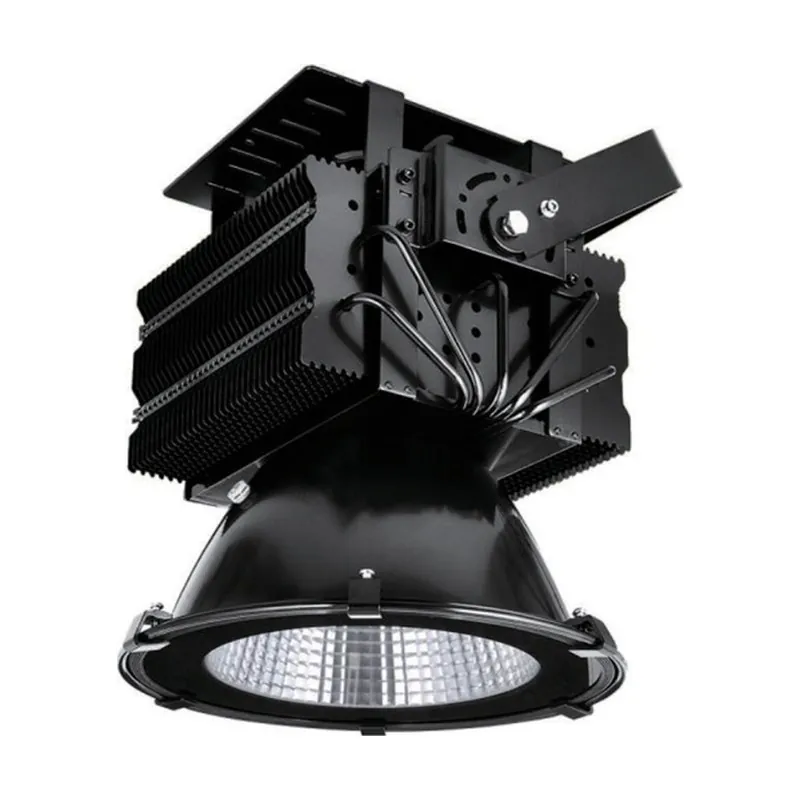
- Full-size pitches: 500–1,500 W fittings with narrow to medium beams (25–60°) on high poles. Our heat-pipe stadium floodlights cover 200–1,500 W with 25°, 40°, 60° and 90° reflectors and IP67 housings.
- Small-sided pitches: 200–400 W asymmetric fittings kept nearly flat. Our modular sports floodlights are made for five-a-side courts and school fields.
Spill and glare
Pitches are often next to homes. To reduce complaints:
- Use asymmetric optics or visors to cut light above the horizontal
- Keep aiming angles low
- Add rear shields on poles facing houses
- Check light at the nearest windows in the design
- Switch off at a fixed time
Controls
- Scene levels: training (for example 75–100 lux), match (200 lux), maintenance (low)
- Instant restart: LED needs no warm-up after a power cut
- Remote control or app: switch from the clubhouse
- Timers linked to bookings
Training at a lower level than match lighting halves energy use for most of the week.
Poles and foundations
High poles carry large wind loads from the floodlights and crossarms. Foundations must be designed for local wind speeds and soil. For very high masts with raising systems, see high mast lighting.
Converting from metal halide
Many pitches still use 1,500–2,000 W metal halide floodlights. LED fittings of 800–1,200 W usually replace them one-for-one with better uniformity, if poles and crossarms are reused. Check aiming with a new photometric design rather than copying old angles.
Running costs
A 200 lux pitch with 28 kW of LED used 3 hours a night, 250 nights a year, uses about 21,000 kWh, roughly US$3,150 a year at US$0.15/kWh. Training at half power on most nights reduces this further.
Multi-use pitches and artificial turf
Artificial turf pitches are used almost every evening, often split into several small-sided pitches. Plan the lighting so each third or half of the pitch can be switched on separately, with uniform light across each section. Pole positions should suit both the full pitch and the smaller layouts.
School and community fields
Schools and community fields often combine football, athletics and other sports. Lighting for training levels (75–150 lux) with good uniformity is usually enough. Poles placed outside the running track avoid conflicts with athletics. Keep switching simple, with timers so lights are not left on overnight.
Maintenance
Clean floodlight glass every year or two, check aiming after storms and record aiming angles. Inspect crossarms, bolts and cable entries at the top of poles, which need a lift or a climbing team. Choose fittings with long warranties to reduce work at height.
Ordering
Send the pitch size, level of play, existing poles if any, and distance to nearby homes. We will propose floodlights, a pole layout and a photometric estimate.
Sources
Frequently asked questions
How many lux does a football field need?
Under EN 12193, about 75 lux for recreational and training use, 200 lux for club and league matches and 500 lux for national-level matches. Televised matches need much higher vertical illuminance set by broadcasters.
How tall are soccer field light poles?
For full-size pitches, typically 15–25 m depending on the number of poles and the level of play. Small-sided and training pitches often use 8–12 m poles.
How many floodlights for a soccer field?
For a full-size pitch at 200 lux, roughly 25–35 kW of LED, for example 24–32 fittings of 1,000 W on 4–6 poles. A photometric design with the chosen floodlight gives the exact number and aiming.