
High Mast Lighting Guide: Mast Height, Wattage, Layout and Cost Factors
How to plan high mast lighting for interchanges, ports, yards and plazas: typical mast heights, how many LED floodlights per mast, spacing between masts, a worked design calculation, lowering systems, foundations and what drives the price.
Key points
- High masts are 15–40 m tall; 20–30 m for interchanges, 30–40 m for ports and yards.
- Space masts at up to 3–4 times their height; 30 m masts can be about 100 m apart.
- Use narrow and medium beams (15°–40°) and corrosion-proof floodlights at height.
- A lowering system is strongly recommended above about 20 m.
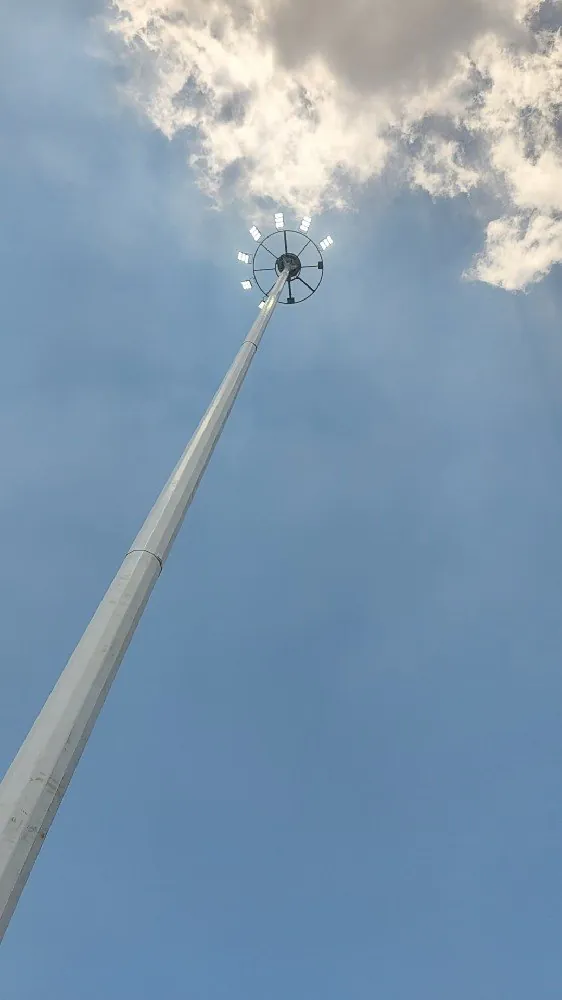
High mast lighting puts a ring of powerful floodlights on a single tall pole, typically 15 to 40 metres high. One mast can light an area that would otherwise need a dozen ordinary poles, and it keeps the ground clear of obstructions. That is why it is the standard solution for interchanges, ports, container yards, airport aprons, rail yards, large plazas and sports grounds.
When high mast makes sense
| Choose high mast when… | Choose conventional poles when… |
|---|---|
| The area is wide and open (yards, junctions, aprons) | The area is a long, narrow road |
| Poles on the ground would obstruct vehicles or cranes | Poles can stand along the edge |
| Fewer foundations and cable runs are cheaper | Mounting height must stay low for neighbours |
| Maintenance from one point is an advantage | No lowering device or platform is available |
Typical heights and loads
| Application | Mast height | Floodlights per mast (typical) | Target illuminance (typical) |
|---|---|---|---|
| Roundabouts, interchanges | 20–30 m | 6–12 × 300–600 W | 15–30 lx |
| Plazas, car parks, stations | 18–25 m | 6–10 × 200–400 W | 10–30 lx |
| Ports, container yards | 30–40 m | 10–24 × 600–1000 W | 20–50 lx |
| Sports grounds | 25–40 m | 8–20 × 1000–1500 W | 200–500 lx+ |
Target levels depend on the local standard and the activity; port and yard operators often set their own minimums for safety and for camera surveillance.
How the design is calculated
The quick estimate uses the lumen method:
Total lumens = target lux × area ÷ (utilisation factor × maintenance factor)
For high masts, the utilisation factor is lower than for street lights, typically 0.4–0.6, because part of the light falls outside the area, especially at its edges.
Worked example: a container yard
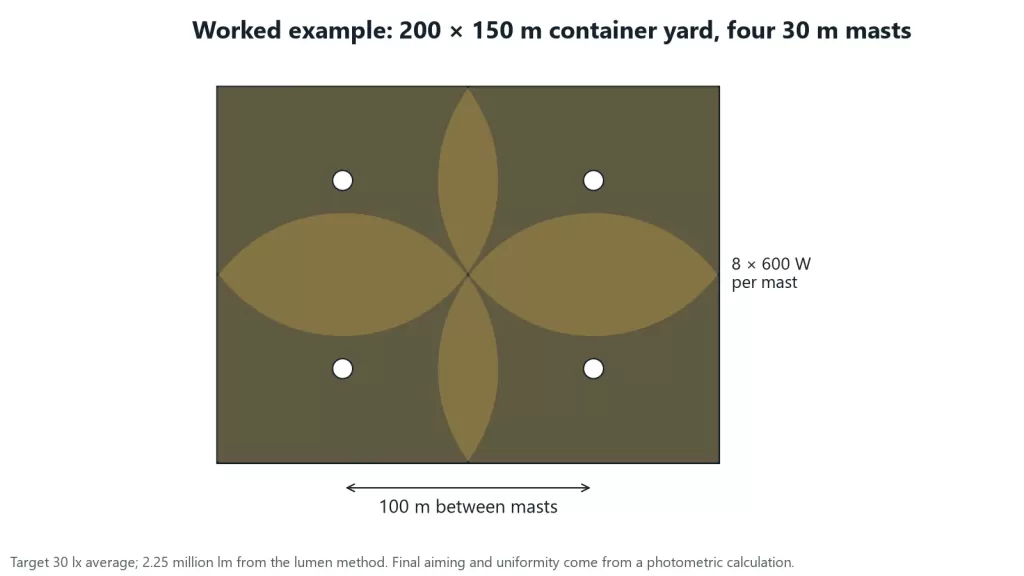
A yard of 200 × 150 m (26,000 m²) needs 30 lx average.
- Total lumens = 30 × 30,000 ÷ (0.5 × 0.8) = 2.25 million lm
- With 600 W floodlights at about 130 lm/W (78,000 lm each): about 29 fixtures
- With masts spaced at about 3.5 times their height, 30 m masts can be roughly 100 m apart, so 4 masts in a 2 × 2 grid cover the yard, each with 8 × 600 W (32 fixtures in total)
The detailed design then aims each floodlight and checks uniformity: the darkest point between masts should not drop below about 40% of the average for operational areas. That check needs the photometric file and lighting software, which we run for every high mast inquiry.
Choosing the height: fewer masts or shorter masts?
For the same yard, the height decides how many masts you need. With masts spaced at about 3.5 times their height:
| Mast height | Approximate spacing | Masts for 200 × 150 m | Comment |
|---|---|---|---|
| 20 m | 70 m | 3 × 2 = 6 | Lighter masts and foundations, more of them, more cable |
| 30 m | 100–105 m | 2 × 2 = 4 | A common balance for yards |
| 40 m | 140 m | 2 × 1 or 2 × 2 | Fewest masts; heaviest steel and foundations, narrow beams needed |
Taller masts also put each floodlight further from the ground, so it needs a narrower beam and more lumens to deliver the same lux. In ports, the masts must also clear the cranes’ working envelope and stacked containers, which often fixes the positions before the lighting design starts. Near airports, mast heights are limited by aviation rules, and taller masts may need obstruction lights.
Converting existing masts to LED
Many masts still carry metal halide or high-pressure sodium floodlights. Take the yard above with 4 existing masts, each carrying 8 × 1000 W metal halide floodlights (about 1,100 W each with ballasts), replaced one for one by 400 W LED floodlights, running 12 hours a night:
- Before: about 154,000 kWh a year
- After: about 56,000 kWh a year
- Saving about 98,000 kWh a year, roughly US$14,700 at US$0.15/kWh, plus far less relamping on a 30 m mast
Instant restrike is a safety benefit in ports and yards: after a power dip, metal halide lamps stay dark for several minutes while they cool, LED floodlights come back at once. Run your own numbers in the LED retrofit savings calculator. Check that the head frame and lowering system are in good condition and that the new floodlights’ weight and wind area suit them; LED floodlights are usually lighter, which helps.
Floodlight choice for high masts
- Narrow and medium beams. At 30 m and above, 15°–40° reflectors put the light on the ground instead of the sky.
- Asymmetric optics at the edge of the site keep light off neighbours and roads.
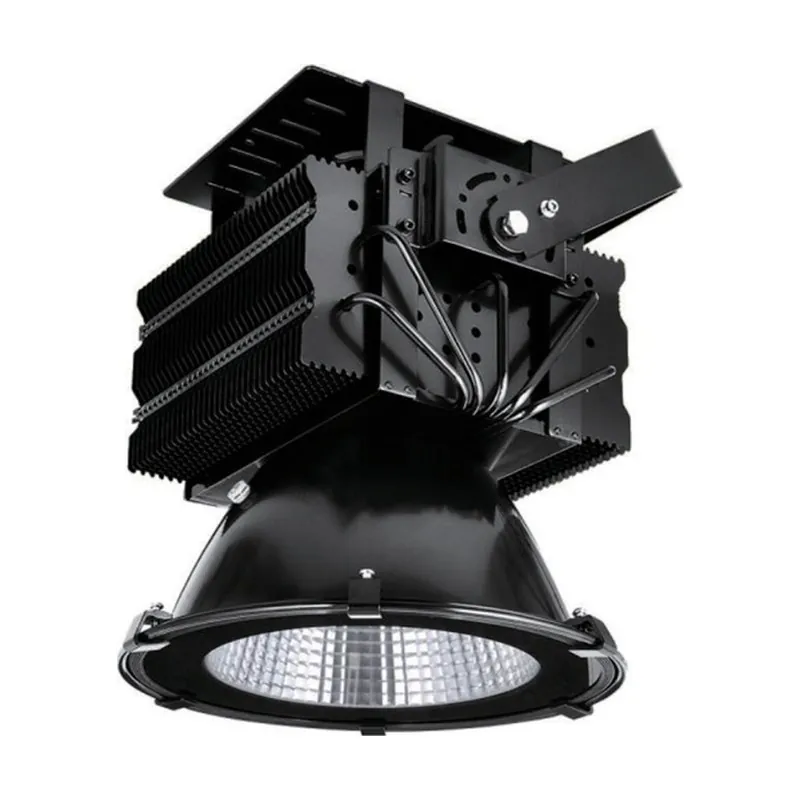
- Heat management and weight. Light, efficient floodlights reduce the wind area and the load on the head frame. Heat-pipe cooling keeps high-power LEDs cool without a heavy housing.
- Corrosion protection. Ports and coastal sites need IP66–IP67, stainless hardware and salt-spray tested surfaces.
Our heat-pipe port and stadium floodlights are designed for this: 200–1500 W, more than 130 lm/W on the port version, 25°–90° reflectors, IP67, 500-hour salt spray tested stainless hardware.
The mast itself
- Construction: polygonal tapered steel sections, slip-jointed, hot-dip galvanised after fabrication.
- Wind load: designed for the local design wind speed, with the area and weight of the luminaires and head frame included. Supply the wind speed with the inquiry.
- Foundation: a reinforced concrete foundation with anchor bolts, designed for the soil conditions; often the largest civil item.
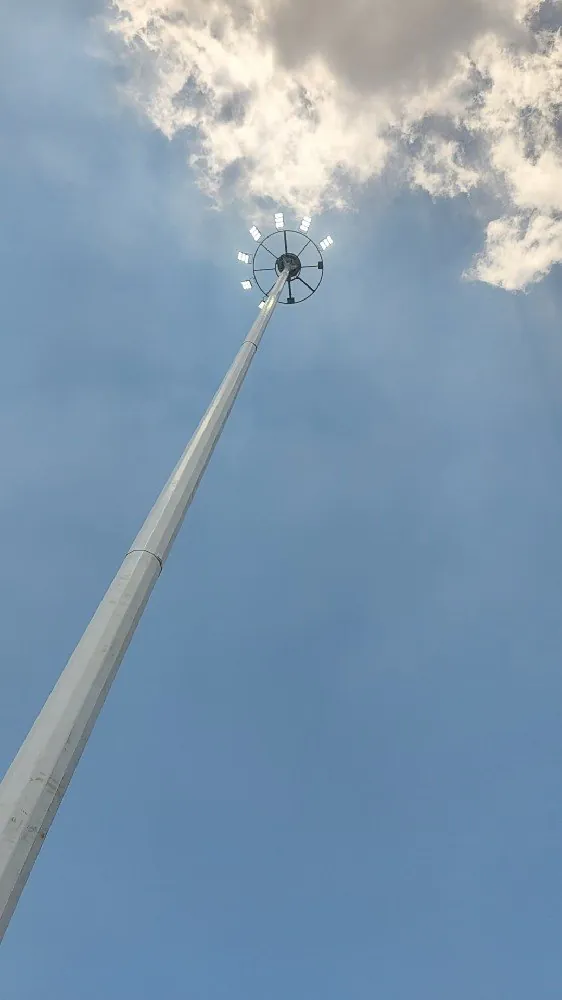
- Lowering system: a motorised winch lowers the luminaire ring to the ground for maintenance. On masts above about 20 m it is strongly recommended.
- Lightning protection and earthing at the top and the base.
Maintenance
| Interval | Task |
|---|---|
| Every year | Visual check of mast, door and base; anchor nut torque; earthing; lowering winch test |
| Every 1–2 years | Lower the ring: clean floodlight glass, check fixings, aiming and cable condition |
| Every 5 years or after a severe storm | Structural inspection of the shaft, welds and galvanising; inspect the wire ropes |
Wire ropes and winches deserve particular attention: a ring that cannot be lowered turns every repair into a crane job. Keep the aiming record from commissioning, so floodlights can be re-aimed to the original design after maintenance.
What drives the price
The price of a high mast project is driven by the mast height (steel weight and foundation), the wind design, whether a lowering system is included, the number and wattage of floodlights, and the cable and control system. Converting existing high masts from metal halide or HPS to LED often reuses the masts and ring, and typically halves the energy use; see our HPS to LED wattage chart for typical equivalents.
Send us the area dimensions, the required lux level, any existing mast positions and the design wind speed. We will propose the mast layout, floodlight wattage and aiming, and quote the complete set.
Sources
Frequently asked questions
What is the height of a high mast light?
High masts are usually 15–40 m tall. 20–30 m is typical for highway interchanges, roundabouts and plazas, and 30–40 m for ports, container yards and airport aprons. Poles below about 15 m are normally called mid-height or area lighting poles.
How many lights are on a high mast?
Commonly 6 to 24 LED floodlights of 200–1000 W, mounted on a ring at the top. A 25 m mast at a roundabout might carry 8 × 400 W; a 35 m mast in a container yard might carry 12–16 × 600–1000 W.
How far apart should high masts be?
As a rule of thumb, area-lighting masts are spaced at up to about three to four times their height, so 25 m masts are roughly 75–100 m apart. The final spacing comes from a photometric calculation of uniformity on the ground.
Why do high masts have a lowering system?
So the luminaire ring can be winched down to the ground for maintenance. Without it, every lamp change or cleaning needs a large aerial platform or crane, which is costly and closes the area below.