
LED Stadium Lights: Lux Levels, Pole Height, Wattage and What Drives the Cost
How to plan LED stadium lights for football, tennis and multi-sport fields: lux levels by competition class, how tall stadium light poles are, pole layouts, how many lights a field needs, and what drives the cost.
Key points
- EN 12193: football needs about 75 lx for training, 200 lx for club matches and 500 lx for national competition.
- School and club fields typically use 18–25 m poles; stadiums 30–50 m masts or roof mounting.
- A full-size pitch at 200 lx needs roughly 3.25 million lumens, about 30 × 1000 W floodlights.
- Poles, foundations and power supply often cost more than the floodlights.
“Stadium lights” covers everything from four poles around a community pitch to the floodlight rings of a televised arena. The planning questions are the same at every scale: how much light, from how high, from where, and with which beam. This guide answers them in that order.
1. How much light: lux levels by class
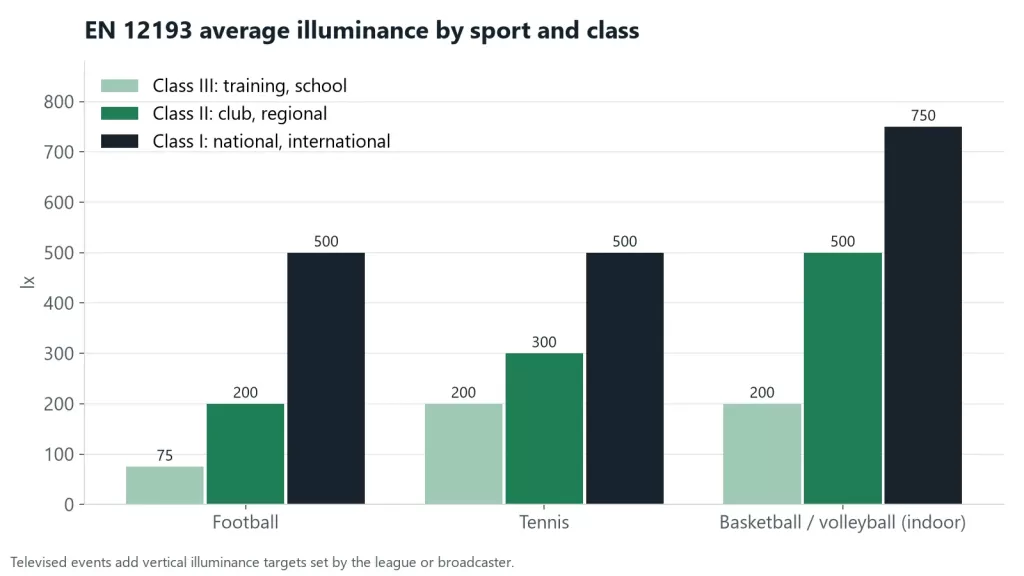
The European standard for sports lighting, EN 12193, sets three classes. Class I is high-level national and international competition, Class II is mid-level club and regional competition, and Class III is training, school and recreational use.
| Sport (outdoor unless noted) | Class III | Class II | Class I |
|---|---|---|---|
| Football | 75 lx | 200 lx | 500 lx |
| Tennis | 200 lx | 300 lx | 500 lx |
| Basketball, volleyball (indoor) | 200 lx | 500 lx | 750 lx |
These are maintained average horizontal illuminance values, with uniformity requirements on top (the minimum must not fall far below the average). Televised events add vertical illuminance towards the cameras, often well over 1,000 lx for professional football. Leagues and broadcasters publish the exact figures, and they override the class table.
2. From how high: pole height
Height controls glare and uniformity. A common design rule for football is that the line from the centre of the pitch to the luminaires should be at least about 25° above the horizontal, so players looking up are not blinded.
| Facility | Typical mounting height |
|---|---|
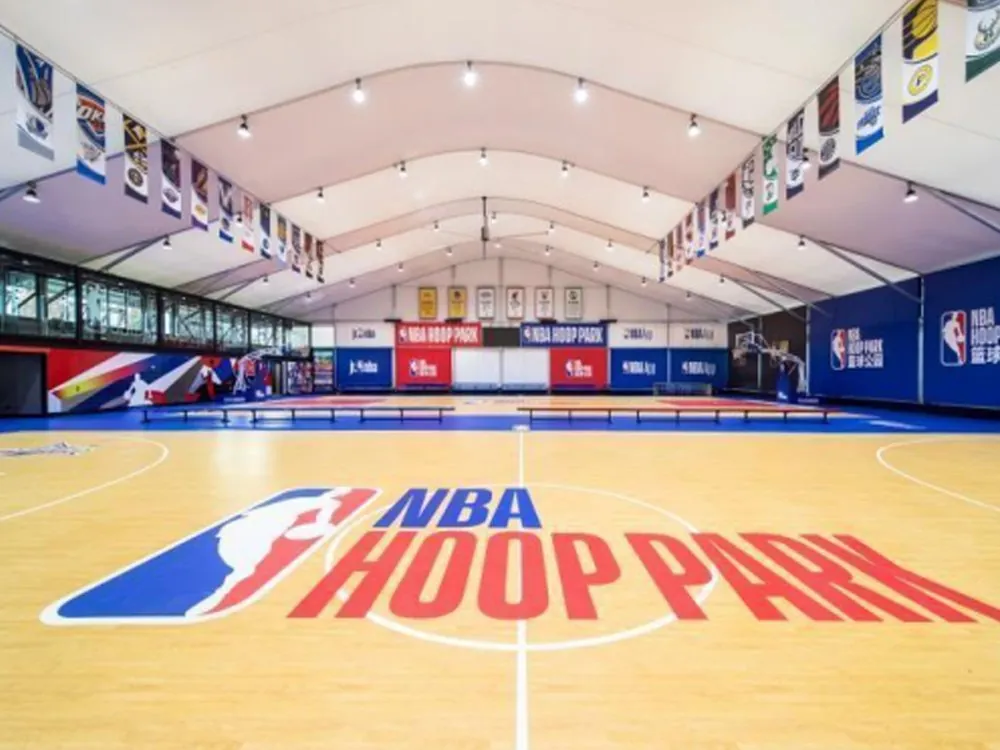
| Five-a-side, tennis, basketball courts | 8–12 m |
| Training and community pitches | 12–18 m |
| School and club football fields | 18–25 m (about 60–80 ft) |
| Stadiums | 30–50 m masts, or roof-mounted |
Taller poles cost more and need bigger foundations, but they let each floodlight cover more area with a narrower beam, which usually means fewer fixtures and better control of spill light into neighbouring houses.
3. From where: pole layouts
- 4 poles at the corners: cheapest, suitable for training. Corner poles must be tall to light the centre evenly.
- 6 poles (3 per side): the most common layout for club football; good uniformity at moderate heights.
- 8 poles (4 per side): for higher classes and longer pitches, or where poles must stay short.
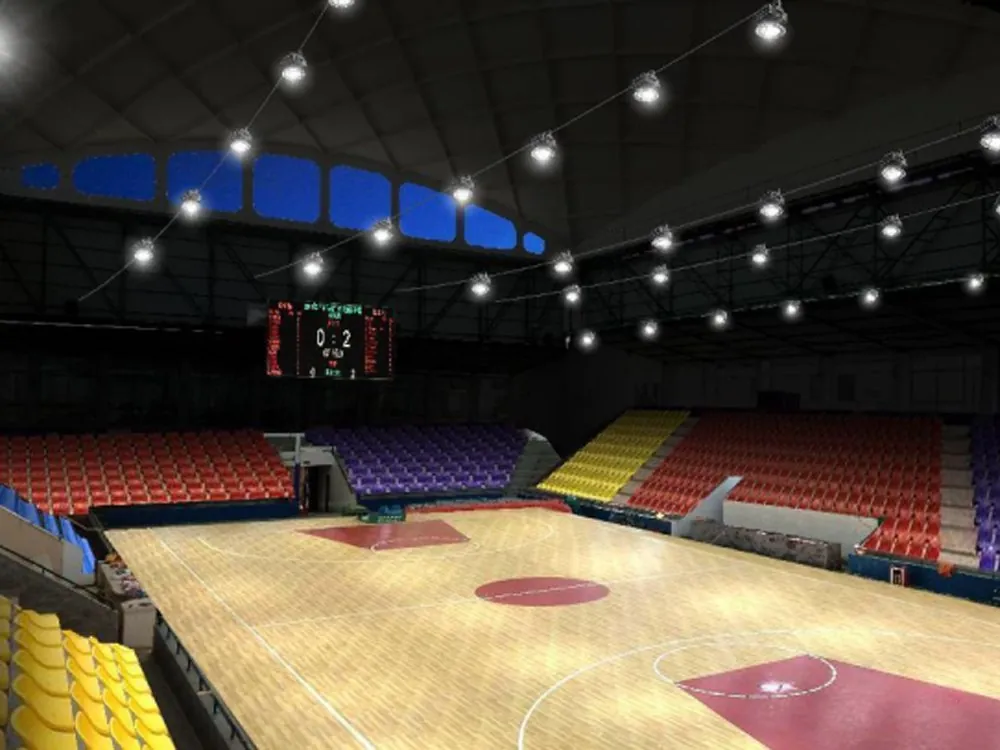
- Roof or catwalk mounting: for stadiums with stands.
Poles on the sides must stay outside the playing area and safety zone, and their positions are often fixed by the stands and the site boundary, so the layout comes before the fixture count.
4. How many lights: a quick estimate
The lumen method gives a first estimate:
Total lumens = target lux × area ÷ (utilisation factor × maintenance factor)
For a full-size pitch of 105 × 68 m (7,140 m²) at 200 lx, with a utilisation factor of about 0.55 for well-aimed floodlights and a maintenance factor of 0.8:
- Total lumens ≈ 200 × 7,140 ÷ (0.55 × 0.8) ≈ 3.25 million lm
- With 1000 W LED floodlights at about 110 lm/W (110,000 lm each): about 30 fixtures
- On 6 poles, that is 5 per pole, about 30 kW in total
A real design then sets the beam angle and aiming point of every floodlight, and checks uniformity and glare with the photometric file. For tennis and basketball courts, smaller modular floodlights of 100–300 W on 8–10 m poles are more economical than high-power fixtures.
A second example: one tennis court
A tennis court with its run-off area is about 36.6 × 18.3 m (670 m²). For Class II at 300 lx, with a utilisation factor of about 0.5 (side-mounted floodlights lose more light outside a small area) and a maintenance factor of 0.8:
- Total lumens ≈ 300 × 670 ÷ (0.5 × 0.8) ≈ 500,000 lm
- At 130 lm/W, about 3.9 kW of LED: for example 8 floodlights of about 500 W on 4 poles along the sides, or more, smaller units on 6 poles for better uniformity
- Poles of 8–10 m behind the side fences, with asymmetric optics so the light goes onto the court and not into the players’ eyes or the neighbours’ gardens
Glare and spill light
Two kinds of unwanted light decide whether a sports installation is accepted by players and neighbours:
- Glare for players and spectators. EN 12193 limits it with a glare rating (GR); for many outdoor sports the limit is around 50. Higher poles, correct aiming angles and asymmetric optics with flat glass keep GR down.
- Obtrusive light for the surroundings. Planning authorities often set limits on light spill onto houses and on upward light, typically based on CIE 150 guidance and the environmental zone (rural, suburban, urban). Floodlights aimed steeply down with sharp cut-off optics, and visors where needed, solve most complaints.
Ask for the spill-light calculation at the site boundary along with the pitch calculation; it is often a condition of planning permission.
Energy: match mode, training mode and metal halide
LED makes it practical to light a pitch at different levels for different uses. For the football example above (30 kW at full output), a club using the pitch 3 hours a night on 250 nights a year might run:
| Mode | Light level | Power | Hours a year | Energy |
|---|---|---|---|---|
| Matches | 200 lx | 30 kW | 150 | 4,500 kWh |
| Training | about 100 lx (dimmed) | about 15 kW | 600 | 9,000 kWh |
| Total | 750 | 13,500 kWh |
Running the same hours at full output would use 22,500 kWh. With metal halide, which cannot be dimmed in the same way and is usually left on at full power once struck, a comparable installation of, for example, 24 × 2,000 W lamps (about 2,160 W each with gear) would use about 38,900 kWh. Try your own numbers in the LED retrofit savings calculator.
5. Choosing the floodlight
- Optics: narrow beams (15°–40°) for high poles and long throws, wider beams for low poles and small courts. Asymmetric optics reduce glare for players and neighbours.
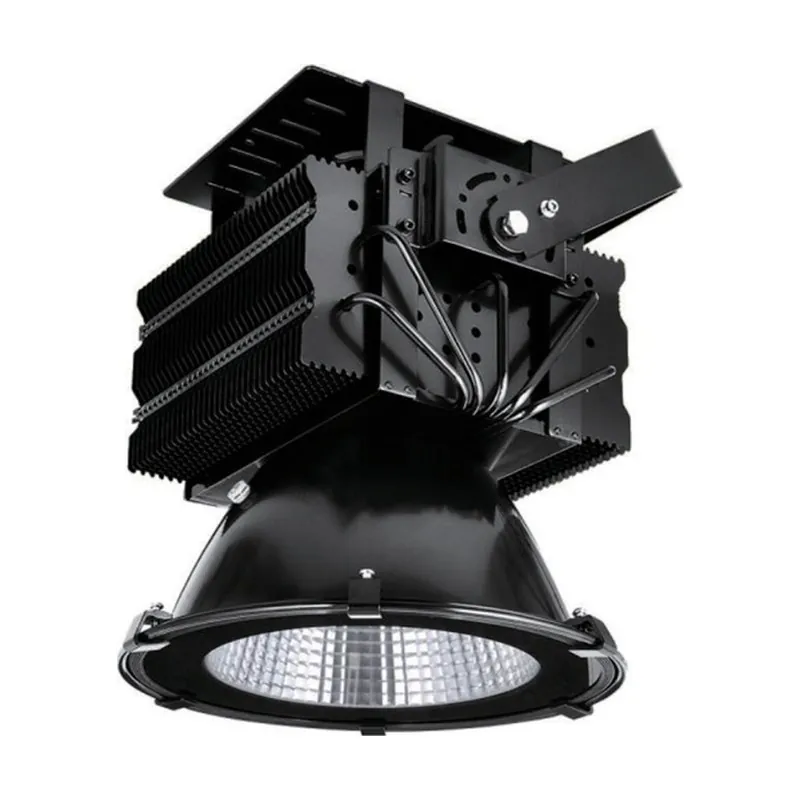
- Thermal design: a 1000 W floodlight runs for hours in summer heat; heat-pipe or large fin heat sinks keep the LEDs and driver cool, which protects lumen output.
- Weather: IP66 or IP67, stainless hardware and a breather valve. Masts are windy places, so check the projected area and the bracket.
- Flicker: for broadcast and slow-motion replay, the drivers must be flicker-free; ask for the test data.
- Control: on/off by section, dimming for training versus matches, and instant restrike (LED’s great advantage over metal halide, which needs 10–15 minutes to restrike after a power cut).
Our LED stadium lights run from 200 W to 1500 W with 25°–90° reflectors, IP67 heat-pipe housings and a 216° aiming bracket. For courts, the modular sports floodlight offers asymmetric optics from 50 W to 300 W.
6. What drives the cost
Buyers searching “how much do stadium lights cost” are usually surprised that the floodlights are only part of the bill:
- Poles and foundations. Height drives steel weight and foundation size; 30 m masts are a civil project.
- Number of fixtures, set by the class (lux level) and the field size.
- Power supply: cable from the nearest supply, distribution boards, sometimes a transformer.
- Installation: cranes or aerial platforms and aiming on site.
- Controls: switching zones, dimming, remote control.
Converting an existing metal halide installation to LED often reuses the poles and cabling, which cuts the cost sharply and typically halves the energy use.
Send us the field dimensions, the sport and level of play, and any existing pole positions. We will return a photometric layout with the fixture count, aiming and the expected lux and uniformity, and quote the complete set.
Sources
Frequently asked questions
How many lux does a football field need?
Under the European sports lighting standard EN 12193, about 75 lx for recreational and training use, 200 lx for club and regional matches, and 500 lx for national and international competition, all as average horizontal illuminance. Televised matches are designed to much higher vertical illuminance towards the cameras, set by the competition organiser.
How tall are football stadium lights?
Community and training pitches typically use 12–18 m poles. School and club fields often use 18–25 m (about 60–80 ft). Large stadiums mount floodlights on 30–50 m masts or on the roof. The higher the light, the narrower the beam it needs and the less glare players see.
How many lights does a football field need?
For a full-size pitch (105 × 68 m) at 200 lx, plan roughly 3 million lumens of installed output. With 1000 W LED floodlights at about 110 lm/W, that is around 30 fixtures, usually on 4 or 6 poles. A photometric layout fixes the exact number and aiming.
How much do stadium lights cost?
The total depends far more on the number and height of poles, foundations, the power supply and installation than on the price of the lights. A training pitch on four short poles and a televised stadium can differ by a factor of fifty. Send the field size and level of play for an itemised quotation.