
Explosion-Proof Emergency and Exit Lights: What Hazardous Areas Need
Emergency and exit lighting in hazardous areas: escape route light levels and duration, exit sign viewing distances, batteries and certificates, and how to plan it for a plant.
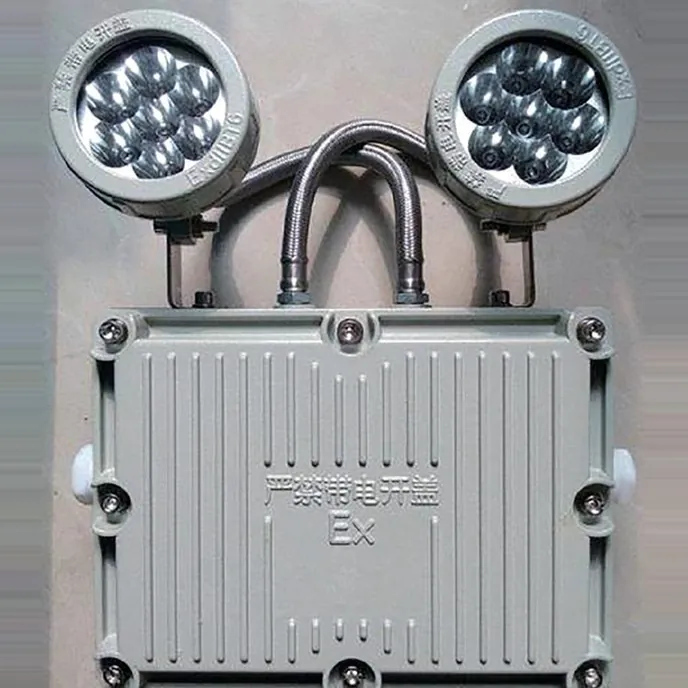
Key points
- In a hazardous area, emergency and exit lights must be explosion-protected like any other luminaire, including their batteries, and certified for the zone, gas group and temperature class.
- European practice (EN 1838) asks for at least 1 lux on the centre line of escape routes; US practice (NFPA 101) for an average of 1 fc (about 10 lux) on the egress path, for 90 minutes.
- Exit signs must be readable from the furthest point they serve: about 200 times the sign height for internally lit signs.
- Plan emergency lighting with the area classification drawing, the escape routes and the local code, then choose the fittings.
When the power fails in a refinery, a fuel depot or a chemical plant, people still have to find their way out, and sometimes shut down a process first. Emergency lighting makes that possible. In a hazardous area, it has to do so without becoming a source of ignition itself. This guide covers what the standards ask for and how to plan it.
Three kinds of emergency lighting
| Type | Purpose | Typical requirement |
|---|---|---|
| Escape route lighting | Light the path to the exit | About 1 lux on the centre line (EN 1838) |
| Open area (anti-panic) lighting | Let people reach an escape route from a large space | About 0.5 lux on the floor |
| High-risk task area lighting | Let operators shut down a dangerous process safely | 10% of normal light, at least 15 lux |
Exit signs, or safe condition signs, mark the routes and exits. Under US practice, NFPA 101 asks for an average of 1 foot-candle (about 10.8 lux) along the path of egress, with at least 0.1 foot-candle at any point, for 90 minutes.
Why hazardous areas are different
In a classified area, every electrical device must be explosion-protected for the zone, gas or dust group and temperature class on the site’s area classification drawing. Emergency lights add two complications:
- They contain a battery. The battery, its charger and the changeover circuit must be inside the protected enclosure and covered by the certificate. A standard emergency pack added to an explosion-proof luminaire breaks its certification.
- They must work when everything else fails, including in a fire or after an incident, which is exactly when the atmosphere may be explosive.
So the choice is between a self-contained explosion-proof emergency light (its own battery, certified as a whole) and central battery systems feeding certified luminaires. For most plants, self-contained fittings are simpler: each one tests itself and does not depend on cables that might be damaged.
For the markings and zones themselves, see explosion proof lighting explained.
How long emergency lights must run
| Requirement | Duration |
|---|---|
| EN 1838 minimum for escape routes | 1 hour |
| NFPA 101 (US) | 90 minutes |
| Many European premises, and many industrial specifications | 3 hours |
| Common choice for process plants | 2–3 hours |
Longer duration means a bigger battery, and in an explosion-proof housing that means a bigger, heavier fitting. Specify what the local regulation and the site’s emergency plan need, rather than the longest available.
Exit signs: size and viewing distance
A sign is only useful if it can be read from where people are. EN 1838 links the maximum viewing distance to the height of the pictogram:
- Internally illuminated signs: viewing distance = 200 × sign height
- Externally illuminated signs: viewing distance = 100 × sign height
So a sign with a 100 mm pictogram, lit from inside, serves up to 20 m. On a long pipe-rack walkway, signs must be repeated so that the next one is always within reading distance. Pictograms in Europe follow ISO 7010 (the running figure and arrow); the US typically uses the word EXIT.
Planning emergency lighting in a hazardous area
- Start from the area classification drawing: zones, gas groups, temperature classes.
- Mark the escape routes, exits, assembly points and any high-risk task areas, such as a control panel that must be switched off.
- Place lights at the points that must be lit: each exit door, changes of direction, stairs, intersections, first-aid and firefighting points, and outside each final exit.
- Add lights along the routes to keep the minimum level between those points.
- Place exit signs so that one is always visible within its viewing distance.
- Choose the fittings for the zone and gas group at each point, with the required duration.
- Plan testing: monthly function tests and an annual full-duration test are common practice.
Lighting for operators, not only for escape
In process plants, people sometimes need to stay to make a plant safe. Those places, such as control rooms, valve stations and pump bays, need high-risk task lighting of at least 15 lux, which is far more than escape lighting.
Battery and temperature
Batteries are the weak point of any emergency light. Cold reduces their capacity; heat shortens their life. Check:
- The operating temperature range of the complete fitting, including the battery
- The rated duration at the lowest temperature on site
- The expected battery life and how easily the battery can be replaced, which in an explosion-proof fitting must be done in a way that keeps the protection intact
- A self-test function or indicator, so failed batteries are found before an emergency
Our explosion-proof emergency light
Our BG-FBYJ10A explosion-proof emergency light has twin adjustable 10 W LED heads, an Ex d IIC T4 marking and 2 hours of emergency operation, in a die-cast aluminium housing rated from −30 °C to +50 °C. It suits escape routes in refineries, chemical plants, substations and fuel depots. The explosion-proof certificate for this model is supplied with the quotation. For the normal lighting of the same areas, see our explosion-proof lights.
Send us the area classification, the escape route plan and the required duration, and we will suggest the emergency light positions and quantities.
Sources
Frequently asked questions
Do emergency lights in hazardous areas need to be explosion-proof?
Yes. Any electrical equipment inside a classified hazardous area, including emergency and exit lights and their batteries, must have a certificate for that zone, gas or dust group and temperature class. An ordinary emergency light is a source of ignition.
How long must emergency lighting last?
Common requirements are 1 hour (EN 1838 minimum for escape routes), 90 minutes (NFPA 101 in the US) and 3 hours in many European premises where people may stay after an evacuation. Local regulations decide; many industrial sites choose 2–3 hours.
How much light does emergency lighting need?
Under EN 1838, at least 1 lux on the centre line of escape routes, 0.5 lux in open areas and 10% of normal lighting (at least 15 lux) in high-risk task areas. NFPA 101 asks for an average of 1 foot-candle (about 10.8 lux) along the path of egress, with at least 0.1 foot-candle at any point.