
Types of Emergency Lights: Bug-Eye, Plug-In, Power-Failure and Maintained Lights
The main types of emergency lights: bug-eye twin heads, exit signs, maintained and non-maintained fittings, plug-in lights, emergency drivers and central battery systems.
Key points
- Escape route lighting comes from self-contained fittings with their own battery or from central battery systems; most small and medium buildings use self-contained units.
- Maintained fittings are on all the time and stay on in a power cut; non-maintained fittings only light when the power fails.
- Twin-head 'bug-eye' units light corridors and stairs cheaply; emergency drivers turn normal LED fittings into emergency lights.
- Plug-in power-failure lights help in homes and offices but do not replace code-compliant escape lighting.
When the power fails, emergency lighting must show people the way out and let them find fire equipment and first aid. There are several types of fitting, and choosing the right mix depends on the building, the escape routes and the local code. This guide explains each type and where it fits.
Self-contained or central battery
| Self-contained | Central battery | |
|---|---|---|
| Battery | In each fitting | In one battery room |
| Wiring | Normal circuits | Fire-resistant cables to every fitting |
| Cost | Low for small buildings | Economical for large buildings |
| Testing | Each fitting tested | Central testing and monitoring |
| Battery replacement | Each fitting, about every 4 years | Central, longer-life batteries |
| Typical use | Shops, offices, schools, small factories | Hospitals, airports, large complexes |
Maintained and non-maintained
- Maintained: lit all the time from mains, continues on battery. Used for exit signs and in places of entertainment where lights may be dimmed.
- Non-maintained: off normally, on only in a power cut. Used for escape route lighting in most buildings.
- Sustained / combined: fittings with two lamps, one normal and one emergency.
Types of fitting
| Type | Description | Use |
|---|---|---|
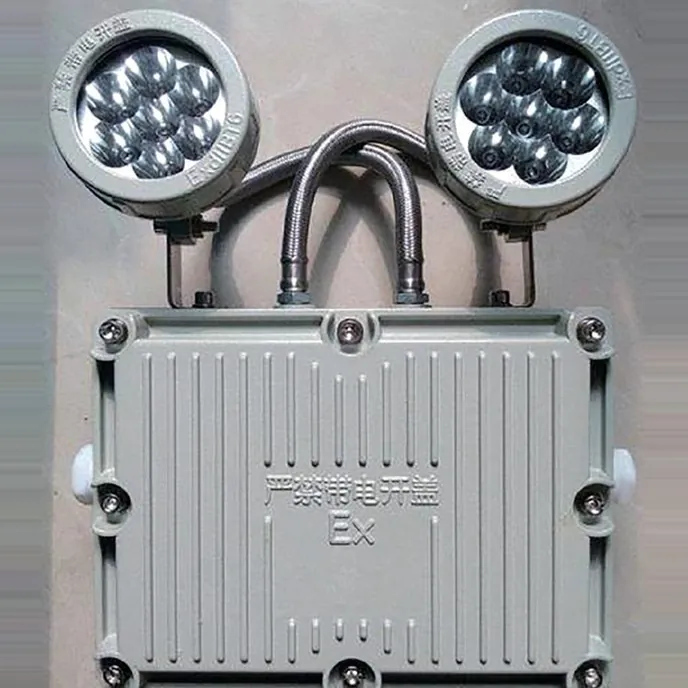
| Twin-head (bug-eye) | Two adjustable heads, battery in the box | Corridors, stairs, warehouses, car parks |
| Exit sign | Lit sign with arrow and running man or EXIT | Above exits and along routes |
| Combo exit sign + heads | Sign with two lamp heads | Small buildings, budget |
| Bulkhead | Surface fitting, often IP65 | Outdoor exits, plant rooms |
| Recessed spot | Small ceiling spot | Offices, hotels, where looks matter |
| Emergency driver in LED fitting | Battery pack inside a normal light | Panels, downlights, linear fittings |
| High bay emergency | Emergency module in high bays | Warehouses and factories |
| Explosion-proof emergency | Certified for hazardous zones | Oil, gas, chemical plants |
| Plug-in power-failure light | Plugs into a socket, lights in a power cut | Homes, offices, server rooms (supplementary) |
Our LED exit signs (3/5 W) give at least 90 minutes of backup with switchover in under 2 seconds. For hazardous areas, our explosion-proof emergency light has twin heads, Ex d IIC T4 marking and 2 hours of emergency operation. See explosion-proof emergency and exit lights for more on hazardous-area escape lighting.
Twin-head bug-eye lights
Bug-eye units are popular because they are cheap, easy to install and throw light along corridors and stairs.
- Heads can be aimed separately, for example along a corridor and down a stair
- Typical outputs of a few hundred lumens per head
- Wall-mounted at 2.2–2.5 m
- Must be placed so light reaches the floor along the full route
They can look industrial; in hotels and offices, recessed spots or emergency drivers in normal fittings are often preferred.
Emergency drivers in normal fittings
An emergency driver with a battery inside an LED panel, downlight or linear fitting turns it into an emergency light at reduced output. Benefits:
- No extra fittings on ceilings
- Uniform look
- Light already where people are
Check output in emergency mode, often 10–20% of normal, against the required lux on escape routes.
Plug-in and power-failure lights
Plug-in emergency lights sit in a wall socket, charge continuously and light up when power fails; many can be removed and used as a torch. They are useful:
- In homes during outages
- In server rooms and offices as extra light
- In regions with frequent power cuts
They are not a substitute for code-required escape lighting, which must be permanently installed and tested.
How much light and for how long
- Duration: at least 90 minutes under NFPA 101 and many other codes; 3 hours in some buildings and countries
- Escape routes: EN 1838 requires at least 1 lux on the centre line of routes up to 2 m wide; NFPA 101 an average of 10 lux (1 fc) with a minimum of 1 lux (0.1 fc)
- Open areas: anti-panic lighting of at least 0.5 lux (EN 1838)
- High-risk task areas: higher levels so machinery can be shut down safely
Where to put them
- At each exit door and emergency exit
- Near stairs, so each tread is lit
- At each change of direction and level
- At fire alarm call points and fire-fighting equipment
- At first-aid points
- Outside final exits, to a place of safety
- In lifts, toilets over 8 m² and plant rooms, according to code
Batteries
| Battery | Notes |
|---|---|
| Ni-Cd | Long-established, robust, contains cadmium |
| Ni-MH | Cadmium-free, sensitive to heat |
| LiFePO4 | Longer life, lighter, good in heat |
Whatever the type, regular testing tells you when batteries need replacing. Our emergency light testing guide covers monthly and annual tests and records.
Outdoor and harsh areas
Exits that open onto car parks, yards and loading bays need IP65 bulkheads or weatherproof twin-heads. Cold stores and freezers need fittings and batteries rated for low temperatures; standard batteries lose much of their capacity below 0 °C.
Choosing a system
- Map escape routes, exits and high-risk areas
- Choose self-contained or central battery
- Choose fitting types for each area: signs, bug-eyes, recessed spots, emergency drivers, explosion-proof units
- Check lux and duration against the code
- Plan testing: manual, self-test or central monitoring
Ordering
Send building plans with escape routes, the required duration and any hazardous areas. We will propose exit signs, emergency fittings and explosion-proof units where needed.
Sources
Frequently asked questions
What is a bug-eye emergency light?
A wall-mounted emergency light with two adjustable lamp heads that look like eyes. It contains a battery and charger, stays off while mains power is on, and switches on automatically when the power fails, lighting corridors, stairs and exits.
What is the difference between maintained and non-maintained emergency lights?
Maintained emergency lights are on all the time, powered by the mains, and switch to battery in a power cut. Non-maintained lights are off while the mains is on and only light up in a power cut. Exit signs in public buildings are usually maintained.
Do plug-in emergency lights meet fire codes?
Usually not on their own. Plug-in power-failure lights are useful as backup in homes, server rooms and offices, but code-required escape lighting needs hard-wired, tested fittings installed to the relevant standards.