
LED Tubes to Replace Fluorescent: Type A, Type B Ballast Bypass and Type C
How LED tubes replace T8, T5 and T12 fluorescent tubes: plug-and-play (Type A), ballast bypass (Type B), external driver (Type C), single and double-ended wiring, safety labels and savings.
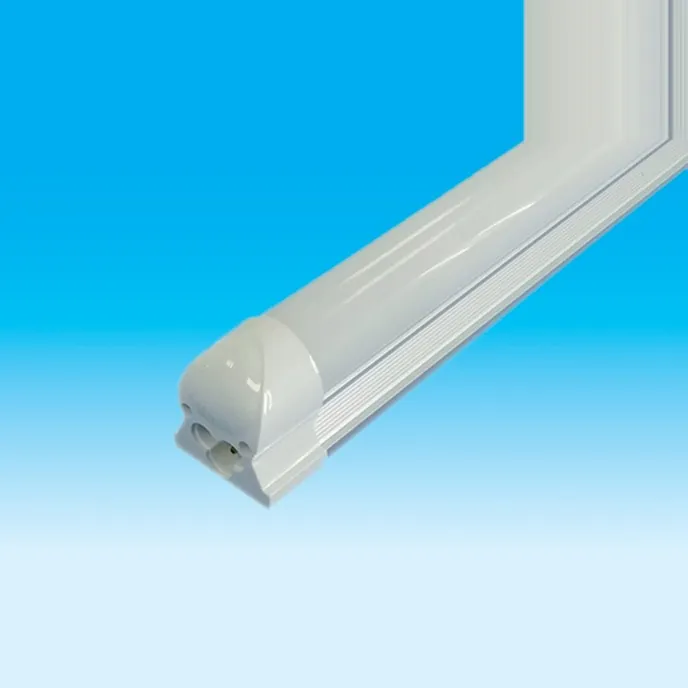
Key points
- Type A tubes work with the existing ballast; Type B tubes bypass it and run on mains; Type C tubes use a separate LED driver.
- Ballast bypass tubes save the most energy and avoid future ballast failures, but need rewiring and a label on the fixture.
- Single-ended and double-ended bypass tubes are wired differently; mixing them up can be dangerous.
- A 4 ft T8 LED tube of 16–18 W typically replaces a 32–36 W fluorescent tube, cutting energy by about half.
Fluorescent tubes are still in millions of offices, schools, factories, car parks and shops. LED tubes let these fixtures stay in place while cutting energy roughly in half. The choice that matters is how the tube is powered.
The three types
| Type | Power from | Installation | Pros | Cons |
|---|---|---|---|---|
| Type A (plug-and-play) | Existing fluorescent ballast | Swap tube | Fast, no rewiring | Ballast compatibility, ballast still fails and uses power |
| Type B (ballast bypass, direct wire) | Mains, ballast removed | Rewire fixture | Most efficient, no ballast failures | Rewiring, labelling, care with wiring type |
| Type C (external driver) | Separate LED driver | Replace ballast with driver | Dimming, long life, low-voltage tubes | Highest cost |
| Hybrid (A+B) | Works with ballast now, mains later | Swap tube now, bypass later | Flexibility | Higher tube cost |
Sizes
| Tube | Diameter | Common lengths | Fluorescent power | Typical LED |
|---|---|---|---|---|
| T12 | 38 mm | 2, 4, 8 ft | 20–40 W (4 ft) | 16–20 W |
| T8 | 26 mm | 600, 1200, 1500 mm (2, 4, 5 ft) | 18–36 W (4 ft: 32 or 36 W) | 9–18 W |
| T5 | 16 mm | 549, 1149, 1449 mm | 14–28 W (HE), 24–54 W (HO) | 7–25 W |
T5 tubes are shorter than T8 for the same nominal length; they are not interchangeable without adaptors.
Our LED T8 tubes come in 600 mm (9 W) and 1200 mm (16 and 18 W) versions, AC 100–240 V, 180° beam.
Ballast bypass wiring
Single-ended: live and neutral connect to one end of the tube; the other end has no power or is shorted for support only.
Double-ended: live goes to one end, neutral to the other.
Steps (general guide; follow the tube maker’s instructions and local codes):
- Isolate the circuit and confirm it is dead
- Remove the ballast or disconnect it
- Rewire the lampholders as the tube requires; single-ended tubes often need non-shunted lampholders
- Fit the tube
- Label the fixture: “This fixture has been modified for LED tubes; do not use fluorescent lamps”
Fitting a fluorescent tube in a bypassed fixture, or the wrong LED tube type, can cause failure or shock hazards. That is why the label matters.
Plug-and-play compatibility
Type A tubes work only with ballasts on the maker’s compatibility list. Electronic ballasts are usually compatible; magnetic ballasts often need a starter replaced with a fuse starter. Check the list before buying hundreds of tubes.
Savings
An office with 400 tubes of 4 ft T8 at 36 W (about 40 W each with ballast) converted to 18 W ballast-bypass LED tubes, 3,000 hours a year at US$0.15/kWh:
- Saving per tube: about 22 W
- Annual saving: 22 × 400 × 3,000 = 26,400 kWh, about US$4,000
Use the LED retrofit savings calculator for your figures.
Light distribution
Fluorescent tubes emit light all around; most LED tubes emit 160–240°. In fixtures with reflectors, this usually helps, putting more light down. In open battens, a wider-beam tube avoids dark ceilings.
Tubes, kits or new fixtures?
| Situation | Best option |
|---|---|
| Sound fixtures, quick upgrade | LED tubes |
| Better look, new diffusers | Retrofit kit or panel |
| Damaged or yellowed fixtures | New LED fixtures |
| Need dimming and sensors | Type C tubes or new fixtures |
For panels and office layouts, see LED flat panel lights and office light fixtures.
Colour and quality
- 4000K for offices and schools, 5000–6500K for industry and car parks, 3000K for hospitality
- Ra 80 standard
- Flicker-free drivers for offices and classrooms
- PC or glass covers: glass looks like fluorescent and resists yellowing; PC is shatter-resistant for food and industrial areas
Safety and listings
In North America, LED tubes are listed under UL 1598C categories (Type A, B, C). In other markets, check the local requirements for retrofitting fixtures. Always use tubes with a clear wiring diagram and warning labels.
Disposal
Fluorescent tubes contain mercury. Collect and recycle old tubes through approved channels. Old magnetic ballasts may contain capacitors that also need proper disposal.
Planning a large conversion
For buildings with hundreds or thousands of tubes, plan the conversion floor by floor:
- Survey fixture types, ballast types and tube lengths; take photos of the lampholders
- Pick one tube type for the whole building where possible, to simplify stock
- Convert a pilot area and check light levels, flicker and appearance
- Schedule work outside working hours, with lifts and ladders arranged in advance
- Label every converted fixture and update the maintenance records
- Recycle old tubes and ballasts through approved collectors
Common problems after conversion
| Problem | Likely cause |
|---|---|
| Tube does not light | Wrong wiring for single- or double-ended tube, shunted lampholders |
| Flicker | Incompatible ballast (Type A), loose lampholder |
| Ends darker than the middle | Tube design; choose tubes with even LED spacing |
| Buzzing | Old magnetic ballast still in circuit |
Where tubes are used most
Car parks, stairwells, warehouses, supermarkets and schools have the most fluorescent tubes. In car parks and stairwells, tubes with integrated microwave sensors cut energy further by dimming when nobody is there.
Ordering
Send the tube type and length, the fixture type and quantity, and whether you prefer plug-and-play or bypass. We will propose tubes and wiring instructions for your project.
Sources
Frequently asked questions
Do LED tubes need a ballast?
It depends on the type. Plug-and-play (Type A) tubes work with a compatible fluorescent ballast. Ballast bypass (Type B) tubes are wired directly to mains with the ballast removed. Type C tubes run on their own external LED driver.
Which is better, plug-and-play or ballast bypass?
Plug-and-play is quickest to install but depends on the old ballast, which will eventually fail and uses some power. Ballast bypass takes longer to install but is more efficient and removes the ballast as a failure point. For large commercial projects, bypass is usually preferred.
Can I put an LED tube in a fluorescent fixture?
Yes, with the right type of LED tube and, for ballast bypass tubes, by rewiring the fixture according to the tube maker's instructions. Label the fixture so fluorescent tubes are not fitted again by mistake.