
LED Flat Panel Lights: Edge-Lit vs Back-Lit, Sizes and Mounting Options
How LED flat panel lights are built: edge-lit and back-lit designs, standard sizes, wattage and lumens, recessed, surface and suspended mounting, drivers, flicker and how to compare panels.
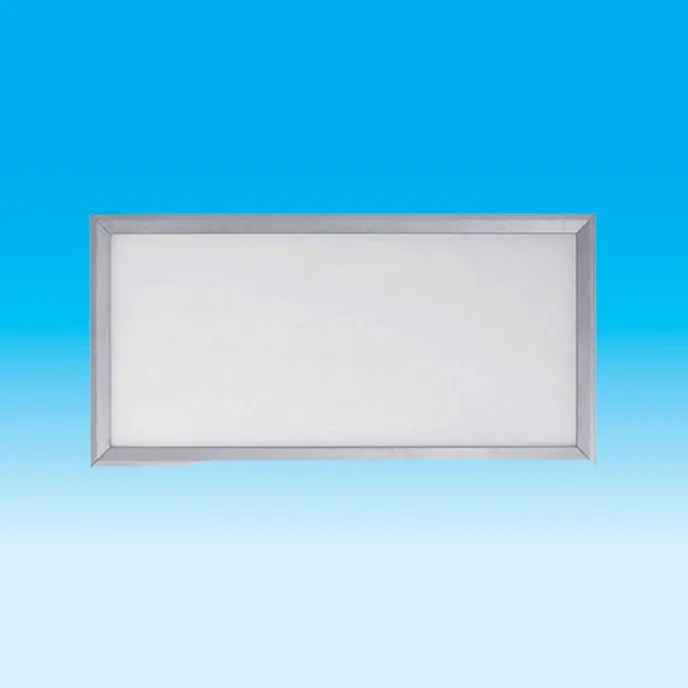
Key points
- Edge-lit panels push light from LEDs around the frame through a light guide plate; back-lit panels place LEDs behind a diffuser. Edge-lit is thinner, back-lit usually more efficient.
- Standard sizes are 300 × 300, 300 × 600, 600 × 600 and 600 × 1200 mm, or 1x1, 1x4, 2x2 and 2x4 ft in North America.
- Mounting options include lay-in to a grid, recessed in plasterboard with a frame, surface frames and suspension kits.
- Compare lumens, efficacy, UGR, flicker and the driver, not just watts and price.
Flat panels have become the default ceiling light in offices, schools and public buildings. They look clean, fit standard ceiling grids and replace fluorescent fittings at about half the power. But two panels that look identical on the ceiling can differ a lot in light output, glare, flicker and how long they keep their colour.
How a flat panel works
Edge-lit panels
– LEDs sit along the edges of the frame
– A light guide plate (LGP), usually acrylic, spreads the light across the face
– A diffuser in front evens it out, a reflector behind sends light forward
– Very thin: often 9–12 mm
Back-lit (direct-lit) panels
– LEDs are spread across a board behind the diffuser
– No light guide plate
– Deeper: often 25–40 mm
– Usually higher efficacy and fewer parts to yellow over time
| Edge-lit | Back-lit | |
|---|---|---|
| Thickness | 9–12 mm | 25–40 mm |
| Efficacy | Good | Often higher |
| Uniformity | Excellent | Very good with a good diffuser |
| Long-term yellowing | Depends on the LGP quality | Lower risk |
| Weight | Light | Light |
| Typical use | Low ceiling voids, design | Budget and high-efficiency projects |
Our BG-MBC panels are edge-lit with SMD4014 LEDs and an aluminium frame, in 12–48 W.
Sizes
| Metric | Imperial (nominal) | Typical power |
|---|---|---|
| 300 × 300 mm | 1 × 1 ft | 12–18 W |
| 300 × 600 mm | 1 × 2 ft | 18–24 W |
| 600 × 600 mm (595 visible) | 2 × 2 ft | 30–40 W |
| 300 × 1200 mm | 1 × 4 ft | 36–40 W |
| 600 × 1200 mm | 2 × 4 ft | 40–50 W |
Metric and imperial grids are close but not identical. Panels for one do not always fit the other; check the grid before ordering.
Lumens and efficacy
Efficacy of complete panels ranges from about 80–90 lm/W for standard edge-lit panels to 120 lm/W and more for high-efficiency back-lit designs. At 36 W:
- 90 lm/W → about 3,240 lm
- 120 lm/W → about 4,320 lm
That difference changes how many panels a room needs. For a room layout, use the lumen method in our lighting calculator, which works for ceilings of 2.5–4 m as well as for warehouses.
Mounting options
| Mounting | How | Use |
|---|---|---|
| Lay-in | Drops into a T-bar grid | Suspended ceilings |
| Recessed in plasterboard | Spring clips or a recessed frame in a cut-out | Solid ceilings |
| Surface-mounted | Surface frame screwed to the ceiling | Concrete or plaster ceilings with no void |
| Suspended | Wire suspension kit | High ceilings, design looks |
| Wall-mounted | Bracket | Corridors, special designs |
Surface frames add depth (often 40–60 mm) and hide the driver. Suspension kits allow up-light if the panel has a back light component.
Drivers and flicker
- External drivers are easier to replace and keep heat away from the LEDs
- Isolated drivers are safer and usually better quality
- Flicker-free drivers matter for offices, classrooms and video calls
- Dimmable versions: 0–10 V, DALI or TRIAC, chosen to match the building’s controls
- Emergency packs for escape routes
Ask for the driver’s power factor (above 0.9), THD and flicker percentage.
Glare and UGR
Standard flat panels have a bright, uniform face; on their own they may exceed UGR 19 in large rooms. For screen work, choose panels with micro-prismatic diffusers or low-glare optics, such as our low-glare office panel, designed for classrooms and offices.
Colour temperature and CRI
- 3000K: hotels, lounges, warm interiors
- 4000K: offices, schools, shops
- 5000–6000K: hospitals, labs, some industrial areas
- Ra 80 is standard; Ra 90 where colour matters
- CCT-selectable panels let one product cover several rooms
Comparing panels
| Check | What to ask for |
|---|---|
| Real lumens | Test report of the complete fixture |
| Efficacy | lm/W of the fixture, not the LED chip |
| Glare | UGR value for a standard room |
| Flicker | Percent flicker or flicker-free statement |
| Driver | Brand, PF, isolation, warranty |
| LGP | PMMA (acrylic) rather than PS, which yellows faster |
| Frame | Aluminium, square corners that fit the grid |
| Warranty | Three to five years |
Replacing fluorescent fittings
A 600 × 600 fluorescent troffer with four 18 W tubes draws about 70–80 W with its ballast; a 36 W panel replaces it and halves the energy. Our conversion chart covers other fluorescent and HID sizes. For a quick upgrade without changing fittings, LED tubes are an alternative; for a fresh look and better glare control, panels win.
Panels in schools and hospitals
Classrooms need even light on desks and the board, low glare and flicker-free drivers, typically 300–500 lux at 4000K. Hospitals add cleanability: sealed panels with gaskets around the frame keep dust out of the ceiling void and can be wiped down. In operating and examination rooms, higher CRI (Ra 90) and special clean-room fittings are used. For corridors in both, panels on occupancy sensors cut energy where rooms are used intermittently. Ask for a sample panel to test in one room first.
Where panels are not the best choice
- High ceilings above about 4 m: high bays or linear fittings
- Wet areas: sealed IP65 fittings instead of standard panels
- Accent lighting: downlights or track lights
- Very low glare needs: louvred fittings
Ordering
Send room plans, ceiling types and grid sizes, target lux and any glare, dimming or emergency requirements. We will confirm panel sizes, wattages and mounting kits for each area.
Sources
Frequently asked questions
What is an LED flat panel light?
A thin, rectangular LED fixture that gives even light from its whole face. It is used mainly in suspended ceilings in offices, schools, hospitals and shops, replacing fluorescent troffers, and can also be surface-mounted or suspended.
Are edge-lit or back-lit panels better?
Edge-lit panels are thinner, often 9–12 mm, and look very uniform. Back-lit panels are deeper but usually more efficient, run cooler and have no light guide plate to yellow. Both work well when made with good components.
How many watts is a 2x4 LED flat panel?
Typically 40–50 W, giving about 4,000–6,000 lumens. A 2x2 or 600 × 600 panel is usually 30–40 W with about 3,000–4,500 lumens.