
Lumens to Watts: Conversion Chart for LED, Incandescent, Fluorescent and HID
How to convert lumens to watts and back: what 800, 1,000 and 1,600 lumens equal for LED and incandescent, efficacy by lamp type, and how many lumens you need for rooms and outdoor areas.
Key points
- Lumens measure light; watts measure power. Watts = lumens ÷ efficacy (lm/W).
- 800 lumens is the light of a 60 W incandescent bulb, or about 8–9 W of LED; 1,600 lumens equals a 100 W incandescent, or about 14–16 W of LED.
- Efficacy differs hugely: incandescent about 14 lm/W, halogen 16–20, CFL 55–65, fluorescent tubes 80–100, metal halide 70–100, LED 100–160.
- For areas, think in lux (lumens per square metre) and use a lighting calculation rather than bulb equivalents.
For a century people bought light by watts: a 60 W bulb for a lamp, a 100 W bulb for a kitchen. With LED, watts no longer tell you how bright a lamp is, because a 10 W LED can be as bright as a 60 W incandescent. Lumens are the measure of light; watts are only the power it costs.
The basic formula
- Watts = lumens ÷ efficacy
- Lumens = watts × efficacy
Efficacy is lumens per watt (lm/W). It depends on the lamp type and, for LED, on product quality.
Efficacy by lamp type
| Lamp type | Typical efficacy |
|---|---|
| Incandescent | 12–15 lm/W |
| Halogen | 16–22 lm/W |
| Compact fluorescent (CFL) | 55–65 lm/W |
| Fluorescent tube (T8, T5) | 80–100 lm/W |
| Mercury vapour | 35–55 lm/W |
| Metal halide | 70–100 lm/W |
| High pressure sodium | 90–130 lm/W |
| LED bulbs | 80–120 lm/W |
| LED commercial fittings | 110–160 lm/W |
HID figures are for the lamp only; ballast losses lower the system figure.
Lumens to watts chart for household bulbs
| Lumens | Incandescent | Halogen | CFL | LED |
|---|---|---|---|---|
| 450 | 40 W | 29 W | 9–11 W | 4–6 W |
| 800 | 60 W | 43 W | 13–15 W | 8–10 W |
| 1,100 | 75 W | 53 W | 18–20 W | 11–13 W |
| 1,600 | 100 W | 72 W | 23–26 W | 14–17 W |
| 2,600 | 150 W | 125 W | 40–42 W | 23–28 W |
So “800 lumens to watts” has several answers: 60 W in old incandescent terms, about 8–10 W for a typical LED.
Lumens for commercial and outdoor lighting
| Application | Typical LED | Typical lumens |
|---|---|---|
| Office panel 600 × 600 | 36 W | 3,200–4,300 lm |
| LED tube T8 1.2 m | 18 W | 1,800–2,200 lm |
| Warehouse high bay | 150 W | 19,500–24,000 lm |
| Residential street light | 40 W | 5,000–6,000 lm |
| Main road street light | 120 W | 15,000–18,000 lm |
| Stadium floodlight | 1,000 W | 130,000–150,000 lm |
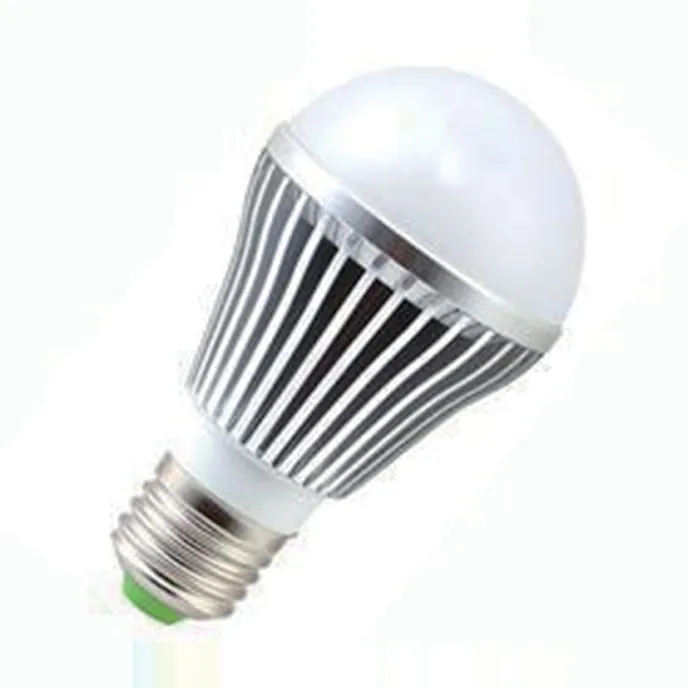
Our LED bulbs give household light at 5–12 W; for streets and halls, see the HPS to LED conversion chart, which compares old and new wattage directly.
How bright is 1,000 lumens?
| Lumens | Roughly like | Typical use |
|---|---|---|
| 100–300 | Night light to a small table lamp | Orientation, accents |
| 450 | 40 W bulb | Bedside lamp |
| 800 | 60 W bulb | General room lamp |
| 1,000–1,600 | 75–100 W bulb | Kitchen, workshop lamp |
| 2,000–4,000 | Fluorescent tube fitting or panel | Offices, classrooms |
| 5,000–6,000 | Small street light | Residential street |
| 20,000 | Warehouse high bay | High ceilings |
From lumens to lux
Lumens tell you how much light leaves the lamp. Lux tells you how much arrives on a surface: 1 lux = 1 lumen per square metre.
A room of 20 m² lit to 300 lux needs about 6,000 lumens on the working plane. Because some light is lost on walls and ceilings and fittings get dirty, the lamps must produce more, often 1.5–2 times as much:
Lamp lumens ≈ lux × area ÷ (utilisation factor × maintenance factor)
For larger rooms and halls, our lighting calculator does this sum and draws a layout.
Typical light levels
| Space | Lux |
|---|---|
| Corridors | 100 |
| Living rooms | 100–300 |
| Kitchens, workshops | 300–500 |
| Offices, classrooms | 300–500 |
| Warehouses | 100–300 |
| Residential streets | 5–15 |
| Car parks | 5–20 |
| Sports fields (club) | 200 |
Watts still matter for energy
Lumens decide brightness; watts decide cost. A 9 W LED running 4 hours a day uses about 13 kWh a year; a 60 W incandescent giving the same light uses about 88 kWh. For commercial upgrades, the LED retrofit savings calculator shows energy and payback.
What the label should tell you
- Lumens (light output)
- Watts (power)
- Efficacy (lm/W), or calculate it
- Colour temperature (K)
- Colour rendering (CRI / Ra)
- Beam angle for directional lamps
“Equivalent” wattage on packaging is a guide only; compare lumens.
Common mistakes
- Buying by watts when changing from incandescent to LED, then finding rooms too bright or too dim
- Comparing a bare LED chip’s lm/W with a complete fitting’s lm/W
- Ignoring beam angle: a narrow spotlight with fewer lumens can light a small area more than a wide bulb
- Forgetting maintenance: all lamps lose some output with age and dirt
Lumens in solar lighting
For solar lights, watts matter twice: they decide brightness and battery drain. A solar light labelled “300 W” with a 6 Wp panel cannot sustain 300 W; check real lumens and real LED watts. Our solar street light calculator sizes panels and batteries from real power.
Lumens over a lamp’s life
Rated lumens are measured when a lamp is new. LEDs slowly lose output over tens of thousands of hours; metal halide and fluorescent lamps lose more, and faster. Lighting designs use a maintenance factor (often 0.7–0.9) so that the space still meets its target after years of use. When comparing products, ask for the lumen maintenance figure, such as L70 or L80 at a stated number of hours, as well as initial lumens.
Ordering
Tell us the area and the light level you need, or the old lamps you are replacing, and we will propose fittings by lumens and watts.
Sources
Frequently asked questions
How many watts is 800 lumens?
About 60 W for an incandescent bulb, 43 W for halogen, 13–14 W for a compact fluorescent and 8–9 W for a typical LED bulb. The exact LED figure depends on its efficacy: at 100 lm/W, 800 lumens needs 8 W.
How many lumens is a 60 watt bulb?
A standard 60 W incandescent bulb gives about 800 lumens. An LED labelled '60 W equivalent' should give at least 800 lumens while drawing about 8–10 W.
Is higher lumens brighter?
Yes. Lumens measure the total light a lamp gives. Two lamps with the same lumens look about equally bright, even if one uses far fewer watts. How bright a room looks also depends on beam, distance, colour temperature and surfaces.