
Emergency Light Testing and Battery Replacement: Monthly, Annual and Records
How to test emergency lights and exit signs: monthly and annual tests under NFPA 101 and BS 5266-1, what to record, why batteries fail, how to replace them, and self-test systems.
Key points
- NFPA 101 calls for a 30-second functional test every month and a 90-minute full-duration test every year; BS 5266-1 calls for a short monthly test and an annual full rated-duration test.
- Every test must be recorded: date, result, faults and action taken.
- Batteries in emergency lights typically last about 4 years; replace when a light fails its duration test, or on a planned cycle.
- Self-test emergency lights run their own tests and flag faults, which cuts labour in large buildings.
Emergency lights and exit signs sit unnoticed for years and are needed for a few minutes in a fire or a power cut. Testing is the only way to know they will work. It is also a legal duty for building owners and managers in most countries.
What the codes require
| NFPA 101 (USA and many other markets) | BS 5266-1 / EN 50172 (UK and Europe) | |
|---|---|---|
| Monthly | Functional test of at least 30 seconds | Short functional test, simulating mains failure |
| Annual | Full test for 1.5 hours (90 minutes) | Full test for the rated duration (often 1 or 3 h) |
| Records | Written records kept for inspection | Log book with all tests and faults |
| Self-test | Allowed, with records | Allowed, with records |
Many countries follow one of these, often with local amendments. Check the local fire code for the duration your building needs.
Monthly test, step by step
- Simulate mains failure: use the test switch, key switch or test button
- Check every emergency light and exit sign comes on
- Check that each is clean, undamaged and legible
- Restore mains and check the charging indicator returns to normal
- Record the date, the lights tested and any faults
Keep the test short, so the batteries recharge before the building is occupied again.
Annual full-duration test
- Choose a time when the building has low risk, because batteries will be flat for up to 24 hours afterwards
- Cut the supply to the emergency circuits
- Leave the lights on battery for the full duration: 90 minutes or the rated time
- Check at the end that every light still gives light
- Record failures and replace batteries or fittings
- Restore mains and confirm charging
In large buildings, test alternate fittings on different days so half the lights are always charged.
Records
A log book or digital record should show:
- Building and location of each emergency light
- Date and type of each test
- Pass or fail for each fitting
- Faults found and action taken
- Battery and lamp replacements
- Name of the person testing
Inspectors and insurers ask for these records after incidents.
Why batteries fail
| Cause | Result |
|---|---|
| Age | Capacity falls; light does not last its rated time |
| Heat | Ceiling voids and hot plant rooms shorten life |
| Never discharged | Ni-Cd and Ni-MH lose usable capacity |
| Constant overcharging | Poor chargers cook the cells |
| Long power cuts | Repeated deep discharges |
Ni-Cd, Ni-MH and lithium iron phosphate (LiFePO4) are common in emergency lights. LiFePO4 lasts longer and handles heat better.
Replacing batteries
- Switch off and isolate before opening the fitting
- Use the same chemistry, voltage and capacity; the charger is set for that chemistry
- Check connectors and polarity
- Mark the date on the new battery
- Allow 24 hours of charging before the next full-duration test
- Recycle old batteries properly
Many sites replace all batteries on a planned cycle of around four years, rather than waiting for failures.
Self-test emergency lights
Self-test fittings run their own monthly and annual tests and show the result with an LED indicator or report it to a central panel. They:
- Save labour in large buildings
- Reduce missed tests
- Still need someone to check indicators and act on faults
- Still need records, often exported from the panel
Exit signs
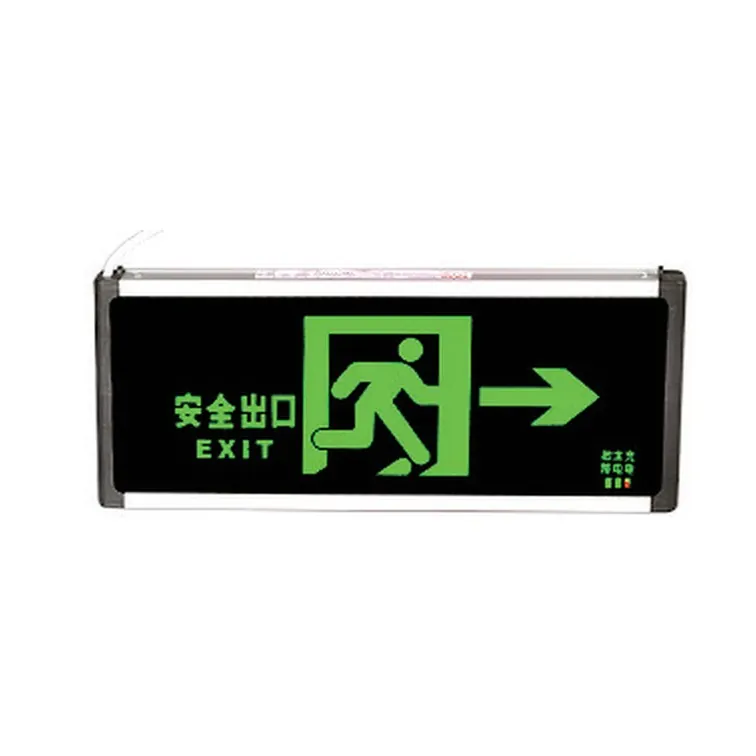
Exit signs must be visible, legible and lit in a power cut. Our LED exit signs (BG-XFYJ, 3/5 W) give at least 90 minutes of battery backup with switchover in under 2 seconds and a charging time of up to 24 hours. Test them with the same monthly and annual routine as other emergency lights.
Emergency lights in hazardous areas
In areas with flammable gas or dust, emergency lights must be explosion-proof and certified for the zone. Testing must follow the site’s permit rules, and fittings may only be opened by competent people. Our explosion-proof emergency light is marked Ex d IIC T4 and gives 2 hours of emergency operation. For zone and marking basics, see explosion-proof light ratings explained.
Emergency lighting design basics
Testing finds failed lights; design makes sure there are enough:
- Escape routes lit to at least 1 lux on the centre line (EN 1838), many US codes use average 10 lux (1 fc) with minimum 1 lux (0.1 fc)
- Lights at every exit door, stair, change of direction and level, fire equipment point and first-aid point
- Exit signs visible from every point on the route
- Open areas over 60 m² lit for anti-panic
Common faults found in tests
| Fault | Action |
|---|---|
| Light does not come on | Check lamp or LED, battery, fuse |
| Light goes out before rated time | Replace battery |
| Charging indicator off | Check supply and charger |
| Sign hard to read | Clean, replace diffuser or legend |
| Fitting missing or damaged | Replace; investigate cause |
Planning maintenance for many buildings
For portfolios of schools, hospitals or factories, a schedule with monthly tests by site staff and annual tests by a contractor, plus planned battery replacement, keeps everything compliant. Self-test fittings make the monthly round much faster.
Ordering
Send the building plans with escape routes, the required duration and any self-test requirement. We will propose emergency fittings, exit signs and explosion-proof emergency lights where needed.
Sources
Frequently asked questions
How often should emergency lights be tested?
Monthly, with a short functional test (30 seconds under NFPA 101, a brief test under BS 5266-1), and once a year with a full-duration test, usually 90 minutes or the rated duration of the light. Local rules may add requirements.
How long should an emergency light last on battery?
Most codes require at least 90 minutes; some buildings and countries require 3 hours. The light must still meet its required output at the end of the duration.
How do I know if an emergency light battery needs replacing?
If the light fails its annual full-duration test, the charge indicator shows a fault, or it dims or goes out before the rated time, the battery should be replaced. Many sites also replace batteries on a fixed cycle of about four years.