
Wind-Solar Hybrid Street Lights: When a Turbine Beats a Bigger Battery
How wind-solar hybrid street lights work, wind turbine vs solar panel output, which sites suit them, sizing the turbine, panel and battery, maintenance, and when solar-only is the better choice.
Key points
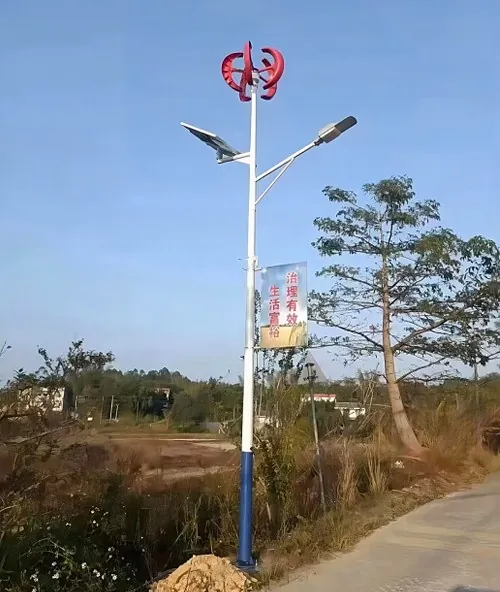
- A wind-solar hybrid street light charges one battery from a small wind turbine and a solar panel through a hybrid controller.
- It makes sense where the windiest months are also the cloudiest: coasts, islands, plateaus and regions with long rainy seasons.
- Small turbines need steady wind, typically an average of 3–4 m/s or more at hub height; below that, a larger solar panel and battery is usually cheaper.
- Turbines add moving parts: bearings and fixings need an annual inspection, and poles must carry the extra wind load.
Solar street lights fail in a predictable way: several cloudy days in a row empty the battery. The usual fix is a bigger battery and panel. On some sites there is another option. If the weather that brings clouds also brings wind, a small turbine on the pole can keep the battery charging when the panel cannot.
How a hybrid light works
| Part | Role |
|---|---|
| Solar panel | Charges the battery on sunny and bright days |
| Wind turbine | Charges the battery when there is wind, day or night |
| Hybrid controller | Combines both inputs, protects the battery, controls the LED |
| Battery | LiFePO4 or gel, stores energy for the night |
| LED luminaire | Usually 30–120 W with dimming |
| Pole | Carries the turbine, panel, light and battery box |
The controller limits turbine speed in high winds (by braking or dumping power) so the turbine and battery are protected.
Where hybrid lights make sense
| Site | Why |
|---|---|
| Coastal roads and ports | Sea breezes most days, cloudy seasons |
| Islands | Strong trade winds, expensive grid |
| High plateaus and mountain passes | Wind, cold and cloud |
| Monsoon regions with wind | Rainy season brings wind but little sun |
| Border and remote roads | No grid, long distances |
Our wind-solar hybrid street lights are designed for these kinds of sites.
When solar-only is better
- Average wind below about 3 m/s at hub height
- Sheltered urban streets, where buildings block wind
- Sites where noise or moving parts are a concern (near homes, hospitals)
- Where maintenance access is very limited
In these cases, a larger panel and battery, plus dimming, is simpler. See how many rainy days a solar street light can last for battery sizing.
Wind energy: why average speed matters so much
Wind power grows roughly with the cube of wind speed. A turbine in 6 m/s wind produces about eight times as much as in 3 m/s. That is why:
- Rated power (for example 400 W at 12 m/s) says little about daily energy at a typical site
- Local wind data at the right height is essential
- A small difference between sites, such as hilltop vs valley, changes results greatly
Wind data for most locations is available from public sources such as the Global Wind Atlas.
Sizing a hybrid system
- Nightly load: LED power × hours, with dimming (for example 60 W, 5 h full and 7 h at 40% ≈ 470 Wh)
- Solar energy: panel Wp × peak sun hours × about 0.6
- Wind energy: from the turbine’s power curve and the site’s wind distribution
- Battery: enough for the nights when both sun and wind are low, usually 2–3 nights
- Check the worst month: the month with the lowest combined energy decides the design
Our solar street light calculator handles the solar part; wind energy must be added from the turbine data for the site.
Turbine types
| Horizontal axis (HAWT) | Vertical axis (VAWT) | |
|---|---|---|
| Efficiency | Higher | Lower |
| Wind direction | Needs a tail to face the wind | Works from any direction |
| Start-up wind | Low | Often higher |
| Noise | Can be noticeable | Usually quieter |
| Look | Familiar “windmill” | Sculptural |
| Use | Open sites with steady wind | Urban-looking sites, turbulent wind |
Poles and wind load
The turbine, panel and luminaire together have a large wind area high on the pole. Hybrid poles are typically 8–12 m, heavier and with larger foundations than solar-only poles of the same height. The pole must be designed for the local design wind speed, including storms. See our solar light pole guide for the principles.
Maintenance
| Item | Frequency |
|---|---|
| Turbine bearings, blades, fixings | Inspect yearly |
| Panel cleaning | 2–4 times a year in dusty areas |
| Battery check | Yearly, replace after 5–8 years (LiFePO4) |
| Controller and wiring | Yearly |
| Pole and foundation | After major storms |
Coastal sites need corrosion-resistant fasteners and coatings for both turbine and pole.
Cost comparison
A hybrid light costs more than a solar-only light of the same LED power, because of the turbine, controller and stronger pole. It pays where the alternative would be a much larger battery and panel, or where solar-only lights would go dark in the cloudy season. For cost over the life of a project, compare:
- Hybrid light with turbine and moderate battery
- Solar-only light with larger panel and battery
- Grid connection, if available
Our solar vs grid street light cost comparison explains how to compare options over 10–20 years.
Common questions from buyers
- Does the turbine work at night? Yes, wind charging is independent of daylight.
- Is it noisy? Small turbines make some noise in strong wind; VAWT designs are usually quieter.
- What about typhoons and cyclones? Turbines must be rated for the site’s extreme wind and have over-speed protection; poles must be designed for storms.
A worked example
Take a coastal road where December has only about 2.5 peak sun hours but average winds of 5 m/s. A 60 W light dimmed after midnight needs roughly 470 Wh a night. A 200 Wp panel collects about 300 Wh on an average December day, leaving a gap. A small turbine that delivers 200–300 Wh a day at that wind speed closes the gap, so a 2-night battery is enough. Without the turbine, the same reliability would need a panel of 350 Wp or more and a much larger battery. In summer, the panel alone covers the load and the turbine adds margin.
Ordering
Send the site coordinates, road layout, the hours of light you need and any wind data you have. We will check wind and solar resources and propose a hybrid or solar-only configuration.
Sources
Frequently asked questions
What is a wind solar hybrid street light?
A street light powered by both a small wind turbine and a solar panel mounted on the same pole. Both charge one battery through a hybrid controller, which also switches and dims the LED.
Is wind or solar better for street lights?
In most places solar is simpler and cheaper. Wind helps where sun is weak for part of the year but wind is steady, such as coastal roads, islands and high plateaus. A hybrid combines both so the battery is charged in more weather.
How much power does a small wind turbine produce for a street light?
Small turbines used on street lights are typically rated 200–600 W, but at average wind speeds of 3–5 m/s they produce only a fraction of that. Actual daily energy depends strongly on the site's wind; check local wind data before relying on it.