
Solar Street Lights in the Philippines: Sizing for the Rainy Season and Typhoons
How to size solar street lights for the Philippines with satellite sun data for Manila, Cebu, Davao and Baguio: worst-month sun hours, panel and battery for a 40 W light, rainy-season autonomy, typhoon-rated poles and what to ask suppliers.
Key points
- Worst-month sun hours (PVGIS, horizontal): about 3.7 in Manila and 3.9 in Baguio (December), 4.2 in Cebu (December), 4.5 in Davao (January).
- A 40 W light using 316 Wh a night needs a 120 Wp panel in Manila, Cebu and Baguio and 100 Wp in Davao.
- In Manila, a 120 Wp panel balances an average day but barely refills the battery after a storm; 160 Wp with a 130 Ah battery covers a 5-day rainy spell and refills in about 11 days.
- Typhoons add wind load: specify poles, brackets and panels for the local design wind speed.
In the Philippines, solar street lights are now standard on barangay roads, school grounds and provincial highways. They avoid the cost of new lines, keep working during brownouts and have no cable to steal. They also face two hard tests: months of monsoon cloud and typhoon winds. This guide sizes a typical light for four cities with public satellite data, and covers what typhoons mean for the pole.
Sun hours by city
Monthly solar irradiation for 2015–2020 from PVGIS, on a horizontal surface, as average daily kWh/m² (= peak sun hours):
| City | Best month | Worst month | Worst-month sun hours |
|---|---|---|---|
| Davao | April: 5.9 | January | 4.5 |
| Cebu | April: 6.4 | December | 4.2 |
| Baguio | April: 6.3 | December | 3.9 |
| Manila | April: 6.3 | December | 3.7 |
The darkest months are not only the wet south-west monsoon (July–September), when many days are overcast but sunny spells are long, but also December, when days are shortest and the north-east monsoon brings cloud.
Month by month (PVGIS 2015–2020, kWh/m² per day, horizontal):
| City | Jan | Feb | Mar | Apr | May | Jun | Jul | Aug | Sep | Oct | Nov | Dec |
|---|---|---|---|---|---|---|---|---|---|---|---|---|
| Manila | 4.1 | 4.9 | 5.8 | 6.3 | 5.9 | 5.2 | 4.5 | 4.5 | 4.7 | 4.4 | 4.3 | 3.7 |
| Cebu | 4.4 | 5.2 | 6.0 | 6.4 | 6.0 | 5.3 | 5.0 | 5.3 | 5.2 | 4.8 | 4.5 | 4.2 |
| Davao | 4.5 | 5.3 | 5.8 | 5.9 | 5.2 | 4.6 | 4.8 | 5.2 | 5.2 | 5.0 | 4.6 | 4.5 |
| Baguio | 4.4 | 5.0 | 6.0 | 6.3 | 5.9 | 5.6 | 4.7 | 4.3 | 4.9 | 4.6 | 4.4 | 3.9 |
Compared with Africa or southern China, the Philippine year is fairly even: the worst month is about 60% of the best in Manila and about 75% in Davao. That makes the rainy spell, not the season, the main design case: a typhoon or a stalled monsoon trough can bring several days of heavy overcast in any month from June to December.
Sizing a 40 W light
The example light: 40 W LED, 5 h at 100% from dusk and 7 h at 30%, 90% driver efficiency, 12.8 V LiFePO4 battery, MPPT controller, 4 nights of autonomy. It uses about 316 Wh a night. Our solar street light calculator gives:
| City | Worst-month sun hours | Panel needed | Standard panel | Battery (4 nights) |
|---|---|---|---|---|
| Davao | 4.5 | 97 Wp | 100 W | 1,402 Wh (110 Ah) |
| Cebu | 4.2 | 104 Wp | 120 W | 1,402 Wh (110 Ah) |
| Baguio | 3.9 | 112 Wp | 120 W | 1,402 Wh (110 Ah) |
| Manila | 3.7 | 118 Wp | 120 W | 1,402 Wh (110 Ah) |
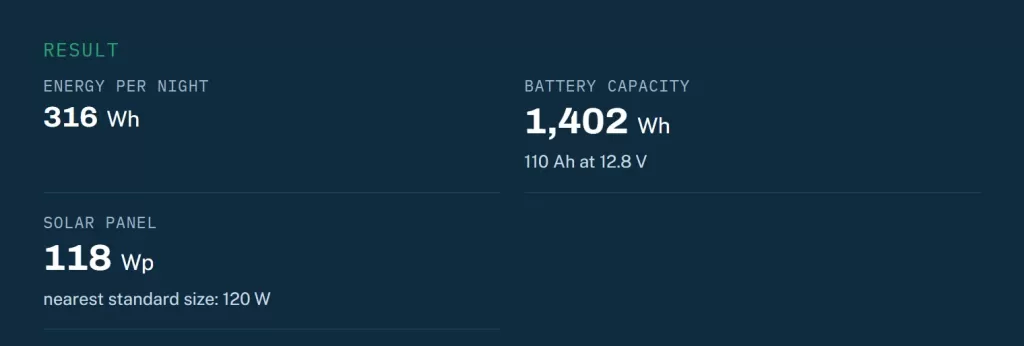
Open the Manila example and change the wattage or schedule.
The storm test
“Panel needed” balances one average day. After a run of overcast days, the panel must also refill the battery. We checked the Manila light in the battery autonomy calculator with a 5-day rainy spell and 15% rainy-day yield:
- 110 Ah battery, 120 Wp panel: the battery lasts about 4.7 rainy days, and the sunny-day surplus is only about 4 Wh, so the battery effectively never refills before the next bad spell.
- 130 Ah battery, 160 Wp panel: about 6 rainy days covered and the battery refills in about 11 sunny days.
The lesson is the same as in every wet climate: a panel sized only for the average day leaves no margin for recovery. Add 30–40% to the panel, or reduce the night’s energy with motion dimming.
Typhoons: the pole matters
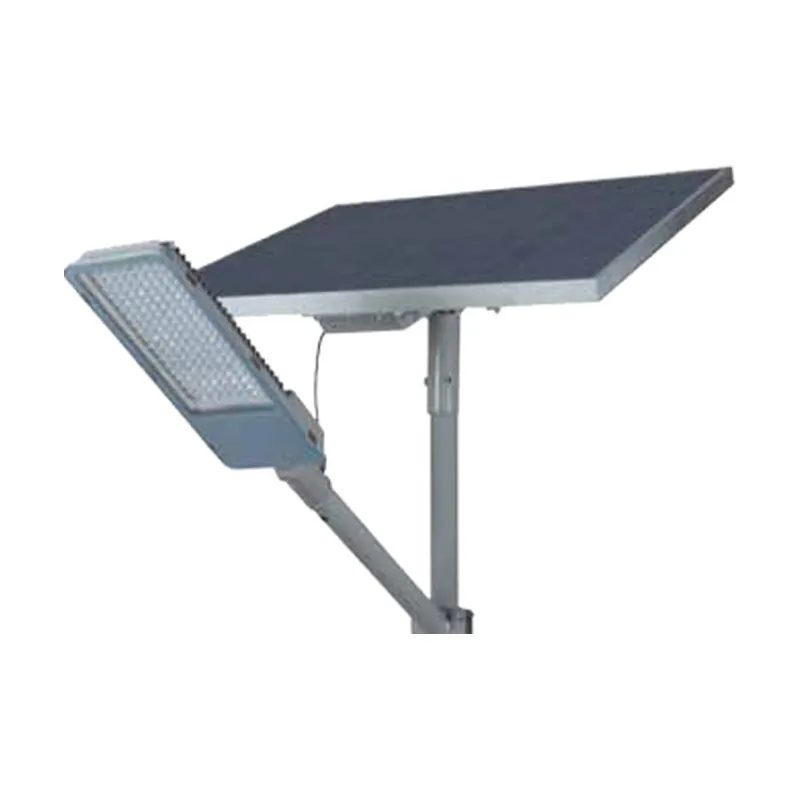
Wind loads on a solar street light come mostly from the panel. A 160 Wp panel has an area of roughly 0.8–1 m², mounted at the top of a 6–8 m pole, which is a large lever arm in a typhoon. Specify:
- The design wind speed for the province, and a pole and foundation calculation that includes the panel and luminaire
- Hot-dip galvanised poles with adequate wall thickness, and anchor bolts set in a proper foundation
- Panel brackets with stainless fixings and locking nuts
- Battery placement away from flood level for low-lying roads
Layouts for barangay and provincial roads
Light only what the road needs: every watt saved shrinks the battery and panel. Checked in our pole height and spacing calculator:
| Road | Width | Pole | Lamp | Layout | Average light |
|---|---|---|---|---|---|
| Barangay road, path | 4–6 m | 6 m | 20–30 W | One side, about 21 m apart | 6 m road with 30 W: about 12 lx |
| Municipal street | 6–7 m | 7–8 m | 40 W | One side, 24–28 m apart | about 10–15 lx |
| Provincial or national road | 7.3–10 m | 8–9 m | 60 W | One side or staggered, 28–31 m | about 15 lx |
Project specifications from DPWH or the local government unit may fix the pole height, wattage and spacing; when they do, check that the solar sizing behind the specified wattage is realistic for your province’s worst month, using the tables above.
Flooding, salt and theft
- Flood level: on low-lying roads, keep batteries high on the pole or in the lamp head, never in a ground-level box.
- Salt air: coastal barangays need stainless fixings, sealed connectors and a powder coat over galvanising.
- Theft and vandalism: anti-theft bolts, lockable battery boxes and panels mounted high; integrated lights are harder to strip than split systems with accessible batteries.
- Brownouts: solar lights keep the road lit when the grid is down, often exactly when they are most needed.
All-in-one or split?
All-in-one lights are quick to install and work well for barangay roads and paths with 20–40 W lights. For national roads, higher wattages or typhoon-exposed coasts, a split system allows a larger panel, a better tilt and a sturdier mounting. See all-in-one vs split solar street lights.
What to ask a supplier
- Panel Wp and battery Wh for your municipality, with the sun hours assumed
- LiFePO4 battery with BMS, MPPT controller, programmable schedule and low-battery dimming
- Rainy-day autonomy and recovery time
- Design wind speed and pole calculation
- IP65 or better for the luminaire and battery box, and stainless fasteners for coastal sites
Send us the location, road width, pole height and quantity. We size each system against satellite data for the site and quote complete sets including poles. See our solar street lights, and the technical specification template for tenders.
Sources
Frequently asked questions
Do solar street lights work in the Philippines during the rainy season?
Yes, if they are sized for the worst month and the longest rainy spell. Satellite data put the darkest month at about 3.7 peak sun hours a day in Manila and 4.2 in Cebu, so panels must be larger than in a dry climate, and batteries must cover several overcast days.
What size solar panel for a 40 W solar street light in Manila?
With 5 h at full power and 7 h dimmed to 30% (about 316 Wh a night) and an MPPT controller, about 118 Wp for an average December day, so 120 Wp. To refill the battery quickly after typhoon weather, 150–160 Wp is better.
Are solar street lights typhoon-proof?
The luminaire and panel can be, but the pole, bracket and foundation must be designed for the local wind speed with the panel's area included. Ask the supplier for the design wind speed and the pole calculation.