
Solar Street Lights in South Africa: Sizing for Winter in Cape Town, Johannesburg, Durban and Limpopo
How to size solar street lights for South Africa with satellite sun data: June sun hours in Cape Town, Johannesburg, Durban and Polokwane, panel and battery for a 40 W light, cold-weather battery derating, load shedding and theft.
Key points
- South Africa's worst month is June: about 2.4 peak sun hours in Cape Town, 3.3 in Durban, 4.1 in Johannesburg and 4.3 in Polokwane (PVGIS, horizontal).
- A 40 W light using 316 Wh a night needs about a 200 Wp panel in Cape Town, 150 Wp in Durban and 120 Wp in Gauteng and Limpopo.
- Tilt the panel steeply (around the site latitude or more) to catch the low winter sun, and derate batteries for cold Highveld nights.
- Solar lights keep working through load shedding and have no cable to steal, but need anti-theft fixings for the panel and battery.
South Africa has two strong reasons to choose solar street lighting. Load shedding leaves grid-powered roads dark, and copper cable theft can disable whole streets. Solar lights avoid both. But South Africa also has something most solar markets do not: a real winter, with short days, low sun and, on the Highveld, cold nights. This guide sizes a typical light for four cities using public satellite data.
Winter is the design month
Monthly irradiation for 2015–2020 from PVGIS, on a horizontal surface, as average daily kWh/m² (peak sun hours):
| City | Best month | June (worst) |
|---|---|---|
| Polokwane | November: 6.8 | 4.3 |
| Johannesburg | November: 7.2 | 4.1 |
| Durban | January: 6.2 | 3.3 |
| Cape Town | January, December: 8.2 | 2.4 |
Cape Town shows the problem most clearly: the best summer month is more than three times the June value. A light that works perfectly in January can fail in June if it was sized on the annual average.
The full year shows how long the low season lasts (PVGIS 2015–2020, kWh/m² per day on a horizontal surface):
| Month | Jan | Feb | Mar | Apr | May | Jun | Jul | Aug | Sep | Oct | Nov | Dec |
|---|---|---|---|---|---|---|---|---|---|---|---|---|
| Cape Town | 8.2 | 7.4 | 5.8 | 4.4 | 3.1 | 2.4 | 2.7 | 3.4 | 4.6 | 6.4 | 7.5 | 8.2 |
| Durban | 6.2 | 5.8 | 5.1 | 4.0 | 3.6 | 3.3 | 3.3 | 3.9 | 4.4 | 5.2 | 5.3 | 5.8 |
| Johannesburg | 6.8 | 6.0 | 5.6 | 4.5 | 4.4 | 4.1 | 4.4 | 5.3 | 6.2 | 6.7 | 7.2 | 6.8 |
In Cape Town, three months (May to July) sit near or below 3 sun hours. A system that only just works in June has no margin in the weeks around it either, so it pays to size for June and add rainy-day reserve on top.
Sizing a 40 W light
The example: 40 W LED, 5 h at 100% and 7 h at 30%, 90% efficient driver, 12.8 V LiFePO4 battery, MPPT controller, 3 nights of autonomy. It uses about 316 Wh per night. The solar street light calculator gives:
| City | June sun hours | Panel needed | Standard panel | Battery (3 nights) |
|---|---|---|---|---|
| Polokwane | 4.3 | 102 Wp | 120 W | 1,052 Wh (82 Ah) |
| Johannesburg | 4.1 | 107 Wp | 120 W | 1,052 Wh (82 Ah) |
| Durban | 3.3 | 133 Wp | 150 W | 1,052 Wh (82 Ah) |
| Cape Town | 2.4 | 183 Wp | 200 W | 1,052 Wh (82 Ah) |
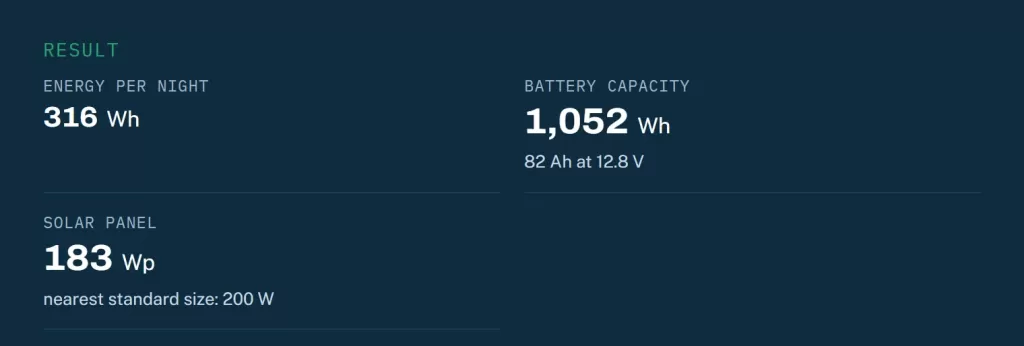
Open the Cape Town example and try your own site.
Tilt matters more than in the tropics
The sun hours above are for a horizontal surface. In winter, a panel tilted towards the north at roughly the site’s latitude (about 26° in Johannesburg, 34° in Cape Town) or a little steeper collects noticeably more than a flat one. All-in-one lights often have a shallow, fixed panel angle; for the Western Cape in particular, a split system with a properly tilted panel is the safer choice.
Cold nights and rainy spells
On the Highveld, winter nights can drop below freezing. Two consequences:
- Battery capacity falls in the cold. Our battery autonomy calculator applies a derating for cold nights.
- LiFePO4 must not be charged below 0 °C without protection or heating. Choose batteries with low-temperature charge protection, or mount them where they stay warmer.
In Cape Town the winter brings rain-bearing fronts. Checking the Cape Town light with a 4-day rainy spell, 15% rainy-day yield and a 0–10 °C derating: a 90 Ah battery with a 200 Wp panel lasts only about 3.5 rainy days and takes about a month of sunny days to refill. A 120 Ah battery with a 250 Wp panel covers about 5 rainy days and refills in about 9 sunny days.
Load shedding and theft
Solar street lights are independent of the grid, so they stay on during load shedding, which is often when streets are most at risk. They also have no buried copper cable to steal. They do have valuable parts on the pole, so specify:
- Anti-theft bolts and lockable battery compartments
- Panels and batteries mounted high, or batteries in the pole
- Robust brackets and poles for the local wind speed
Wind and the coast
Two more South African conditions belong in the specification:
- Wind. The Cape’s winter storms and the south-easter, and exposed Highveld sites, put real loads on a pole carrying a large tilted panel. Poles and foundations should be designed for the site’s wind speed under SANS 10160-3 (wind actions), with the panel area included. A split system with a 250 Wp panel at 40° catches much more wind than an all-in-one light.
- Coastal corrosion. In Durban, Cape Town and Port Elizabeth (Gqeberha), salt air attacks fixings and coatings. Specify hot-dip galvanised poles with a powder coat over the zinc, stainless fasteners and sealed battery boxes.
Solar or grid LED with backup?
Where the grid exists but load shedding is the problem, a third option is sometimes proposed: grid LED street lights with a battery backup unit. It keeps the existing cable and poles, but the cable can still be stolen, and the backup battery must be sized for the longest outage stage. On new roads, informal settlements and rural routes without cable, standalone solar is usually simpler. Our solar vs grid cost calculator compares the 10-year cost of the two main options; enter the local trenching cost and tariff.
What to ask a supplier
- Panel Wp and battery Wh for June at your site, with the sun hours and tilt assumed
- Battery chemistry, low-temperature charge protection and BMS
- Autonomy for rainy spells and recovery time
- Anti-theft design
- Pole and foundation design for the local wind speed
Send us the site location and quantity. We size each system against satellite data for the exact site and quote complete sets. See our solar street lights and the technical specification template.
Sources
Frequently asked questions
Do solar street lights work in Cape Town in winter?
Yes, if they are sized for June, when Cape Town gets only about 2.4 peak sun hours a day on a horizontal surface. That means a panel about 70% larger than in Johannesburg for the same light, a steep panel tilt and a battery that covers several cloudy winter days.
Are solar street lights affected by load shedding?
No. Solar street lights run from their own battery and are not connected to the grid, so they stay on during load shedding.
What size solar panel for a solar street light in Johannesburg?
For a 40 W light running 5 h at full power and 7 h dimmed to 30% (about 316 Wh a night), about 107 Wp at Johannesburg's June average of 4.1 sun hours, so a 120 Wp panel, tilted steeply to catch the winter sun.