
Latest Innovations in Solar and LED Street Lighting: What Is Changing in 2026
What is new in solar and LED street lighting: higher-efficacy LEDs, LiFePO4 and smarter batteries, MPPT and adaptive controllers, remote monitoring, bifacial panels, better optics, and smart poles.
Key points
- LED efficacy keeps rising: complete street light fixtures of 150–180 lm/W need less power, so solar systems can use smaller panels and batteries.
- LiFePO4 batteries have become standard, with battery management systems that report state of charge and health.
- Controllers now combine MPPT charging, adaptive dimming that learns from weather, and remote monitoring.
- Smart poles, better optics with less glare, and warmer colour temperatures are shaping new city projects.
Solar and LED street lighting changes quickly. A light designed five years ago used more power for the same light, had a less durable battery and could not report its own faults. Here are the developments that matter most for buyers and specifiers now.
1. Higher LED efficacy
Complete street light fixtures now reach roughly 150–180 lm/W, compared with around 100–120 lm/W a few years ago. For solar systems this matters twice:
- Less LED power for the same light
- Smaller battery and panel for the same runtime
A 30% gain in efficacy can cut battery size by almost a third.
2. LiFePO4 as standard, with smarter BMS
Lithium iron phosphate batteries have replaced gel and NMC lithium in most quality solar street lights:
- 2,000+ cycles to 80% capacity
- Better tolerance of heat
- Safer chemistry
- Battery management systems (BMS) that protect cells and, increasingly, report state of charge and health
See LiFePO4 vs gel batteries for the comparison.
3. Better controllers
| Feature | What it does |
|---|---|
| MPPT charging | Extracts more energy from the panel, especially in cold and cloudy conditions |
| Adaptive dimming | Adjusts brightness to battery state and weather |
| Motion dimming | Low background light, full output on movement |
| Temperature protection | Stops charging lithium below 0 °C and limits heat |
| Programmable profiles | Different schedules for seasons and roads |
Our solar street light motion sensor guide shows how much energy motion dimming saves.
4. Remote monitoring and smart control
Cellular IoT (NB-IoT, LTE-M), LoRaWAN and mesh networks let solar lights report:
- Battery voltage and state of charge
- Charging energy per day
- Faults and outages
- Tilt or impact
Operators can change dimming profiles remotely and plan battery replacements. See smart streetlights for networks and systems.
5. More efficient and bifacial panels
Monocrystalline PERC and TOPCon cells have raised panel efficiency, so a given panel area produces more energy. Bifacial panels collect some reflected light from the back, useful over light ground or snow. For all-in-one lights, higher efficiency means more energy from the limited area of the head.
6. Integrated and semi-integrated designs
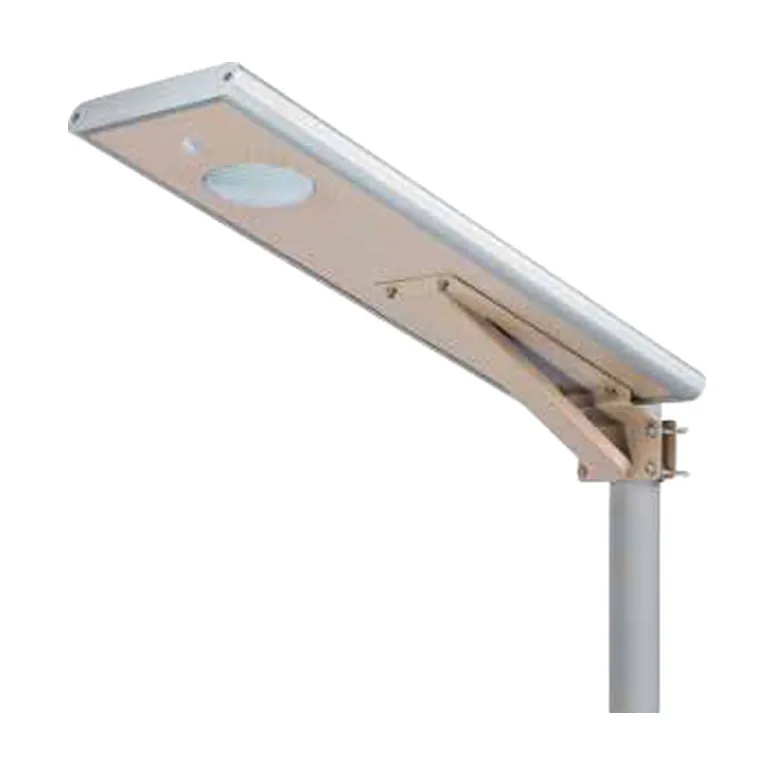
All-in-one lights put panel, battery, controller and LED in one housing, cutting installation time. Semi-integrated designs separate the panel for better orientation while keeping the battery in the light. Our all-in-one solar street lights cover 15–60 W for residential roads and paths.
7. Better optics, less glare
Modern road optics put more light on the road and less into eyes and windows:
- Asymmetric lenses matched to road widths
- Backlight control for houses beside roads
- Lower glare classes for pedestrian areas
8. Warmer colour temperatures
Many cities now specify 3000K or warmer for residential streets to reduce glare, sky glow and effects on wildlife, while keeping 4000K for main roads. LEDs at warm CCT have also become more efficient.
9. LED street light innovations beyond solar
- Constant light output drivers that compensate for LED ageing
- Zhaga Book 18 and NEMA 7-pin sockets for plug-in smart controllers
- Modular designs with replaceable LED modules and drivers
- Circular design: repairable fixtures with longer service life
Our modular LED street lights use replaceable modules and adjustable mounting angles.
10. Smart poles
Poles that carry lighting plus cameras, Wi-Fi, small cells, displays and EV charging are becoming common in new city districts. See our smart poles.
Are smart solar streetlights cost-effective for cities?
For large networks, usually yes. Remote monitoring cuts patrols and site visits, finds failing batteries before lights go dark and verifies that contractors meet performance terms. The extra cost per light is small compared with a single maintenance visit to a remote pole. For small private projects, a good standalone controller is often enough.
What has not changed
Design still starts from the worst month’s sun hours, the nightly load and the autonomy needed. New technology makes systems smaller and smarter, but it cannot replace correct sizing. Use the solar street light calculator to check any design.
What to ask suppliers now
- Complete fixture efficacy (lm/W) with test report
- Battery chemistry, Wh, cycle life and BMS features
- Controller type: MPPT, adaptive dimming, temperature protection
- Monitoring options and network
- Optics and glare control
- Warranty for each component
Innovation and reliability
New features are only useful if the basics are right. A light with remote monitoring but an undersized battery still goes dark in the rainy season; a smart controller with poor surge protection still fails after a storm. When comparing products, check sizing, component quality and warranty first, then the new features. The best projects combine proven hardware with monitoring that helps maintenance teams act early.
What to expect next
LED efficacy is likely to keep improving slowly, battery prices continue to fall, and more lights will ship with monitoring as standard. Cities are also asking for repairable designs and documented carbon footprints. Buyers who specify replaceable batteries, drivers and modules now will benefit from these trends without replacing whole fixtures later.
Questions buyers ask about new features
Buyers often ask whether to pay extra for monitoring, bifacial panels or the very highest efficacy. The answer depends on the project. For hundreds of lights spread over a district, monitoring usually pays for itself. For a few lights at a private site, a reliable standalone controller is enough. Higher efficacy is almost always worth it for solar, because it shrinks the battery, which is the most expensive part.
Working with us
We supply solar and LED street lights with current LEDs, LiFePO4 batteries and programmable controllers, with monitoring options for larger projects. Send your project details and we will propose a configuration.
Sources
Frequently asked questions
What are the latest innovations in solar street lights?
Higher-efficacy LEDs, LiFePO4 batteries with battery management, MPPT controllers with adaptive dimming, remote monitoring over cellular or LoRa networks, higher-efficiency and bifacial panels, and integrated designs that are easier to install.
What is adaptive dimming in solar street lights?
A controller that adjusts brightness based on battery state, weather and activity. After a cloudy day it dims more to make the battery last; on a full battery it allows more light. Motion sensors add brightness when people pass.
Are smart solar street lights worth it?
For large projects, remote monitoring usually pays back through fewer site visits and faster fault repair. For a few lights on private property, a good standalone controller is often enough.