
Smart Streetlights: Controllers, Networks, Sensors and What Cities Gain
How smart streetlights work: node controllers on NEMA and Zhaga sockets, mesh, LoRaWAN and NB-IoT networks, central management, sensors and smart poles, typical savings and how to plan a project.
Key points
- A smart streetlight is an LED street light with a controller that can be switched, dimmed and monitored remotely through a network.
- Controllers plug into NEMA 7-pin or Zhaga Book 18 sockets and talk over RF mesh, LoRaWAN, NB-IoT or LTE-M to a central management system.
- Dimming schedules plus remote fault reports typically save 20–40% of energy on top of the LED conversion and cut maintenance patrols.
- Smart poles add cameras, Wi-Fi, displays, EV chargers and sensors to the same pole; they need power, data and structural planning from the start.
Converting street lights to LED cuts energy by half or more. Making them smart adds the next layer: each light can be dimmed to suit traffic, reports its own faults, and measures its own energy. For a city with tens of thousands of lights, that changes how lighting is run.
What makes a streetlight smart
| Part | Role |
|---|---|
| LED luminaire with dimmable driver | Light, controllable output (DALI or 0–10 V) |
| Node controller | Switches, dims, measures energy, reports faults |
| Socket | NEMA 7-pin (ANSI C136.41) or Zhaga Book 18 |
| Network | Carries commands and data |
| Central management system (CMS) | Schedules, maps, alarms, reports |
A smart controller usually replaces the photocell in the same socket, so streets prepared with 7-pin sockets can be made smart later without changing luminaires. Our LED street light dimming guide explains sockets and interfaces in detail.
Networks
| Network | How it works | Strengths | Watch-outs |
|---|---|---|---|
| RF mesh (e.g. 868/915 MHz, 2.4 GHz) | Lights relay messages to a gateway | Owned by the city, robust | Gateways and planning needed |
| LoRaWAN | Long-range low-power radio to gateways | Long range, low cost per node | Low data rate |
| NB-IoT / LTE-M | Cellular IoT through mobile operators | No own gateways | Subscription per node, coverage |
| Power line communication | Data on the power cable | No radio | Sensitive to network noise |
Many cities choose a system with open protocols (for example TALQ for CMS interoperability) so they are not tied to one vendor.
What the central system does
- Schedules: full output in the evening, dimmed after midnight, different for main roads and residential streets
- Astronomical clock: switching from sunset and sunrise times rather than photocells
- Fault alarms: lamp failure, driver fault, power loss, tilt after vehicle impact
- Energy metering: per light, for billing and reporting
- Maps: every light with its status, age and maintenance history
- Event modes: raise light for events, accidents or emergencies
Savings
| Measure | Typical saving |
|---|---|
| LED conversion from HPS | 50–70% |
| Constant light output (compensates for ageing) | 5–15% |
| Trimming (removing design over-light) | 5–15% |
| Night dimming schedules | 15–30% |
| Fewer patrols and faster repairs | Lower maintenance cost |
Total smart savings on top of LED are often 20–40%, plus maintenance savings because crews go straight to failed lights.
Sensors
- Motion and traffic sensors raise light when vehicles or pedestrians pass on quiet roads
- Environmental sensors for air quality, noise, temperature
- Parking sensors or cameras for occupancy
- Tilt sensors in controllers detect impacts on poles
Adaptive lighting driven by traffic must follow road lighting standards; see road lighting classes for how classes can change with traffic flow.
Smart poles
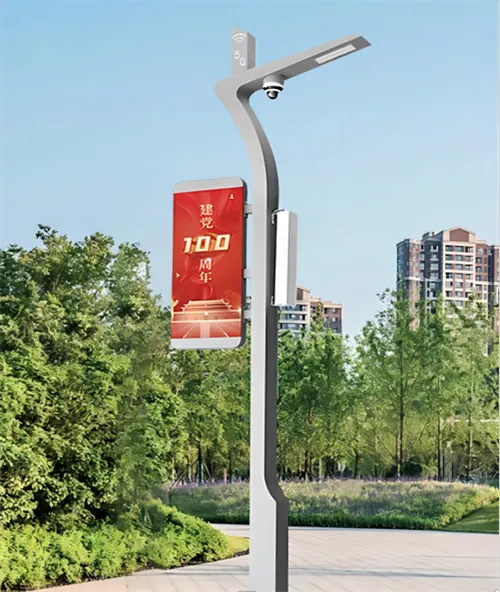
A smart pole carries more than light: CCTV, public Wi-Fi, 4G/5G small cells, LED displays, speakers, emergency call buttons and EV chargers. See our smart poles range.
| Function | Planning points |
|---|---|
| CCTV | Steady poles, power, data backhaul |
| Wi-Fi and small cells | Fibre or wireless backhaul, operator agreements |
| Displays | Power, content management, glare |
| EV charging | Higher power supply, parking layout |
| Emergency call | Link to control room |
Poles must be designed for the added weight, wind area and cable space. Planning power and fibre during road works is far cheaper than adding them later.
Smart solar streetlights
Solar street lights can also be smart: their controllers report battery state, panel charging, faults and energy. On large rural projects this lets operators find failed batteries before residents complain. Remote dimming profiles can be changed by season, which helps in winter. See our solar street light motion sensor guide for adaptive dimming on solar lights.
Planning a project
- Inventory: survey existing lights, poles, circuits and sockets
- Choose luminaires with dimmable drivers and 7-pin or Zhaga sockets
- Choose the network for coverage, cost and ownership
- Choose the CMS with open standards and data export
- Pilot a few hundred lights before city-wide rollout
- Set dimming policy with the road authority
- Train staff and integrate with maintenance processes
Common pitfalls
- Choosing a closed system that cannot accept other vendors’ controllers
- Ignoring cybersecurity: networks need encryption and updates
- No plan for data use; systems are installed but schedules never optimised
- Mixing drivers that do not support the chosen dimming interface
Business case
A city weighing smart controls usually compares three costs over 10–15 years: energy, maintenance and the controllers plus network. Energy savings are easy to calculate from dimming profiles. Maintenance savings come from ending night patrols and sending crews only to failed lights with the right parts. Against these stand the controller price per light, gateways or subscriptions and the CMS licence. Many cities find the payback is shortest on main roads with many lights per kilometre, and longest on scattered rural lights, where solar lights with their own controllers may be a better fit.
Data and privacy
Cameras, Wi-Fi and sensors on poles collect data about people. Cities should decide in advance who owns the data, how long it is kept, and how privacy rules apply. Lighting data itself (switching, energy, faults) is not personal, but it should still be protected.
Our role
We supply LED street lights such as our modular LED street lights with dimmable drivers and control sockets, and smart poles configured to the project. Send us the road classes, number of lights, the network you prefer and the functions you want on the poles.
Sources
Frequently asked questions
What is a smart streetlight?
An LED street light fitted with a controller that connects to a network, so operators can switch it, dim it, set schedules and receive fault and energy reports from a central system instead of patrolling the streets.
How do smart streetlights communicate?
Usually through RF mesh networks where lights relay messages to a gateway, through low-power wide-area networks such as LoRaWAN, or through cellular IoT networks such as NB-IoT and LTE-M. The choice depends on coverage, cost and the number of lights.
How much energy do smart streetlights save?
Compared with LED lights switched by photocells, smart dimming and trimming typically save a further 20–40%. Savings depend on how deeply and how long lights are dimmed at night.