
LED Street Light Dimming and Smart Controls: Schedules, 0–10 V, DALI, NEMA and Zhaga
How LED street lights are dimmed: fixed schedules in the driver, photocells, 0–10 V and DALI interfaces, NEMA and Zhaga sockets for smart controllers, how much energy dimming saves, and how it shrinks solar batteries.
Key points
- The simplest dimming is a schedule built into the driver, for example 100% until midnight and 50% after; no network needed.
- 0–10 V and DALI are control interfaces; NEMA (ANSI C136.41) and Zhaga Book 18 are sockets that accept photocells and smart-city controllers.
- Dimming to 30% for 6.5 of 11.5 hours cuts the energy of a 60 W light from 690 to 417 Wh a night, about 40%.
- On solar lights, dimming shrinks the battery: 1,511 Wh instead of 2,444 Wh for a 60 W light with 3 nights of autonomy.
Converting street lights from sodium to LED already saves 50–65% of the energy. Dimming saves a large share of what is left, and LED drivers make it easy: unlike sodium lamps, LEDs can be dimmed smoothly and instantly without shortening their life. This guide explains the options, from a simple schedule in the driver to a city-wide smart lighting network.
Why dim at all?
Roads are busiest in the evening and nearly empty from midnight to dawn. Lighting standards allow lower classes when traffic is light, and many cities dim by 30–50% after midnight. The benefits:
- Energy and cost: less power for half the night
- LED life: lower current and temperature slow lumen depreciation
- Light pollution: less sky glow and light into homes late at night
- Solar systems: a much smaller battery and panel
How much does it save?
Take a 60 W LED street light on an 11.5-hour night.
- No dimming: 60 W × 11.5 h = 690 Wh a night
- 100% for 5 h, then 30% for 6.5 h: 60 × 5 + 60 × 0.3 × 6.5 = 417 Wh, about 40% less
For a whole retrofit, the savings stack up. Our LED retrofit calculator shows 500 × 150 W sodium street lights (about 173 W each with ballast) replaced by 60 W LED, running 11.5 hours a night at US$0.15/kWh: about 236,000 kWh and US$44,000 saved per year, with a payback of about 19 months, before any dimming. Applying the dimming schedule above to the LED lights saves roughly another 40% of their remaining energy.
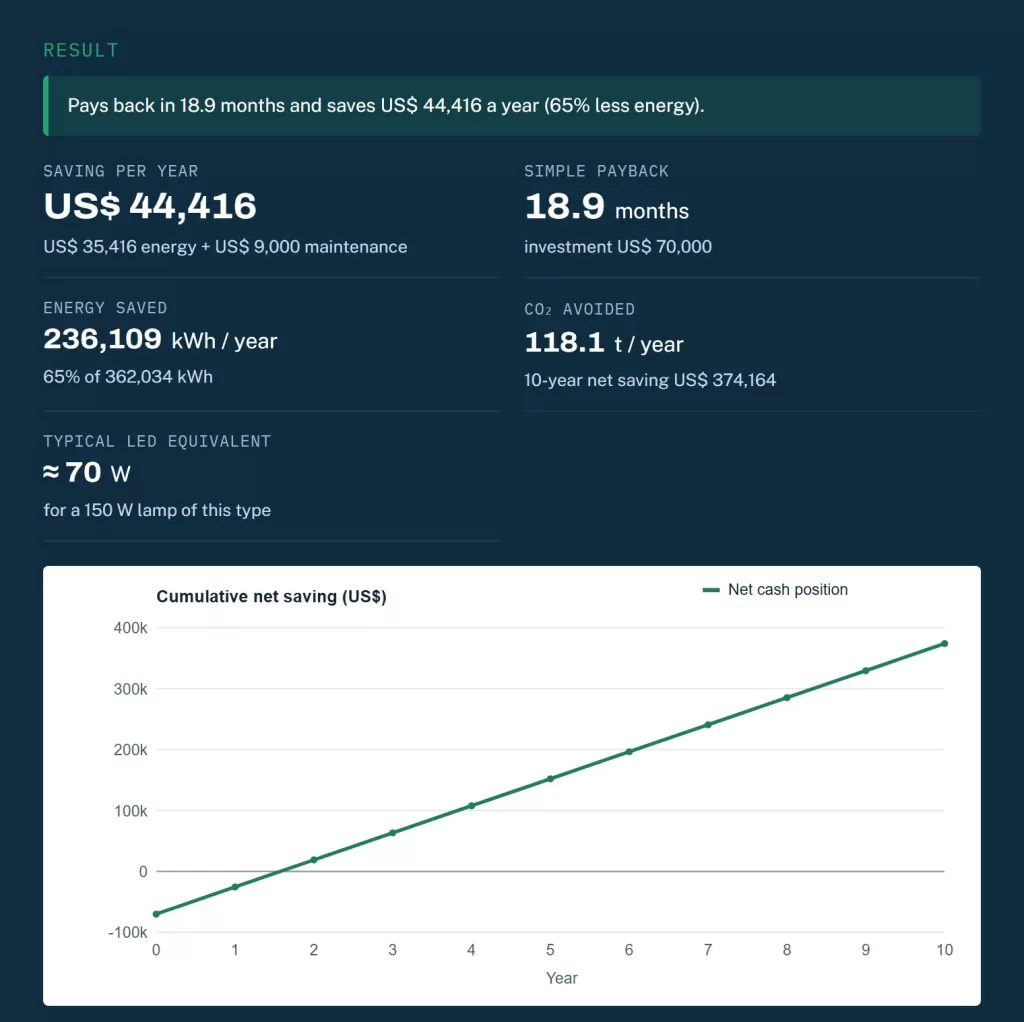
Open this example. To see the effect of dimming, enter the equivalent full-power hours (here 5 + 0.3 × 6.5 ≈ 7 h) as the operating hours.
Option 1: a schedule in the driver
The simplest approach needs no network. A programmable driver stores a dimming profile, for example:
| Time | Output |
|---|---|
| Dusk to midnight (about 5 h) | 100% |
| Midnight to 5:00 | 50% |
| 5:00 to dawn | 70% |
The driver estimates midnight from the switch-on times of previous nights, so it adjusts through the seasons. It is cheap, reliable and suits most retrofits.
Option 2: 0–10 V and DALI interfaces
These are control inputs on the driver:
- 0–10 V (or 1–10 V): an analogue voltage sets the output. Simple and widely supported.
- DALI (and DALI-2 / D4i): a digital bus that sets levels and can report status, energy use and faults back to a controller.
On their own they do nothing; they let a controller in the luminaire or the socket tell the driver what to do.
Option 3: sockets for photocells and smart controllers
Two socket standards let cities plug controllers onto the luminaire:
- NEMA (ANSI C136.41) 7-pin socket: common in the Americas and many export markets; accepts photocells and smart nodes.
- Zhaga Book 18: a smaller socket designed for LED luminaires, widely used in Europe; often with a second socket underneath for sensors.
A smart node in the socket can switch and dim each light remotely, report faults, measure energy, and follow schedules or traffic sensors. Ordering luminaires with a socket and a D4i/DALI driver keeps that option open even if the city starts with simple photocells.
What a central management system adds
Plugging a smart node into each light connects it to a central management system (CMS), usually a web application. Beyond dimming, it gives the road owner:
- Fault reports: each light reports a failed LED, driver or power supply, so crews no longer drive the roads at night looking for dark lamps.
- Energy metering: measured consumption per light, which some utilities accept for billing instead of flat-rate estimates.
- An asset map: every light with its position, type, installation date and history.
- Flexible schedules: different profiles for different roads, events or holidays, changed from the office.
- Sensor and traffic integration: raising the level when traffic or pedestrians are detected, or during rain.
How the nodes communicate
| Technology | Typical use | Notes |
|---|---|---|
| RF mesh (sub-GHz) | City networks owned by the operator | Lights relay messages to each other and a gateway; no SIM fees |
| LoRaWAN | Low data, long range | Gateways cover kilometres; good for simple control and reporting |
| NB-IoT / LTE-M | Cellular, no own gateways | Uses the mobile network; per-node subscription |
| Power line communication | Existing cable networks | Signals travel on the supply cable; no radio, but sensitive to cable quality |
Choose the system first and the luminaires second: the luminaire needs the matching socket (NEMA or Zhaga) and driver interface (D4i/DALI or 0–10 V) for the node the city has chosen.
Practical limits of dimming
- Minimum level: most LED drivers dim smoothly to about 10% of full output; below that, check for flicker or instability.
- 0–10 V vs 1–10 V: with 1–10 V drivers the light does not switch off at the bottom of the range; switching off is done by a relay. Make sure the controller and driver use the same convention.
- Standards: check that the dimmed level still meets the lighting class allowed for that time of night (see road lighting classes).
Dimming on solar street lights
On a solar light, every watt-hour saved at night is a watt-hour the battery does not need to store. In our solar street light calculator, a 60 W light with 3 nights of autonomy and 4 sun hours needs:
| Schedule | Energy per night | Battery | Panel |
|---|---|---|---|
| 100% for 11 h | 733 Wh | 2,444 Wh (191 Ah) | 255 Wp |
| 100% for 5 h, then 30% for 6 h | 453 Wh | 1,511 Wh (118 Ah) | 157 Wp |
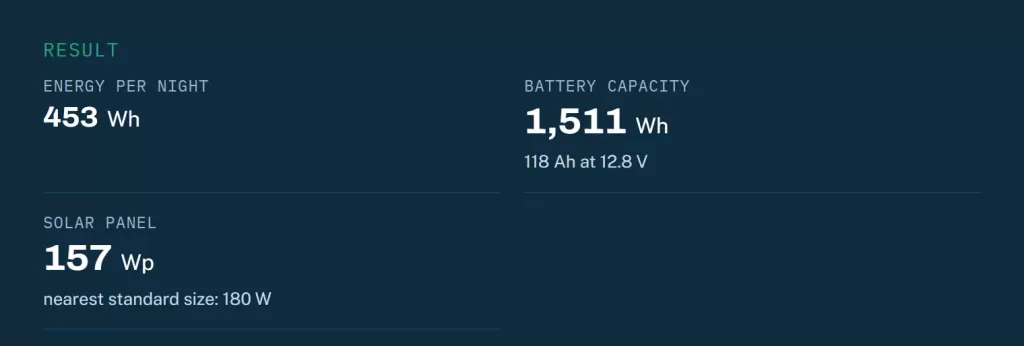
That is about 38% less battery and panel for the same light. Open this example and set the dimmed hours to 0 to compare. With motion sensors, quiet roads can save even more.
What to specify
- Dimmable driver with a programmable schedule (and the schedule you want)
- 0–10 V or DALI/D4i interface if a control system is planned
- NEMA or Zhaga socket, with a photocell or shorting cap to start
- Surge protection that also protects the control circuit
- For solar: controller schedule, motion settings and low-battery dimming
Our modular LED street lights can be supplied with dimming drivers and NEMA or Zhaga sockets on request. Tell us how your road traffic varies through the night and we will propose a schedule.
Sources
Frequently asked questions
Can LED street lights be dimmed?
Yes. LED drivers can reduce output smoothly, either following a schedule stored in the driver or on command from a control system through a 0–10 V or DALI interface. Dimming also reduces heat and extends the life of the LEDs.
What is the difference between NEMA and Zhaga sockets?
Both are standard sockets on top of a street light for plug-in controllers. The NEMA (ANSI C136.41) 7-pin socket is larger and common in the Americas and many export markets; Zhaga Book 18 is smaller, designed for LED luminaires and widely used in Europe. Either lets a city add photocells or smart controllers without opening the luminaire.
How much energy does street light dimming save?
Typically 25–50% on top of the LED retrofit saving, depending on the schedule. A 60 W light dimmed to 30% for 6.5 hours of an 11.5-hour night uses about 40% less energy than running at full power all night.