
Lighting Market Brief, 2 November 2026: Lithium Falls Below RMB 100,000, Battery Export Rebate Ends in Two Months, Freight Eases
Lithium carbonate falls below RMB 100,000/t and 100 Ah LFP cells reach RMB 0.413/Wh, China's battery export VAT rebate ends on 31 December, Drewry's container index falls 3% to US$4,429, Nairobi fits trackers to solar street lights, and Lahore's LDA City moves street lighting to solar.
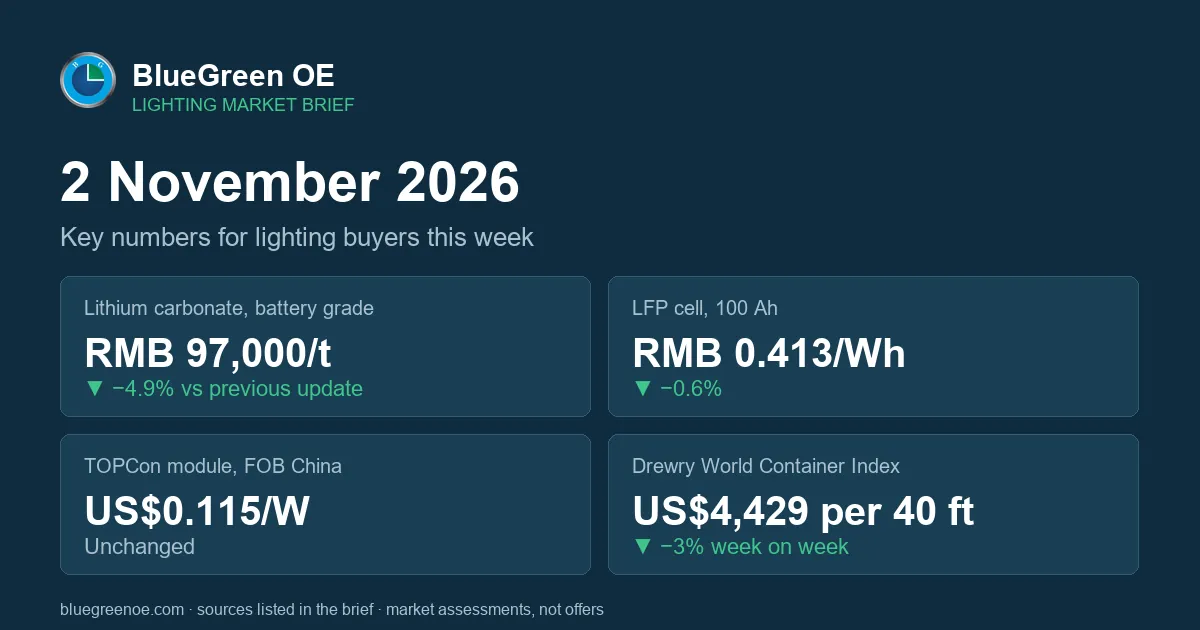
Five things that matter to people who buy road and area lighting this week. Each item covers what happened, why it matters for a lighting project, and where to read more. Sources are listed at the end.
Key numbers this week
| Indicator | Latest | Change | What it affects |
|---|---|---|---|
| Lithium carbonate, battery grade (China, InfoLink) | RMB 97,000/t (28 Oct) | −4.9% vs previous update | Future cell prices |
| LFP cell, 100 Ah (China, InfoLink) | RMB 0.413/Wh (28 Oct) | −0.6% | Battery cost of solar street lights |
| TOPCon module, FOB China (InfoLink) | US$0.115/W (22–28 Oct) | Unchanged | Solar panel cost |
| Drewry World Container Index | US$4,429 per 40 ft (29 Oct) | −3% week on week | Freight cost per shipment |
| Aluminium, benchmark CFD | about US$3,060/t (30 Oct) | About −2% in a month | Luminaire housings and heat sinks |
1. Lithium carbonate falls below RMB 100,000; cell prices barely move
What happened. InfoLink’s assessment of 28 October put battery-grade lithium carbonate at an average of RMB 97,000 per tonne (range RMB 95,000–99,000), down 4.9% in a week. SMM’s average on 29 October was RMB 96,100/t, and the most-traded futures contract closed that day at RMB 88,360/t, down 8.4% on the day. Cells fell far less: 100 Ah LFP cells averaged RMB 0.413/Wh (−0.6%) and 280 Ah and 314 Ah cells RMB 0.355/Wh (−0.7%).
The two sources differ on what comes next. InfoLink expects lithium carbonate to fluctuate around RMB 100,000/t, while SMM says the weak trend is unlikely to reverse soon and expects a range of RMB 80,000–105,000/t for the coming week. Both expect only modest moves in cells: InfoLink sees slight further pressure and thinks steep falls in large cells are unlikely.
Why it matters. Lithium has fallen about 11% in two weeks on InfoLink’s figures (from RMB 109,000/t on 14 October), while 100 Ah cells have fallen only about 2%. Raw material falls reach cells slowly and only in part, so do not expect a 5% lithium drop to take 5% off a battery. Refreshing a September quotation is still worthwhile. Holding an order back in the hope of a much cheaper battery is less so, for the reason in item 2.
Read more: How to calculate solar street light battery capacity · LiFePO4 vs gel batteries · Battery autonomy calculator
2. Two months left on China’s battery export rebate
What happened. This is a dated change rather than this week’s news, but the deadline is now close. Under the announcement issued in January 2026 by China’s Ministry of Finance and State Taxation Administration, the export VAT rebate on battery products fell from 9% to 6% on 1 April 2026 and is abolished from 1 January 2027. The 13% rebate on solar PV products already ended on 1 April 2026. Mysteel estimated in January that losing the rebate would add about RMB 0.03–0.04/Wh to export costs at cell prices of RMB 0.35–0.40/Wh. Benchmark expected buyers might bring purchases forward into the fourth quarter. We found no reports yet that measure such a rush.
Why it matters. Three groups of buyers should check this now:
- Spare or replacement batteries shipped on their own are the most directly exposed.
- Split solar street lights with a separately packed battery may be affected, depending on how the goods are declared.
- Complete all-in-one lights may be classified as luminaires rather than batteries. Ask your supplier how the goods will be classified and whether the quotation changes for shipments in January.
For an order that could ship either side of the new year, agree who carries the change in writing. The rate follows the export date on the Chinese customs declaration, not the order date, so check that date against the production schedule.
Read more: Solar street light battery guide · Our solar street lights · Contact us about a shipping date
3. Container rates turn down after two weeks of rises
What happened. Drewry’s World Container Index fell 3% to US$4,429 per 40 ft container on 29 October, ending a two-week rise. Most of the fall was on the Pacific: Shanghai–Los Angeles fell 6% to US$7,514 and Shanghai–New York 5% to US$9,631. Asia–Europe held up, with Shanghai–Rotterdam up 1% to US$3,686 and Shanghai–Genoa stable at US$4,151. Drewry expects transpacific rates to fall next week and Asia–Europe rates to stay stable, and doubts that higher November rates announced by carriers will hold, given available capacity and weak demand.
Why it matters. Last week’s concern about rising end-of-year freight has eased for now. Drewry does not publish lanes to Africa, the Gulf or South America in this index, so ask for a current rate on your own route. With the January battery date in item 2, it is still sensible to book early: a late sailing can matter more than a small movement in the rate.
Read more: Our factory and production capacity · Contact us for a CIF quotation
4. Nairobi fits trackers to new solar street lights
What happened. Citizen Digital reported on 30 October that Nairobi City County is extending a street lighting programme to all 17 sub-counties. It targets 100,000 lighting points, including new solar street lights and the repair of about 50,000 faulty lights, on highways, residential estates and informal settlements. Crews are at work in Githogoro and along Gitanga Road and Mbagathi Road. The new solar lights carry tracking devices to deter vandalism; Governor Johnson Sakaja said the lights “are of no use to vandals”. The report gives no cost, contractor or number of solar lights.
Why it matters. Together with Juba’s fines for damaging poles, reported last week, this shows East African authorities now treat theft as a design issue, not just a policing one. Buyers writing a specification can ask for a tracker or remote monitoring as a priced option, and should state who pays for the SIM or data service after handover. A tracker does not replace the basics: mount the battery out of reach and use tamper-resistant fasteners.
Read more: How to install a solar street light · Solar street light not working? · Brief of 26 October: Juba’s penalties
5. Lahore’s LDA City moves street lighting to solar, with 200 W lights
What happened. ProPakistani reported on 29 October that the Lahore Development Authority’s governing body approved funding for solar street lights in the Jinnah Sector of LDA City, on new poles with 200 W LED lights. The authority plans to move all street lighting in the housing project to solar to cut electricity costs, after assessing the performance of earlier solar installations. The report gives no quantity, cost or timetable.
Why it matters. 200 W is a very large solar street light, and Lahore’s winter is the hard case. If the lights really drew 200 W, we can size them with PVGIS data (January on a flat panel, 3.28 peak sun hours) and our solar street light calculator. With 5 hours at full power, 7 hours at 30% and 3 nights of autonomy, one light needs about 1,580 Wh a night, a 5,260 Wh battery and a 700 Wp flat panel, or about 450 Wp tilted at 30°. That is a large load on one pole.
Many “200 W” solar lights on the market do not draw anything like their label, so buyers should ask for the real power in watts, the battery in Wh and the panel in Wp. For most housing society streets, a true 40–60 W at 7–9 m is enough: 60 W with the same schedule needs about 130 Wp when tilted at 30°. Check the road first, then size the system.
Read more: How many watts does an LED street light need? · Solar street light pole height and spacing · Solar street light calculator
The market brief is compiled by the BlueGreen OE team from the public sources listed below. Prices are market assessments, not offers. Send us your project details for a current quotation.
Sources
- InfoLink — ESS spot price update (28 Oct 2026)
- SMM — Lithium carbonate prices fell sharply this week, with the pace of inventory destocking slowing (29 Oct 2026)
- InfoLink — PV spot price (22–28 Oct 2026)
- Mysteel — China's phase-out of export tax rebates on batteries (12 Jan 2026)
- Benchmark Source — How will China's VAT rebate changes affect the battery market?
- Zeroline — China battery export tax rebate ends 1 Jan 2027: what buyers do
- Drewry — World Container Index (29 Oct 2026)
- Citizen Digital — Nairobi County rolls out solar streetlights in 17 sub-counties to boost security (30 Oct 2026)
- ProPakistani — LDA to shift all streetlights to solar power (29 Oct 2026)
- Trading Economics — Aluminium (30 Oct 2026)
Frequently asked questions
What is the price of lithium carbonate and LFP cells in early November 2026?
InfoLink's 28 October 2026 assessment put battery-grade lithium carbonate at about RMB 97,000/t, down 4.9%, with 100 Ah LFP cells at about RMB 0.413/Wh (−0.6%) and 280/314 Ah cells at about RMB 0.355/Wh (−0.7%). SMM's average on 29 October was RMB 96,100/t, and the main futures contract closed at RMB 88,360/t.
When does China's battery export VAT rebate end?
Under the announcement of January 2026, the rebate for battery products fell from 9% to 6% on 1 April 2026 and is abolished from 1 January 2027. The rebate on solar PV products ended on 1 April 2026. Whether a given lighting order is affected depends on how the goods are classified at customs, so ask the supplier.