
How Long Do Solar Street Lights Last? Battery, LED, Panel and Pole Lifespans
How many years a solar street light lasts, component by component: LED module, LiFePO4 and gel batteries, solar panel, controller and pole, what shortens their life in hot and rainy climates, and how to make a system last longer.
Key points
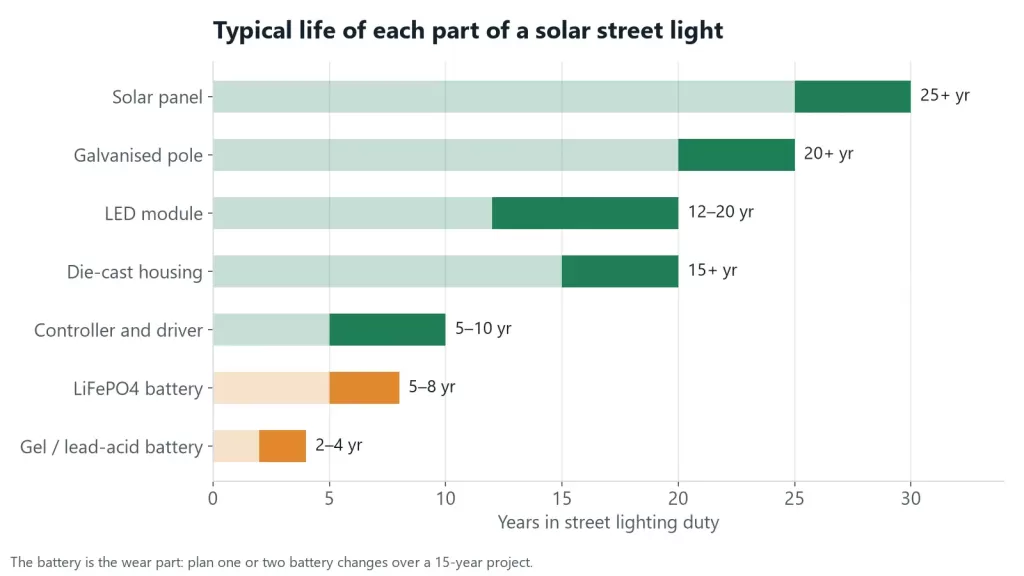
- The LED head, panel and pole last 15 years or more; the battery is the wear part.
- Quality LiFePO4 batteries last about 5–8 years in street lighting, gel batteries 2–4 years.
- Depth of discharge, heat and cell quality decide battery life.
- Size for the rainy season, dim after midnight and order replaceable battery packs.
“How long will it last?” is the right question to ask about a solar street light, because the answer decides whether it is a 3-year purchase or a 15-year asset. The honest answer is that a solar street light is several components with very different lifespans, and one of them, the battery, sets the maintenance plan.
Lifespan by component
| Component | Typical life in street lighting duty | What limits it |
|---|---|---|
| LED module | 50,000–100,000 h (about 12–20 years at 4,000 h a year) | Heat; quality of LEDs and solder joints |
| LiFePO4 battery | About 5–8 years | Depth of discharge, temperature, cell quality |
| Gel / lead-acid battery | About 2–4 years | Deep discharge, heat, sulphation |
| Solar panel | 25 years or more, losing roughly 0.5–0.8% output a year | Hail, cracked glass, dirt |
| Charge controller and driver | 5–10 years or more | Heat, moisture, lightning surges |
| Galvanised steel pole | 20 years or more | Coating thickness, coastal salt |
| Housing (die-cast aluminium) | 15 years or more | Seal ageing, corrosion at fixings |
So for a 15-year project, plan for the LED head, panel and pole to last the whole time, and budget for one or two battery replacements.
Why batteries wear out, and how to slow it down
A solar street light battery goes through roughly one charge cycle every day, around 365 a year. Three things decide how many years that lasts:
- Depth of discharge. A battery that is emptied to 90% every night ages much faster than one that only uses 30–50% on a normal night and saves its reserve for cloudy days. Sizing the battery for several days of autonomy therefore also extends its life.
- Temperature. Heat is the main enemy. A battery in a dark housing under a tropical sun can exceed 60 °C; each 10 °C of extra heat speeds up ageing considerably. Good designs shade the battery, ventilate the compartment, or put it in the pole or a buried box.
- Cell quality and battery management. Grade-A LiFePO4 cells with a battery management system that balances the cells and prevents over-charge and over-discharge last far longer than recycled or grade-B cells.
The arithmetic of depth of discharge
Take a 40 W light that uses about 316 Wh a night (5 hours at 100%, 7 hours at 30%). On a normal sunny-season night, the share of a 12.8 V battery it uses depends on the battery size:
| Battery | Stored energy | Used on a normal night | Comment |
|---|---|---|---|
| 60 Ah | 768 Wh | about 41% | Deep daily cycling, little reserve |
| 100 Ah | 1,280 Wh | about 25% | Shallow cycling, about 4 nights of reserve |
| 150 Ah | 1,920 Wh | about 16% | Very shallow; long life, long autonomy |
LiFePO4 cycle life is usually quoted at a fixed depth (for example 2,000 cycles at 80%), and it is generally much higher at shallow depths. So a battery that is a little larger than the minimum not only covers more rainy days, it also ages more slowly, and the extra capacity partly pays for itself in a later replacement date. Ask your supplier for the cycle-life curve of the cells at different depths of discharge.
That is why we recommend LiFePO4 over gel for almost every climate: it tolerates deeper daily use and heat better, and lasts two to three times longer.
LEDs: what L70 and L80 really mean
LED life is not the time until the light goes out; it is the time until the output falls to a stated share of the original. L70 means 70% of the initial lumens remain; L80, 80%. Two things to check in a datasheet claim such as “L70 > 100,000 h”:
- It should come from LM-80 test data and a TM-21 projection. LM-80 measures LED packages for thousands of hours; TM-21 extrapolates the trend. TM-21 limits the projection to six times the test duration, so 10,000 hours of LM-80 data supports a reported figure of at most about 60,000 hours. Bigger numbers are marked as “calculated” rather than “reported”.
- It applies at a stated temperature and current. An LED run hotter than in the test, for example in a sealed solar housing in the tropics, will age faster.
For a solar street light, the LED is rarely the limiting part: at about 4,000 hours a year and with dimming after midnight, a well-cooled LED module outlasts several batteries.
Panels and poles over 15 years
Panels. Crystalline panels typically lose about 0.5–0.8% of output a year. After 15 years at 0.5% a year, a panel delivers about 93% of its original power; at 0.8%, about 89%. That is one reason to choose a panel with some margin over the calculated minimum. Cracked glass from hail or stones and permanent dirt are bigger risks than ageing.
Poles. Hot-dip galvanising to ISO 1461 gives a minimum average zinc coating of 85 µm on steel thicker than 6 mm. Zinc wears away slowly and evenly; in a normal inland climate that coating lasts for decades, but on coastal and industrial sites it wears faster. A powder coat over the galvanising (a “duplex” system) extends life considerably in harsh environments.
Signs a battery is reaching the end of its life
- The light runs normally after sunny days but goes out early after one cloudy day
- The light dims early in the night on its low-battery setting
- The controller reports low capacity, if it has remote monitoring
Battery capacity fades gradually. A system sized with margin keeps working even at 70–80% of its original capacity, which is another reason to size for the rainy season rather than for the average day. Check how many rainy days a system covers with our battery autonomy calculator.
How to make a solar street light last longer
- Size it properly: enough panel for the worst month and enough battery for the longest rainy spell
- Dim after midnight: smaller nightly discharge, longer battery life
- Keep the panel clean in dusty areas; dirt reduces charging and pushes the battery deeper every night
- Specify replaceable, standard battery packs and order spares with the project
- Check seals and fixings at the first maintenance visit after installation
- Protect against theft: anti-theft bolts and tamper-proof battery compartments
Planning battery replacement
On a project of hundreds of lights, battery replacement is a maintenance programme, not a repair. A few habits make it cheap and predictable:
- Record the installation date and battery batch of every light, so replacements can be planned by area rather than by complaint.
- Use the controller data. Many controllers log daily charge and discharge; a battery that reaches full charge noticeably faster than in its first year has lost capacity.
- Replace by area, not light by light. One truck visit for a whole street is much cheaper than many single call-outs.
- Order spare packs with the original project, from the same supplier and cell type, so replacements fit the housing and the controller settings.
- Recycle the old batteries through a licensed collector; lithium and lead-acid batteries must not go to landfill.
What our datasheets state
Our catalog states a design life of 5 years for the integrated (all-in-one) system with a lithium battery and 3 years for the split system with a standard lead-acid battery. In practice these figures are set by the battery: the LED heads, panels and galvanised poles are designed for much longer service, and a battery change restores the system. See our solar street lights or ask us to size a system for your site.
Sources
Frequently asked questions
How long do solar street light batteries last?
A good LiFePO4 battery typically lasts about 5–8 years in street lighting duty, and a gel or lead-acid battery about 2–4 years. Battery life depends mostly on depth of discharge, temperature and cell quality, which is why a correctly sized battery lasts longer than an undersized one of the same chemistry.
How many years does a solar street light last?
The light as a whole lasts 10–15 years or more, provided the battery is replaced when it wears out. The LED module, housing, panel and pole outlast the battery, so a solar street light is best thought of as a long-life fitting with one replaceable wear part.
Can you replace the battery in an all-in-one solar street light?
In most designs, yes: the battery sits in a compartment in the housing and can be exchanged on the pole or after taking the head down. Ask for the battery to be a standard, replaceable pack, and for spare packs with the order.
Do solar street lights stop working after a few years?
Cheap ones often do, usually because an undersized battery is deeply discharged every night, or because it cooks inside a hot housing. Well-sized systems with quality LiFePO4 cells and good thermal design keep working for many years, with gradually shorter autonomy as the battery ages.