
Solar Light Poles: Heights, Wind Load, Panel Mounting and Foundations
How to choose a solar energy light pole: heights from 4 to 12 m, why solar poles need more strength, panel brackets and tilt, battery placement, anti-theft details, foundations and galvanising.
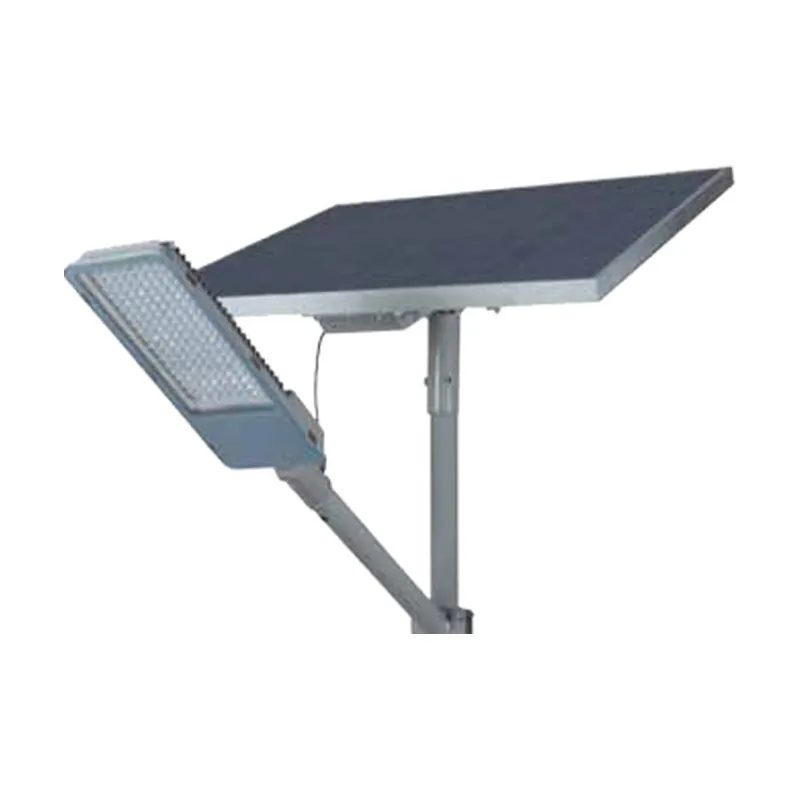
Key points
- Solar light poles carry a panel as well as the light, so they must be designed for much more wind area than a normal street light pole.
- Typical heights: 4–6 m for estates and paths, 6–9 m for village and secondary roads, 9–12 m for main roads and car parks.
- The panel bracket must allow the right tilt and orientation for the site's latitude, and must not shade the panel.
- Hot-dip galvanising, anti-theft bolts and a foundation designed for local wind keep solar poles working for decades.
A solar street light is only as reliable as the pole under it. The pole carries a panel that acts like a sail, a light head and sometimes a battery box, often on sites with strong wind and little maintenance. Most structural failures and many thefts of solar lights trace back to poles and brackets chosen as an afterthought.
Pole heights
| Site | Typical height | Typical solar light |
|---|---|---|
| Garden paths, parks | 3–4 m | Solar post-top, 10–20 W |
| Residential estates | 4–6 m | All-in-one, 15–40 W |
| Village and secondary roads | 6–9 m | All-in-one or split, 30–60 W |
| Main roads, car parks | 9–12 m | Split system, 60–120 W |
For spacing at each height, see solar street light pole height and spacing, or check a layout with the pole height and spacing calculator.
Why solar poles need more strength
A normal street light head has a small projected area. A solar pole adds a panel of 0.5–1.5 m² or more, mounted high where the wind is strongest. Wind force grows with the square of the speed, so a pole fine in a sheltered town can bend in a coastal storm.
Design inputs:
- Design wind speed from local code (for example 30–45 m/s in many cyclone regions)
- Panel area and height on the pole
- Light head, arm and battery box areas and weights
- Terrain: open land, coast, or sheltered urban
- Safety factor required by the client or code
Typical steel pole wall thickness ranges from about 3 to 5 mm, with larger base diameters for solar versions than for grid poles of the same height.
Pole shapes and materials
| Round taper | Octagonal | Straight tube | |
|---|---|---|---|
| Strength per weight | Good | Very good | Lower |
| Look | Smooth, modern | Traditional road pole | Simple |
| Typical use | Estates, roads | Main roads, higher poles | Short poles, paths |
Hot-dip galvanising (commonly to ISO 1461 or equivalent) is standard; a powder coat on top adds colour and extra corrosion protection.
Panel brackets and tilt
- Tilt: roughly equal to the site latitude, with a minimum of about 10–15° so rain washes the panel. Near the equator, 10–15°.
- Orientation: facing the equator: south in the northern hemisphere, north in the southern.
- Shade: the panel must sit above the light head and clear of trees and buildings.
- Adjustable brackets let installers set the tilt and azimuth on site.
All-in-one lights have the panel in the head, so the head angle and arm length decide both light distribution and panel orientation. Split systems with a separate panel give more freedom.
Battery placement
| Position | Pros | Cons |
|---|---|---|
| In the light head (all-in-one) | Simple, hard to reach | Hotter in sun; size limited |
| Box on the pole, 3–4 m up | Easy to service, harder to steal | Exposed to sun and heat |
| Inside the pole base | Hidden | Hot, hard to service, flood risk |
| Buried battery pit | Cool, hidden | Flood risk, needs drainage and sealed box |
Our split solar street light suits higher poles and larger panels; the all-in-one SL series suits 3–8 m poles where simplicity matters most.
Anti-theft details
Solar panels and batteries are valuable. Poles can help:
- Anti-theft (security-head) bolts on panels, battery boxes and heads
- Battery boxes high on the pole rather than at hand height
- Welded rather than clamped brackets on high-risk sites
- No climbing aids near the base
- Marking components with the project name
Foundations
Solar poles usually stand on a base plate and anchor bolts in a concrete footing:
| Pole height | Typical footing (guide only) |
|---|---|
| 4–6 m | about 0.4–0.5 m square, 0.8–1.0 m deep |
| 6–8 m | about 0.5–0.7 m square, 1.0–1.5 m deep |
| 9–12 m | about 0.7–1.0 m square, 1.5–2.2 m deep |
These are rough sizes for normal soils and moderate wind. The final design must be checked by a local engineer for the soil and design wind speed. Our solar street light installation guide covers casting, curing and erecting.
Arms and light distribution
- Arm length sets how far the light head reaches over the road
- Arm angle (often 5–15°) tilts the head; too much increases glare
- Double arms carry two heads for dual carriageways or a central median
Grid poles converted to solar
Existing poles can sometimes take solar heads, but check:
- Strength for the added panel area
- Corrosion at the base
- Spigot size for the new head
- Shade from trees that grew since the poles were installed
Coastal and cyclone sites
Near the sea, salt spray attacks thin galvanising within a few years. Specify a heavier zinc coating plus a powder coat, stainless steel fixings, and sealed battery boxes. In cyclone regions, the panel bracket is often the weak point: use through-bolted brackets and check that the panel frame itself is rated for the wind.
Ordering
For each project we need the road or site layout, the light level or class, the design wind speed, the location (for panel tilt and sun hours) and any theft concerns. We supply poles, arms, panel brackets and anchor bolts matched to the light, with drawings for the foundation designer.
Sources
Frequently asked questions
How tall is a solar street light pole?
Usually 4–6 m for residential estates and paths, 6–9 m for village and secondary roads and 9–12 m for main roads and large car parks. The height is chosen with the road width and the fixture's light distribution.
Do solar light poles need a special foundation?
They need a foundation designed for the wind load, which is higher than for a normal street light because of the panel. Typical concrete footings for 6–8 m solar poles are around 0.5–0.7 m square and 1.0–1.5 m deep, but the design must suit the local soil and wind speed.
Where is the battery on a solar light pole?
On all-in-one lights, inside the light head. On split systems, in a box on the pole, in the pole base, or buried in a battery pit beside the pole. Placing it higher or underground reduces theft and keeps it cooler.