
Parking Lot Light Repair: Troubleshooting Poles, Fixtures and Controls
How to troubleshoot parking lot and area lights: lights out, cycling, on in daytime, dim heads, tripping circuits, pole damage, and when to repair, retrofit or replace with LED.
Key points
- Most parking lot light faults come from four places: the photocell or timer, the lamp or LED driver, the cable and connections, and the pole or base.
- Old HID lights that cycle on and off usually have a failing lamp; LED heads that flicker or stay dark usually have a failing driver or surge damage.
- Check controls first: a failed photocell or a timer reset after a power cut accounts for many 'all lights out' and 'on all day' calls.
- When several old HID heads fail, a retrofit to LED usually costs less over five years than repeated lamp and ballast repairs.
Parking lot lights are out of reach, run every night and are often forgotten until someone complains. When they fail, a systematic check finds the cause faster than replacing parts at random, and saves lift-truck hire, which is often the most expensive part of any repair.
Start with the pattern
| What you see | Most likely area |
|---|---|
| All lights on a circuit out | Breaker, contactor, timer or photocell |
| Lights on during the day | Photocell failed on, timer wrong, contactor stuck |
| One light out | Lamp, driver, connection in head or pole |
| Light cycles on and off | End-of-life HID lamp, photocell seeing own light, failing driver |
| Light dim or pink/orange | Old HID lamp, failing ballast |
| LED flickers | Driver fault, loose neutral, surge damage |
| Breaker trips in rain | Water in a pole base, cable damage, failed fixture |
| Pole leaning or rusted | Structural: make safe immediately |
1. Controls
Check these first; they are at ground level.
- Breaker: reset once; if it trips again, there is a fault to find
- Contactor: listen for it closing at dusk; check the coil and contacts
- Timer: many timers lose their settings after a power cut; check time and date
- Photocell: cover it in daytime with something dark; the lights should come on after the delay
Many photocells are designed to fail on, so lights burning all day often point to the photocell. Where lights are being upgraded, smart controllers in the same socket can replace photocells; see LED street light dimming controls.
2. Supply at the pole
At the hand-hole in the pole base:
- Measure the voltage on the supply cable
- Inspect connections for corrosion, water and burnt marks
- Check the fuse or breaker in the pole if fitted
- Check earth continuity
Water in the pole base, especially in low-lying lots, is a frequent cause of tripping. Use sealed connectors and fill the base with drainage gravel where possible.
3. The head
Old metal halide and sodium (HID) heads
- Lamp: the most common failure; cycling is the classic end-of-life symptom
- Ignitor: lamp does not start, no flicker at all
- Ballast: hum, overheating, dim light
- Capacitor: low light or tripping
LED heads
- Driver: the most common failure; often after storms or power surges
- Surge protector: some heads have a replaceable surge module that sacrifices itself
- LED module: rare, but water ingress can damage it
- Connector: check for corrosion
4. Cable
Buried cable can be cut by digging, crushed under paving, or degraded by water in damaged conduit. Signs: several lights out beyond a certain point, or tripping that gets worse in wet weather. An insulation resistance test between conductors and earth shows whether a cable section is damaged.
5. Pole and base
- Rust at the base, especially where the pole meets the base plate
- Loose or corroded anchor bolts
- Cracks in the concrete footing
- Damage from vehicles
- Leaning poles
A pole that leans or has heavy corrosion at the base must be made safe before anything else. Our parking lot light pole guide covers pole design, foundations and when poles can be reused.
Repair, retrofit or replace?
| Situation | Usually best |
|---|---|
| One HID lamp failed in an otherwise healthy system | Replace the lamp, plan an LED upgrade |
| Several HID heads failing, ballasts ageing | Replace heads with LED in one visit |
| LED head failed under warranty | Claim warranty; replace driver or head |
| Poles corroded or damaged | Replace poles; use LED heads on new poles |
| Cable faults across the site | Repair cable, or consider solar heads for isolated poles |
Old HID heads also use two to three times the energy of LED. If the lift truck is already on site, swapping the head saves the next call-out. Check payback with the LED retrofit savings calculator, and see the HPS to LED conversion chart for replacement sizes.
Choosing LED replacement heads
- Wattage: 100–150 W LED for typical 250–400 W metal halide heads on 8–9 m poles
- Optic: type III or IV for perimeter poles, type V or wide for centre poles
- Mounting: slip-fitter or adapter for the existing arm or spigot
- Surge protection: 10 kV for exposed sites
- Photocell socket if the system uses individual photocells
- Colour temperature: 3000K or 4000K
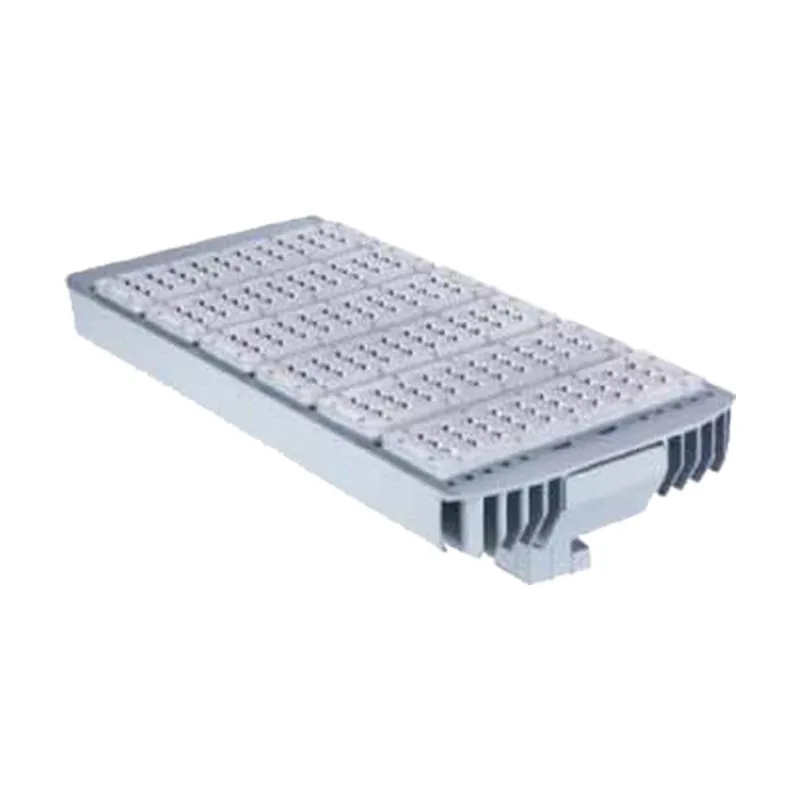
Our modular LED street lights are often used as replacement heads on car park poles, with modules chosen for the pole height.
Safety
- Isolate and lock off the circuit before opening any pole or head
- Use qualified electricians and suitable access equipment
- Mark the work area to keep vehicles away
- Treat leaning or damaged poles as an immediate hazard
Preventive maintenance
- Night patrols monthly to spot outages
- Clean lenses and check aiming every year or two
- Check pole bases and bolts yearly
- Keep spare drivers, photocells and surge modules
- Record each repair to spot repeat problems
Keeping records
A simple log of each pole saves time on every call: pole number, head model, install date, lamp or driver changes and problems found. Over a year it shows which circuits trip, which heads fail repeatedly and where an upgrade would pay back fastest.
Ordering replacement heads
Send photos of the existing heads and arms, pole heights, the lamp wattage, and the number of poles. We will propose LED heads, adapters and photocell options.
Sources
Frequently asked questions
Why are my parking lot lights not working?
If all lights on a circuit are out, check the breaker, contactor, timer and photocell first. If single lights are out, the cause is usually the lamp or driver, a loose connection in the head or pole, or cable damage.
Why do parking lot lights turn on and off?
Old metal halide and sodium lamps cycle at the end of their life as they overheat and restart. A photocell that sees its own light, or a failing driver in an LED head, can also cause cycling.
How much does parking lot light repair cost?
It depends on access (lift truck hire is often the largest cost), the parts and local labour. Replacing an old HID head with an LED head at the same visit often costs only a little more than a lamp and ballast and avoids repeat visits.