
Flag Pole Lights: Solar and Wired Options, Beam Angles and Mounting
How to light a flag at night: solar top-mounted lights vs ground spotlights, lumens and beam angles by pole height, mounting, and what lasts for homes, schools and offices.
Key points
- Flags flown at night are usually lit, and flag etiquette in many countries asks for it; the light must reach the whole flag as it moves.
- Two approaches: a light mounted on top of the pole shining down, or spotlights on the ground shining up.
- Ground spotlights need narrow beams for tall poles: about 10–25° for 9–15 m poles, 25–40° for 6 m home poles.
- Solar top-mount lights suit home poles; for schools, offices and civic poles, wired spotlights or larger solar floodlights give more light.
A flag left in the dark at night looks forgotten, and in many countries flag etiquette asks for it to be lit if it flies after sunset. Lighting a flag is a small project, but it has its own challenges: the target moves, the pole may be tall, and the light should not glare at drivers or neighbours.
Two ways to light a flag
| Top-mounted downlight | Ground spotlights | |
|---|---|---|
| Position | On the pole top, below the finial | On the ground around the pole |
| Direction | Down along the flag | Up at the flag |
| Typical power | Solar 1–5 W, wired 10–30 W | 10–200 W per spotlight |
| Best for | Home poles, 5–8 m | All heights, schools, offices, civic poles |
| Pros | One fitting, no cable for solar | Lots of light, easy to aim and service |
| Cons | Limited output, flag can wrap over it | Needs cable or a separate solar panel; must avoid glare |
Lumens by pole height
| Pole height | Typical light needed |
|---|---|
| 5–6 m (15–20 ft) home pole | 1,000–3,000 lm |
| 7.5–9 m (25–30 ft) | 3,000–6,000 lm |
| 12 m (40 ft) | 6,000–10,000 lm |
| 15–24 m (50–80 ft) civic pole | 10,000–30,000 lm or more |
Darker surroundings need less; flags in front of brightly lit buildings or busy roads need more to stand out.
Beam angle matters most
A wide floodlight at the base of a tall pole spills most of its light into the sky and the surroundings. A narrow beam puts it on the flag:
| Pole height | Typical beam for ground spotlights |
|---|---|
| 5–6 m | 25–40° |
| 9 m | 15–25° |
| 12–15 m | 10–20° |
| 20 m and above | 8–15°, several fittings |
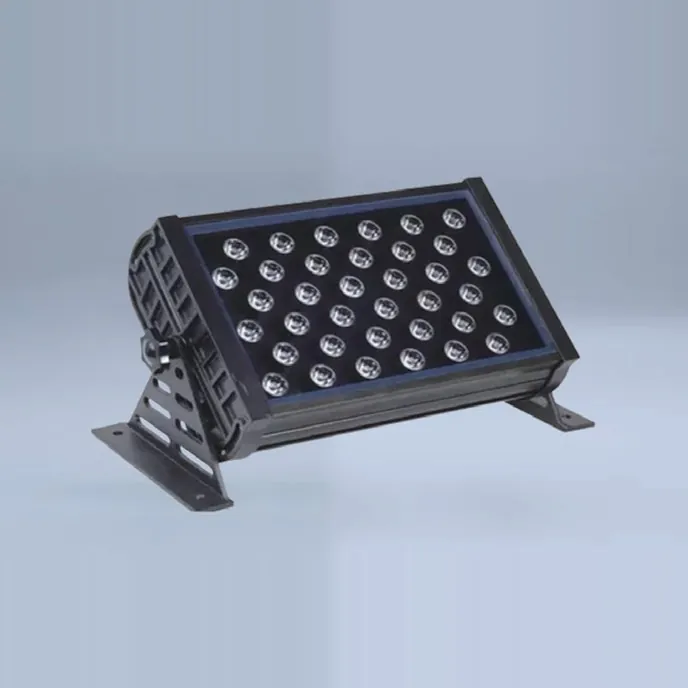
Our landscape spotlights come with 15° to 120° optics in 30–200 W, with an angle scale on the bracket for aiming. For larger civic flags, a narrow-beam slim floodlight can also be used.
How many spotlights
- One spotlight works when the wind is mostly from one direction, so the flag usually flies on one side
- Two spotlights on opposite sides cover the flag whichever way it flies
- Three spotlights at 120° spacing give the most even result for large flags
Place spotlights about 1–3 m from the base, depending on height and beam. The closer the spotlight, the steeper the aim and the less glare for people walking by.
Solar flag pole lights
Top-mounted solar lights clamp to the top of the pole under the finial and shine down. They:
- Need no cable, so they suit existing home poles
- Typically give a few hundred lumens, enough for flags up to about 1 × 1.5 m on 6 m poles
- Depend on the panel getting sun at the top of the pole, which is usually easy
- Must fit the pole diameter and the halyard arrangement
For larger flags, a ground-mounted solar floodlight with a separate panel gives more light. Our solar flood lights list the real panel watts and battery watt-hours, so you can check runtime. A narrow-beam head aimed up the pole works better than a wide one.
Wired spotlights
For schools, offices, hotels and government buildings:
- Run a cable to the base in conduit, often alongside existing landscape lighting
- Use IP65 or better spotlights with tempered glass
- Use a photocell or timer to switch at dusk and dawn
- Choose 3000K or 4000K with good colour rendering (Ra 80+) so the colours of the flag look right
- Use glare shields or louvres if people walk near the spotlights
Colour and colour rendering
Flags are bright, saturated colours. Light with poor colour rendering makes red look brown and blue look grey. Choose LEDs with Ra 80 or higher. Cool white (4000–5000K) makes white and blue crisp; warm white (3000K) flatters red and gold but can make white look cream.
Mounting and aiming
- Mount ground spotlights on a concrete base or a sturdy stake; flags pull poles and wind shakes fittings
- Aim at night, with the flag flying, from the main viewing direction
- Make sure the beam reaches the top of the flag at the highest position
- Check for glare from the road, paths and windows
- Lock the aiming screws
For a clean look, in-ground uplights at the base hide the fitting entirely. Our in-ground uplights come with 15°, 25° and 60° beams; check drainage before burying them.
Flags at schools, offices and civic buildings
Several flags on a row of poles look best with matching spotlights at equal distances and angles. For very tall civic poles, put fittings on a small mast nearby rather than on the ground, so the beam reaches the top without blinding pedestrians. Light the building facade behind separately, a little dimmer than the flags.
Maintenance
- Clean lenses and solar panels once or twice a year
- Re-aim after storms and lawn works
- Check that halyards and flag clips do not shade top-mounted lights
- Replace solar batteries when runtime falls, usually after a few years
Ordering
Send pole heights, flag sizes, the number of poles and whether there is power at the base. We will suggest spotlights, beams and solar or wired options.
Sources
Frequently asked questions
What is the best light for a flag pole?
For tall poles at offices, schools and public buildings, one to three narrow-beam LED spotlights on the ground, aimed up at the flag. For home poles of 6–8 m, a solar light mounted on top of the pole or one or two ground spotlights work well.
How many lumens do I need for a flag pole light?
Roughly 1,000–3,000 lumens for a 6 m (20 ft) home pole, 3,000–6,000 lumens for 9 m (30 ft) poles and 6,000–15,000 lumens or more for 12–24 m poles, depending on the beam and the surroundings.
Do solar flag pole lights work?
Yes, for small and medium poles, if the panel gets direct sun. Top-mounted solar lights shine down along the pole and light the flag well when it hangs close. Their output is limited by the panel and battery, so tall poles usually need wired or larger solar floodlights.