
LED Flood Light Wattage Guide: 50 W to 1000 W, and What Each Replaces
Which LED flood light wattage for yards, car parks, facades, sports courts and high masts; metal halide and halogen equivalents; beam angle and mounting height; and a 400 W metal halide retrofit worked through in our savings calculator.
Key points
- Choose flood light wattage from the area, mounting height and lux target; then pick the beam that puts the light on the target.
- Typical metal halide equivalents: 100–150 W LED replaces 250 W MH, 150–200 W replaces 400 W, 300–400 W replaces 1000 W.
- In our example, 20 × 400 W metal halide floodlights replaced by 150 W LED save about 26,000 kWh and US$4,700 a year and pay back in about 10 months.
- Narrow beams for high mounting and long throws, wide beams for low mounting and close areas.
“Flood light” covers everything from a 30 W security light on a garage wall to a 1500 W fixture on a 40 m mast. Choosing the wattage means answering three questions: how big is the area, how high is the light, and how much light does the task need. Then the beam angle decides whether that light lands where you want it.
Wattage by application
| Application | Mounting height | Typical LED wattage | Typical beam |
|---|---|---|---|
| Building entrance, small yard | 3–5 m | 30–50 W | 90°–120° |
| Loading bay, workshop yard | 6–8 m | 100–150 W | 60°–120° |
| Car park, logistics yard | 8–12 m | 150–300 W | 60°–90° asymmetric |
| Building facade, billboard | Ground or 1–3 m away | 50–200 W | 15°–60° |
| Tennis, basketball courts | 8–10 m | 150–300 W per pole | Asymmetric |
| Football fields | 18–25 m | 500–1000 W | 25°–60° |
| High masts, ports | 25–40 m | 400–1000 W | 15°–40° |
Replacing metal halide and halogen
Old floodlights are rated by lamp wattage, but draw more from the grid and lose much of their light in the reflector. Typical LED equivalents at 120–140 lm/W:
| Existing lamp | Grid draw with gear | LED replacement |
|---|---|---|
| 500 W halogen | 500 W | 50–80 W |
| 250 W metal halide | ~280 W | 100–150 W |
| 400 W metal halide | ~450 W | 150–200 W |
| 1000 W metal halide | ~1,100 W | 300–400 W |
| 2000 W metal halide | ~2,150 W | 600–1000 W |
These are starting points: aiming, beam angle and the condition of the old lamps all change the result.
Worked example: a yard with 400 W metal halide floodlights
A logistics yard has 20 floodlights with 400 W metal halide lamps (about 448 W each with a magnetic ballast), running 12 hours a night. Relamping and maintenance cost about US$40 per fixture a year. They are replaced with 150 W LED floodlights at US$150 each plus US$40 installation. Electricity costs US$0.15/kWh.
Our LED retrofit savings calculator gives:
- Energy: 39,245 kWh a year before, 13,140 kWh after, a saving of 26,105 kWh (67%)
- Money: about US$3,916 in energy plus US$740 in maintenance, US$4,656 a year
- Investment US$3,800, payback about 10 months
- About 13 tonnes of CO₂ avoided per year at 0.5 kg/kWh
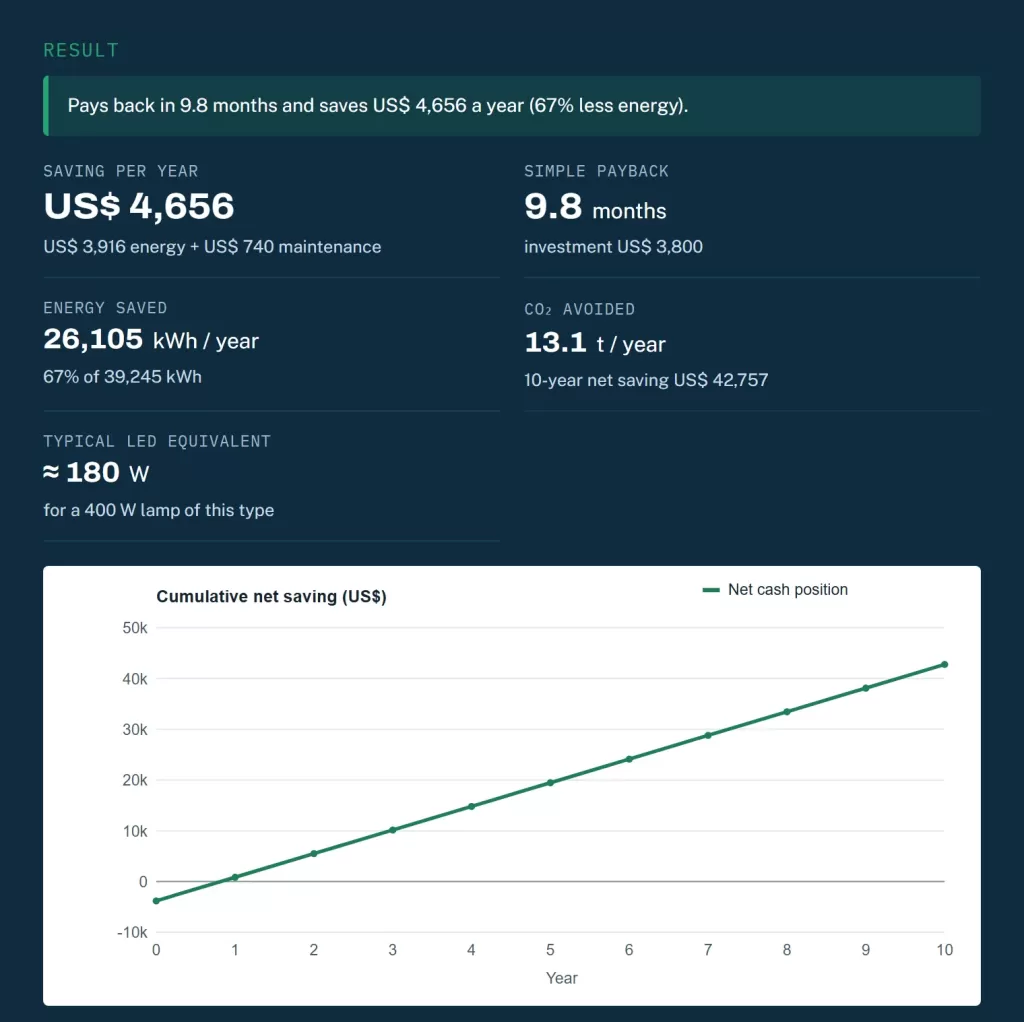
Open this example and enter your own fixtures and tariff.
For larger floodlights the pattern holds: replacing 1000 W metal halide (about 1,100 W with gear) with 400 W LED on the same 20 poles saves about 61,000 kWh a year; at US$400 per LED floodlight plus US$60 installation, the payback is about 11 months.
Worked example: replacing halogen security lights
Small sites often still use 500 W halogen floodlights for security lighting. Ten of them running 6 hours a night use about 10,950 kWh a year. Ten 70 W LED floodlights with the same or better light on the ground use about 1,530 kWh:
- Saving about 9,400 kWh a year, roughly US$1,400 at US$0.15/kWh
- No more halogen lamps failing every few months, and no hot glass that can burn or shatter
With a motion sensor, the LED lights can stay at a low level and brighten only when someone approaches, which cuts the energy further and makes movement more noticeable.
Sizing a floodlight for a facade or sign
For areas you can use the target lux; for a facade or a billboard, the same lumen method works on the vertical surface:
Lumens needed = target lux × surface area ÷ (utilisation factor × maintenance factor)
Take a 30 × 15 m building facade (450 m²) to be lit to 50 lx, from floodlights a few metres in front of it. Facade lighting wastes more light past the edges than area lighting, so use a utilisation factor of about 0.4, and 0.8 for maintenance:
- Lumens needed ≈ 50 × 450 ÷ (0.4 × 0.8) ≈ 70,000 lm
- At 130 lm/W: about 540 W, for example 6 × 100 W floodlights with 30°–60° beams spaced along the facade
The right lux depends on how bright the surroundings are and how light the surface is: a pale wall in a dark area needs far less than a dark stone facade in a bright city centre. Narrow beams grazing a textured wall bring out its relief; wider beams from further away give an even wash.
Beam angle and mounting height
A floodlight’s beam angle decides how far and how wide its light spreads. As a rule:
- High mounting, long throw: narrow beams (15°–40°) put the light on the ground instead of spreading it into the sky.
- Medium heights: 60° beams.
- Low mounting, close area: wide beams (90°–120°).
- Edge of site, near roads or houses: asymmetric optics, aimed down, to limit glare and spill.
Aiming without glare
Most floodlight complaints are about aiming, not wattage:
- Keep the aiming angle low. A floodlight tilted up towards the horizon throws light straight into drivers’ and neighbours’ eyes. Aim the brightest part of the beam at the far side of the area, but keep the main beam well below the horizontal.
- Prefer asymmetric floodlights with flat glass for areas lit from the edge: they can be mounted horizontally and still throw light forward.
- Use visors or louvres near roads and houses.
- Light vertical surfaces from above where possible, so the light ends on the wall instead of in the sky.
- Record the aiming at commissioning, so lights knocked out of position can be reset.
What else to specify
- IP66 for outdoor floodlights exposed to driving rain and pressure cleaning; see IP65 vs IP66 vs IP67
- Surge protection, 10 kV or more for pole-mounted lights
- Bracket and aiming scale, so the aiming angle can be set and kept
- Thermal design, especially above 300 W; heat-pipe floodlights stay cooler and keep their output longer
- Photometric file, so the layout can be calculated
Our floodlight range runs from 50 W slim floodlights to 1500 W heat-pipe stadium and port lights. For sports fields, see the LED stadium lights guide; for masts, the high mast lighting guide.
Sources
Frequently asked questions
What LED flood light replaces a 400 W metal halide?
Usually 150–200 W of LED at 120–140 lm/W. A 400 W metal halide fitting draws about 450 W with its ballast and loses much of its light in the reflector and through lumen depreciation, so a correctly aimed LED floodlight of 150–200 W gives the same or better light on the target.
How many lumens does a 100 W LED flood light give?
Typically 10,000–14,000 lm for a quality floodlight at 100–140 lm/W. Always compare measured luminaire lumens, not the LED chip rating.
What beam angle should a flood light have?
15°–30° for long throws from high masts or onto distant facades, 60° for medium distances, 90°–120° for close, wide areas such as yards and car parks lit from low poles or walls.