
Street Light Arms for Wood Poles: Lengths, Mounting and LED Heads
How to mount street lights on wooden utility poles: arm lengths and rise, bolt-through and band mounting, 1.25 and 2 inch tenons, wiring and photocells, and choosing an LED head that fits.
Key points
- Wood utility poles carry many rural and suburban street lights; the light hangs on a steel or aluminium arm bolted through the pole or fixed with bands.
- Common arm lengths are 1.2–2.4 m (4–8 ft), longer for wide roads; the arm must reach far enough to place the light over the road edge.
- Most LED heads fit a 1.25 in or 2 in pipe tenon (about 42–60 mm outer diameter); check the head's slip fitter range before ordering.
- Clearances to power conductors and the utility's mounting rules come first: only authorised crews work on energised utility poles.
On rural roads, suburban streets and many towns in North America, Latin America, Africa and Asia, street lights are not on their own poles but on the wooden poles that carry power and telecom lines. Converting them to LED or adding new lights means choosing the right arm, the right mounting and a light head that fits.
Parts of a wood-pole street light
| Part | Role |
|---|---|
| Wood utility pole | Carries power lines, telecom and the light |
| Mounting plate or bracket | Fixes the arm to the pole |
| Arm (bracket arm) | Reaches out over the road |
| Tenon or spigot | Pipe end the light head slips onto |
| Light head | LED street light with slip fitter |
| Photocell or controller | Switches the light |
| Supply cable and fuse | From the secondary conductors to the head |
Arm types
| Type | Description | Use |
|---|---|---|
| Straight pipe arm | Steel pipe, horizontal or slightly upswept | Simple, low cost |
| Upswept / truss arm | Curved or braced for longer reach | Wider roads |
| Mast arm | Long tapered arm | Main roads, junctions |
| Decorative arm | Curved or scroll | Town centres |
Arms are usually hot-dip galvanised steel or aluminium.
Arm length and rise
- Length: commonly 1.2–2.4 m (4–8 ft); 3–4.5 m for poles set back from the road
- Rise: the vertical lift from the mounting point to the tenon, often 0.3–1 m, which raises the light above the mounting point and clear of conductors
- Goal: put the light over the road edge or slightly over the carriageway
Longer arms put more bending load on the pole and mounting. Follow the utility’s limits.
Mounting methods
Through-bolting
– One or two galvanised bolts through the pole and the arm plate
– Washers and lock nuts sized to the pole diameter
– The usual utility method
Band or strap mounting
– Steel bands around the pole
– Used where drilling is not allowed or on non-wood poles
Bracket with lag screws
– For light arms on smaller poles, where permitted
Height and clearances
Typical mounting heights on wood poles are 7–9 m (23–30 ft). The light and arm must keep required clearances from power conductors and communication cables; these are set by national electrical safety codes and the utility. Only qualified, authorised crews may work on energised utility poles.
Choosing the LED head
| Check | Why |
|---|---|
| Slip fitter size range | Must fit the tenon: 1.25 in (about 42 mm) or 2 in (about 60 mm) |
| Tilt adjustment | Levels the head on upswept arms |
| Weight and EPA | Within the arm’s and pole’s rating |
| Photocell socket | NEMA 3-pin or 7-pin, matching the utility’s practice |
| Surge protection | 10 kV recommended on overhead networks |
| Optic | Type II or III for roads along the pole line |
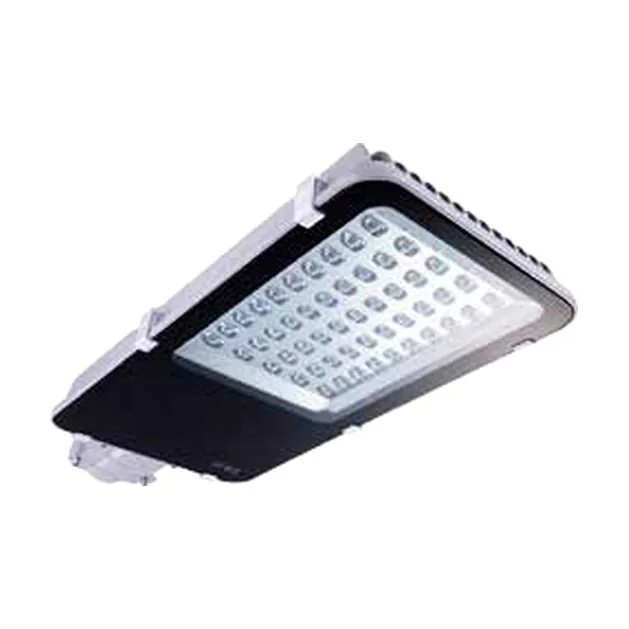
Our compact LED street lights suit residential and rural roads, and our modular LED street lights cover higher wattages for main roads. Confirm tenon size and control socket with each order.
Wattage
On wood poles at 7–9 m:
| Road | Typical LED | Replaces |
|---|---|---|
| Rural lane, residential street | 30–60 W | 70–100 W HPS |
| Collector road | 60–100 W | 150 W HPS |
| Main road | 100–150 W | 250 W HPS |
For more detail, see how many watts an LED street light needs and the HPS to LED conversion chart.
Wiring and controls
- Supply from the secondary conductors through a fused connection
- Cable run along or inside the arm
- Photocell on the head (individual control) or switched circuits (group control)
- Smart controllers can replace photocells where heads have 7-pin sockets
Spacing on utility poles
Lights on utility poles follow the pole spacing, often 30–60 m. That is wider than ideal for even road lighting, so many utilities light every pole near junctions and every second or third pole elsewhere. Asymmetric optics help stretch the light along the road between poles. Check results with our pole height and spacing calculator.
Converting existing HPS lights
- Survey heads, arms and tenon sizes
- Check arm condition: corrosion, cracks, loose bolts
- Match LED wattage and optic to the road
- Fit the photocell or controller the utility uses
- Record each pole and head for maintenance
Replacing just the head, and keeping sound arms, saves cost and reduces work at height.
Wood pole condition
Wood poles rot at the ground line and can be weakened by woodpeckers and insects. Before adding arms or heavier heads, the utility’s pole inspection records should confirm the pole is sound.
Solar on wood poles
In places with unreliable grids, all-in-one solar heads are sometimes fitted to wood poles. Check the added wind area of the panel, the bracket strength and shading by conductors and trees. Our all-in-one solar street lights can be fitted to pipe arms where the pole and arm are rated for them.
Common mistakes
- Ordering heads before checking tenon sizes on site
- Heavy heads on old, light arms
- Arms too short, leaving the road edge dark
- Photocell sockets that do not match the utility’s spares
Ordering
Send pole heights, arm lengths and tenon sizes, the road widths and the existing lamp wattage. We will propose LED heads, slip fitters and control options, and arms where needed.
Sources
Frequently asked questions
How long should a street light arm be?
Long enough to place the light over the edge of the road or a little beyond, usually 1.2–2.4 m (4–8 ft) on wood poles near the kerb, and longer where poles stand further back from the road.
How is a street light arm attached to a wood pole?
Usually with one or two through-bolts passing through the pole and the arm's mounting plate, or with steel bands around the pole where drilling is not allowed. The utility's standards set bolt sizes and positions.
What size tenon do LED street lights fit?
Most fit pipe tenons of 1.25 in or 2 in nominal (about 42 mm and 60 mm outside diameter). Many heads have adjustable slip fitters that cover a range, for example 42–60 mm.