
Why Is My Solar Street Light Not Working? A Troubleshooting Guide
Why solar street lights stop working, dim early or stay on in daytime, and how to find the cause: dirty or shaded panels, ageing batteries, controller settings, sensors, wiring and undersized systems, with a battery calculator example.
Key points
- Most 'dead' solar street lights have a charging problem, not a broken LED: dirt, shade, a damaged panel or a loose connection.
- A light that works after sunny days but fails after one cloudy day usually has an ageing battery or an undersized panel.
- In our example, halving the panel output by dirt or shade turns a 3.7-day system into one that can no longer even cover a sunny day.
- Check controller settings and sensors before replacing parts, and record what you find.
A solar street light has four parts that can fail: the panel that charges, the battery that stores, the controller that decides, and the LED that lights. When a light goes dark, the LED is the least likely culprit. This guide sorts the symptoms into causes, so a maintenance crew can find the problem in one visit instead of swapping parts until it works.
Start with the symptom
| Symptom | Most likely causes |
|---|---|
| Light does not come on at all | Battery fully discharged, loose battery or load connection, controller fault, panel disconnected (controller cannot detect dusk) |
| Light comes on but goes off early | Not enough charge: dirty, shaded or damaged panel; ageing battery; undersized system; schedule set too high |
| Works after sunny days, fails after one cloudy day | Battery capacity lost with age, or a system sized without rainy-day margin |
| Light stays on during the day | Panel disconnected or damaged, light sensor fault, wrong controller setting |
| Light flickers | Loose connection, failing driver, battery at its cut-off voltage |
| Dim all night | Low-battery dimming active (charging problem), or the schedule is set to a low level |
| Motion sensor does not respond | Sensor obstructed or misaligned, sensor disabled in settings, PIR range reduced in hot weather |
The most common cause: charging
Most lights that “stop working” are simply not charging enough. A light that was sized with a sensible margin can lose it to dirt, shade or a failing connector.
We ran an example in our battery autonomy calculator: a 30 W light with a 60 Ah, 12.8 V LiFePO4 battery and a 100 Wp panel at 4.5 sun hours.
- Clean panel: about 324 Wh collected on a sunny day against 237 Wh used at night. The light covers about 3.7 rainy days and refills in about 6 sunny days.
- Panel output halved by dust or shade (effectively 60 Wp): only about 194 Wh collected. The panel can no longer cover a single night, even on a sunny day. The battery drains a little every day until the light switches off early.
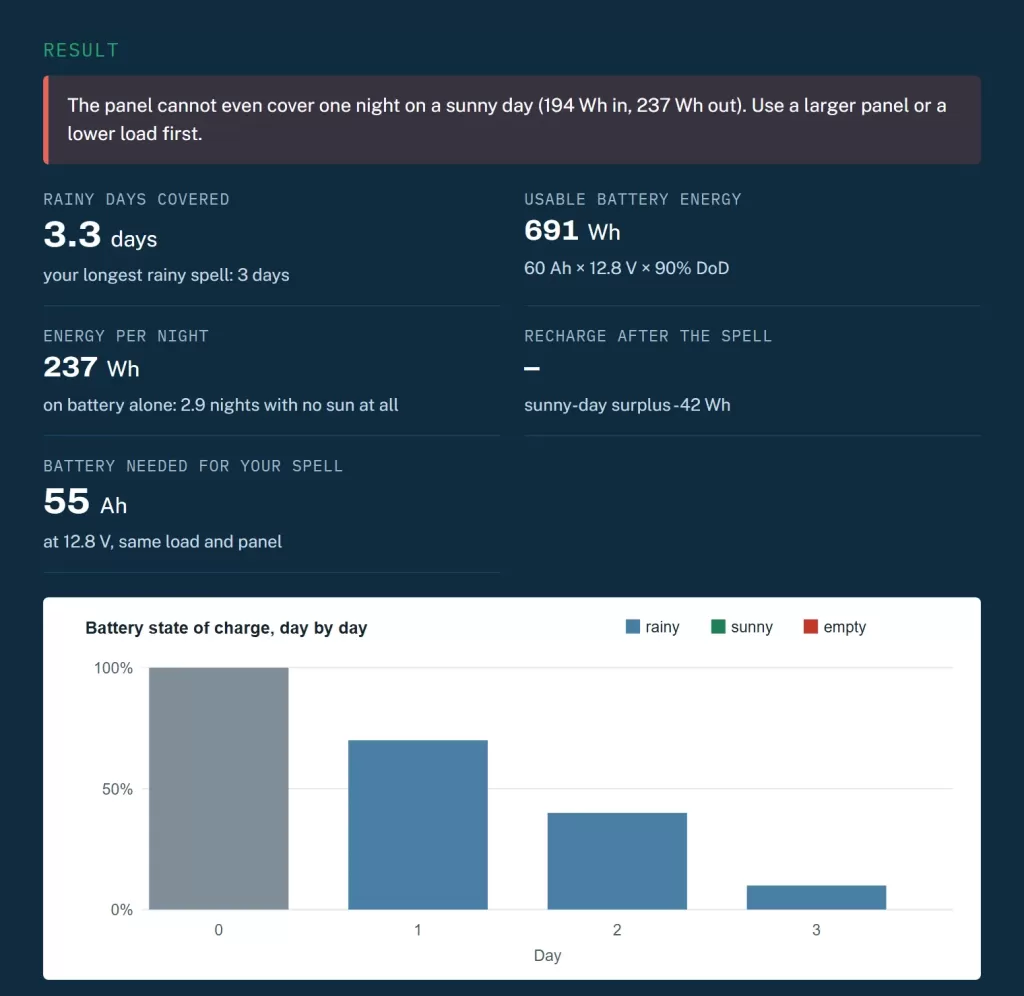
Open this example and set the panel back to 100 Wp to see the difference.
Check the panel
- Dust, bird droppings, leaves: clean with water and a soft brush. In dusty regions, clean every few months.
- New shade: trees grow and buildings go up. Check shade at midday and in the season when the sun is lowest.
- Orientation: a panel knocked out of alignment, or installed facing away from the equator.
- Damage: cracked glass, burned cells or a damaged junction box.
- Connections: in split systems, check the panel cable and connectors for corrosion and looseness.
Second most common: the battery
Batteries wear out. A LiFePO4 battery typically lasts 5–8 years in street lighting, a gel battery 2–4 years. As capacity falls, autonomy falls with it: in the example above, a battery that has lost 30% of its capacity covers only about 2.6 rainy days instead of 3.7. The light still works in good weather, so the problem appears first in the rainy season.
Signs of a worn battery and how to plan replacement are covered in how long do solar street lights last.
Controller and settings
- Wrong schedule: check the light is not set to full power all night when it was sized for dimming.
- Wrong battery type setting: a controller set for lead-acid on a lithium battery (or the reverse) charges incorrectly.
- Low-battery protection: the light may be correctly switching off to protect a battery that is not charging. Fix the charging, not the controller.
- Reset after faults: some controllers need a reset after the battery has been fully discharged.
Wiring, water and the LED
- Water ingress into the housing or battery box: look for condensation, corrosion and failed seals.
- Loose terminals after transport, vibration or theft attempts.
- LED or driver failure is rare compared with the issues above, but a light with good battery voltage, correct settings and no output points to the driver or LED board.
When the system was too small from the start
If a light fails every rainy season from the first year, the system was probably undersized for the site. No maintenance will fix that; the panel, the battery or the schedule must change. Check the original design against the site’s worst-month sun hours with the solar street light calculator, and see how many rainy days a solar street light can last.
A 15-minute field check with a multimeter
A technician with a multimeter, a ladder or platform and the controller’s remote or app can find most faults in one visit. A practical order:
- Look first. Panel dirty or shaded? Housing cracked or full of water? Cables chewed, cut or loose?
- Panel voltage in daylight. Disconnect the panel from the controller and measure across its leads. A typical “12 V” panel (36 cells) should show roughly 19–23 V open-circuit in good light. Near zero means a broken cable, connector or junction box; a low reading in full sun points to damaged cells.
- Battery voltage. Measure at the battery terminals with the load off. See the table below.
- Charging current. With a clamp meter or the controller display, check that current flows into the battery in sunlight. Good panel voltage but no charging current means a controller or wiring fault.
- Controller settings. Battery type, schedule, dimming levels, low-voltage cut-off and the dusk threshold.
- Load test. Cover the panel (or use the test mode) and check that the light switches on and the LED draws the expected current.
Reading a 12.8 V LiFePO4 battery
LiFePO4 holds an almost flat voltage over most of its charge, so voltage is only a rough guide, best measured after the battery has rested for an hour:
| Resting voltage | Approximate state |
|---|---|
| 13.4–13.6 V | Full or nearly full |
| 13.1–13.3 V | Middle of its range, about 40–80% |
| 12.8–13.0 V | Low, roughly 10–30% |
| Below 12.5 V | Nearly empty; the controller should have cut the load |
| Below about 10 V | Over-discharged; the BMS may have disconnected it and it may need a special recovery charge |
A battery that reads full in the afternoon but cannot run the light for a whole night has lost capacity: the voltage looks fine because voltage measures charge level, not how much energy the battery can still hold. For gel batteries the voltages are lower (about 12.7 V full, 12.0 V nearly empty) and the curve is steeper.
Repair or replace?
| Finding | Usual action |
|---|---|
| Dirty or shaded panel | Clean, trim trees, relocate if shade is permanent |
| Wrong settings | Correct and record the settings |
| Corroded connector or broken cable | Replace connector; seal with heat-shrink or a waterproof junction |
| Battery below about 70% of original capacity | Replace battery (often the whole battery pack or module) |
| Failed controller | Replace with the same model or one set for the same battery |
| Failed driver or LED board | Replace module or lamp head; check for water ingress first |
| Light undersized for the site | Bigger panel and battery, or a lower schedule; a repair will not help |
On large projects, replacing all batteries on a street at once is usually cheaper than chasing individual failures.
Keep a record
For every light visited, note the pole number, symptom, battery voltage, panel condition and what was fixed. Patterns across a project (all lights on one street, all lights from one batch) point to causes that a single visit cannot. If you have our solar street lights on site, send us the pole numbers and symptoms and our engineers will help diagnose them.
Sources
Frequently asked questions
Why does my solar street light turn off in the middle of the night?
Usually the battery is not getting enough charge during the day, because the panel is dirty or shaded, or because the battery has lost capacity with age. The controller then switches the light off to protect the battery. Check the panel first, then the battery.
Why does my solar street light stay on during the day?
The controller thinks it is dark. Common causes are a disconnected or damaged panel (many controllers use panel voltage to detect daylight), a faulty light sensor, or wrong controller settings.
How do I know if the battery of a solar street light is bad?
If the light works normally after several sunny days but fails early after one cloudy day, or its controller reports reduced capacity, the battery is likely worn. A capacity test with a battery tester confirms it.