
Battery Powered Flood Lights: Portable Work Lights, Runtime and Uses
How battery powered and rechargeable LED flood lights work: lumens vs runtime, battery capacity in Wh, charging, IP rating, uses on sites and in emergencies, and when solar or mains floods are better.
Key points
- Runtime = battery watt-hours ÷ LED watts, minus losses: a 50 Wh battery runs a 10 W flood for about 4–5 hours.
- Most portable floods offer high, medium and low modes; the headline lumens usually apply to high mode for a short time.
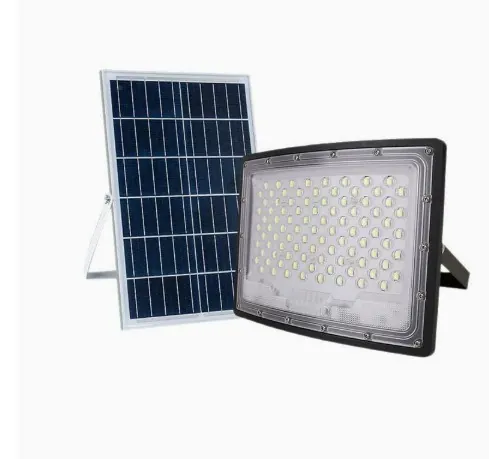
- For permanent outdoor lighting without power, solar flood lights recharge themselves; battery floods suit temporary and mobile work.
- Check real battery capacity in Wh, charging time, IP rating and impact resistance rather than the 'equivalent' wattage.
Battery powered flood lights fill the gap between a torch and a fixed floodlight. They light a work area, a breakdown, an event or a power cut without cables, then go back on charge. Choosing one is mostly about how much light you need and for how long.
Lumens and runtime
The basic sum:
Runtime (hours) ≈ battery Wh ÷ LED watts × 0.85
| Battery | 10 W (about 1,000 lm) | 30 W (about 3,000 lm) | 50 W (about 5,000 lm) |
|---|---|---|---|
| 20 Wh | about 1.7 h | 0.6 h | 0.3 h |
| 50 Wh | about 4.2 h | 1.4 h | 0.85 h |
| 100 Wh | about 8.5 h | 2.8 h | 1.7 h |
| 200 Wh | about 17 h | 5.7 h | 3.4 h |
Most portable floods have several modes. The highest lumen figure on the box usually means the highest mode, which may last only an hour. Check runtime in the mode you will actually use. For other sizes, the battery autonomy calculator runs the same sum with your own battery and load.
Battery capacity: look for Wh
Battery capacity is often given in mAh, which means little without voltage:
- Wh = V × Ah
- 7.4 V × 5,000 mAh = 37 Wh
- 3.7 V × 10,000 mAh = 37 Wh
Ask for Wh to compare lights. Airline rules for carrying lithium batteries also use Wh (commonly 100 Wh without approval, up to 160 Wh with approval, depending on the airline).
Types
| Type | Typical output | Uses |
|---|---|---|
| Hand-held / magnetic work light | 300–1,500 lm | Workshops, car repair |
| Tripod or stand flood | 1,500–5,000 lm | Job sites, events |
| Tool-battery flood | 1,000–6,000 lm | Contractors using power-tool batteries |
| Large portable flood with handle | 5,000–20,000 lm | Emergencies, night work |
| Light tower (generator or battery) | 20,000–100,000+ lm | Construction, mining, events |
Charging
- USB-C charging for small lights, often with power bank output
- Mains adapters for larger ones
- Charging time often 3–8 hours; fast charging helps on daily shifts
- Some can be charged by a separate solar panel
Ruggedness
- IP54–IP65 for outdoor and site use
- IK07–IK08 or rubber bumpers against drops
- Swivel stands and hooks for aiming
- Cold performance: lithium batteries lose capacity in cold weather and should not charge below 0 °C
Uses
- Construction and road works at night
- Maintenance in plant rooms and warehouses during shutdowns
- Breakdowns and roadside repairs
- Events, camping and outdoor markets
- Emergency backup during power cuts
- Disaster relief, with solar charging
Battery, solar or mains?
| Need | Best choice |
|---|---|
| Temporary, mobile light for hours | Battery flood |
| Permanent light where there is no power | Solar flood light |
| Permanent light with power available | Mains LED floodlight |
| Large site for weeks | Light tower or mains floods |
Solar flood lights recharge from their own panel every day. Ours list the real panel watts and battery watt-hours, so you can compare them with battery models. For permanent wattage by application, see the LED flood light wattage guide.
Hazardous areas
Standard battery floods must not be used where flammable gas or dust may be present. Use portable lights certified for the zone; see intrinsically safe vs explosion-proof for the protection types.
Battery care
- Store at about 40–60% charge if unused for months
- Recharge after use; do not leave fully empty
- Keep out of hot vehicles in summer
- Replace swollen or damaged batteries immediately
- Use the charger supplied or specified
Choosing for a job site
For a crew working at night, count how many hours of light are needed per shift and how many lights. Two medium floods on tripods usually light a work area better than one very bright light, because shadows are softer and nobody looks straight into the source. Keep spare batteries charged, or choose lights that share batteries with the crew’s power tools so charging is already organised.
Emergency preparedness
Schools, clinics, hotels and offices in places with frequent power cuts often keep a few rechargeable floods for stairwells, reception areas and generator rooms. They do not replace code-required emergency lighting, but they help staff work safely during long outages. Charge them on a schedule and test them monthly together with other emergency equipment.
Size and weight
Bigger batteries mean longer runtime but also more weight. A light with a 100 Wh battery typically weighs 1.5–3 kg; one with 300 Wh or more may need two hands or wheels. For work at height, magnetic bases and hooks matter more than raw output.
Colour and beam
Most work floods are 5000–6500K, which looks bright and shows detail. For events and camping, 3000–4000K is more comfortable. A wide beam (100–120°) lights a work area evenly; a narrower beam reaches further for searching or inspection.
Checking claims
| Claim | Check |
|---|---|
| “100 W” or “500 W equivalent” | Ask for real watts and lumens |
| “20,000 mAh” | Ask for voltage, calculate Wh |
| “Runs all night” | In which mode, at what lumens |
| “Waterproof” | Which IP rating |
Projects and distributors
For distributors and contractors, we supply solar and mains floodlights for permanent installations and can source portable and rechargeable floods through partner factories. Tell us the uses, runtimes and quantities you need.
Sources
Frequently asked questions
How long do battery powered flood lights last?
It depends on the battery capacity and the mode. A typical rechargeable work light with a 40–80 Wh battery runs 2–4 hours on high and 8–20 hours on low. Divide battery watt-hours by the light's real watts, then allow about 10–15% for losses.
Are battery flood lights bright enough for job sites?
Portable models give 1,000–10,000 lumens on high, enough for repair work, small sites and emergencies. Large construction sites usually use mains or generator-powered floodlights, or light towers.
What is the difference between a battery flood light and a solar flood light?
A battery flood light is charged from mains or USB and used where needed, then recharged. A solar flood light has its own panel and charges itself every day, so it suits permanent installations without power.