How Many Explosion-Proof Lights Do I Need? Three Hazardous Rooms Worked Through the Lumen Method
Count explosion-proof lights with the lumen method: a pump room, a compressor house and a loading shed run through our calculator, plus why fewer, larger fittings often cost less to own.
Key points
- The count comes from the lumen method: target lux × floor area ÷ (lumens per fitting × utilisation factor × maintenance factor), then a check that spacing stays within about 1.2 × mounting height.
- A 12 × 8 m pump room with fittings at 4 m needs twelve 40 W BDE507 lights for 200 lux (264 lux achieved) in our calculator.
- A 24 × 12 m compressor house at 6 m needs fifteen 100 W or eight 150 W ExF lights for 200 lux; the 150 W layout uses 1.2 kW instead of 1.5 kW.
- Every explosion-proof fitting adds glands, flame paths and inspection time, so on hazardous sites fewer, larger fittings often cost less over their life.
“How many explosion-proof lights do I need?” is the first question on most hazardous-area lighting enquiries we receive. The answer comes from the same lumen method used for any industrial building, with two differences: the fittings are more expensive to buy and to inspect, and dirt builds up faster in many hazardous areas. This guide runs three typical rooms through our high bay lighting calculator and shows where the count can be reduced.
The method in four steps
- Target illuminance (E). Set by the task: walkways and loading areas 100–150 lux, pump and compressor rooms around 200 lux, control rooms 300 lux or more.
- Lumens needed. Lumens = E × floor area ÷ (utilisation factor × maintenance factor). The utilisation factor (UF) depends on the room’s proportions, the mounting height and wall reflectance; the maintenance factor (MF) allows for dirt and lumen depreciation.
- Number of fittings. Divide by the lumens of one fitting and round up.
- Spacing check. Arrange the fittings in a grid. If the spacing exceeds about 1.2 times the mounting height above the working plane (medium beam), add rows even if the light level is already met. Otherwise the floor will show dark patches between fittings.
The calculator does all four steps. The examples below use our own fittings and their rated efficacy.
Example 1: pump room, 12 × 8 m, fittings at 4 m
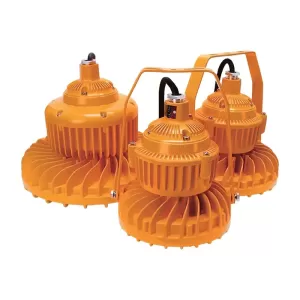
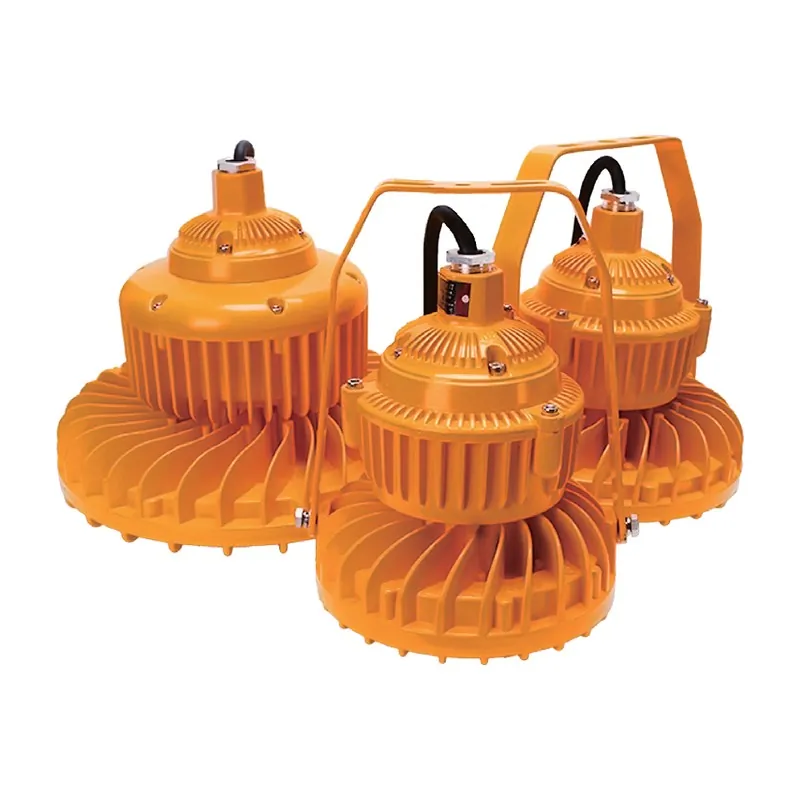
A pump room with medium wall reflectance, 200 lux at 0.8 m, maintenance factor 0.8. We used the BDE507 round light, 40 W at 110 lm/W (4,400 lm), marked Ex d IIC T6 Gb (open the example):
| Result | Value |
|---|---|
| Room index | 1.50 |
| Utilisation factor | 0.60 |
| Fittings by light level alone | 10 |
| Fittings in the grid | 12 (4 × 3) |
| Spacing | 3.0 × 2.7 m |
| Average illuminance | 264 lux |
| Load | 5.0 W/m² |
The light level alone asks for ten fittings, but ten cannot form an even grid in this room, so the calculator places twelve. The result is 264 lux, well above target. The calculator also shows that 30 W per fitting would reach 200 lux with the same twelve positions, so the 30 W BDE507 is the more economical choice here: 360 W instead of 480 W, with identical layout and inspection effort.
Example 2: compressor house, 24 × 12 m, fittings at 6 m
A compressor house is larger and dirtier. We compared two sizes of our ExF series, marked Ex d IIB T6 Gb, at 110 lm/W, for 200 lux. The gas here is natural gas, group IIA, so IIB fittings are acceptable.
| 100 W ExF (open) | 150 W ExF (open) | |
|---|---|---|
| Fittings | 15 (5 × 3) | 8 (4 × 2) |
| Spacing | 4.8 × 4.0 m | 6.0 × 6.0 m |
| Spacing limit | 6.2 m | 6.2 m |
| Average illuminance | 277 lux | 222 lux |
| Total load | 1.5 kW | 1.2 kW |
The 150 W layout meets the target with seven fewer fittings and 300 W less load. Its spacing, 6.0 m, is just inside the 6.2 m limit, so uniformity is still acceptable. Seven fewer fittings also mean seven fewer certified glands, seven fewer flame-path inspections every inspection cycle, and fewer spare lamps in stock.
If the room held hydrogen or another group IIC gas, the ExF would not be allowed; the BED series, marked IIC, would be the alternative.
Example 3: loading shed, 30 × 15 m, fittings at 8 m
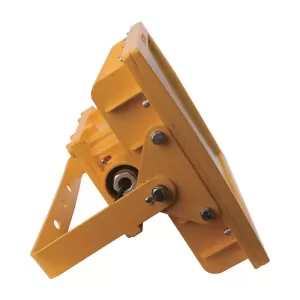
An open-sided tanker loading shed: dark surroundings, diesel and petrol vapour, and dirt from traffic. We aimed for 150 lux and used a maintenance factor of 0.7. Fitting: our BAD8599 floodlight, 200 W at 120 lm/W (24,000 lm), marked Ex d IIC T6 Gb, hung or bracket-mounted and aimed down (open the example):
| Result | Value |
|---|---|
| Room index | 1.39 |
| Utilisation factor | 0.51 |
| Fittings | 8 (4 × 2) |
| Spacing | 7.5 × 7.5 m |
| Average illuminance | 153 lux |
| Load | 3.6 W/m² |
Eight fittings, 1.6 kW. With a maintenance factor of 0.8 instead, the same eight fittings would give about 175 lux; the difference shows how much the dirt assumption matters in a shed like this. If your cleaning interval is long, keep 0.7.
Where the count can be reduced
- Choose the size from the spacing limit, not just the light level. In example 1, the grid was fixed by the room shape; the wattage could be lowered. In example 2, the larger fitting removed almost half the positions.
- Check reflectance honestly. Painting walls light grey in a pump room raises the utilisation factor and can remove a row. Assuming light walls when they are oily and dark does the opposite: the room ends up underlit.
- Separate task lighting. If only a gauge panel needs 300 lux, light that panel locally rather than raising the whole room to 300 lux.
- Use a dual marking where both hazards exist. One model for gas and dust zones keeps the spare stock simple.
The cost of ownership per fitting
On an ordinary site, the cost of a light is mostly its price and its energy. On a hazardous site, add:
| Item per fitting | Why it matters |
|---|---|
| Certified cable gland | Required at every entry; must match cable diameter and protection type |
| Periodic inspection | IEC 60079-17 inspections cover each fitting, including flame paths and gland condition |
| Hot-work or permit time | Work in a classified area often needs a permit, adding hours per visit |
| Spare parts | Each model and size in use adds stock |
These costs scale with the number of fittings, not their wattage. That is the main reason we recommend the largest size that keeps spacing within limits.
Common mistakes
- Counting fittings from wattage rules of thumb (“one 100 W per 30 m²”) instead of lumens and room shape.
- Forgetting that a fitting’s gas group must cover the site’s gas; the cheapest fitting may be IIB when the site is IIC.
- Ignoring the dust rating where dust zones overlap gas zones; our class 1 vs class 2 hazardous locations article explains the difference.
- Using a maintenance factor of 0.9 in dirty process areas, which makes the room underlit within a year.
For low rooms below about 4 m, see our explosion-proof ceiling light examples; for halls above 8 m, our explosion-proof high bay lighting guide.
What to send us
Send the room dimensions, mounting height, zone, gas group and temperature class, the light level you need and the wall condition. We will reply with a fitting count and layout from our calculator, comparing at least two sizes, and the marking and certificate of each fitting proposed.
Sources
Frequently asked questions
How do I calculate how many explosion-proof lights I need?
Multiply the target illuminance by the floor area, then divide by the lumens of one fitting times the utilisation factor and the maintenance factor. Round up, arrange in a grid, and check that spacing does not exceed about 1.2 times the mounting height for a medium beam.
How many lux does a hazardous area need?
Common targets are 100–150 lux for walkways and loading areas, 200 lux for pump and compressor rooms, and 300 lux or more for control rooms and workbenches. Check your site standard; some operators set higher values.
Should I use more small explosion-proof lights or fewer large ones?
Where uniformity allows, fewer larger fittings. Each explosion-proof light needs a certified gland, periodic inspection and spare parts, so reducing the count lowers the cost of ownership. Spacing must still stay within the limit for the mounting height.
What maintenance factor should I use for explosion-proof lights?
0.8 for clean indoor rooms, 0.7 for dusty or oily areas such as compressor houses and loading sheds, and lower if cleaning is infrequent.