
Class 1 vs Class 2 Hazardous Locations: Gas or Dust, and What It Changes for the Light
Class I is flammable gas or vapour, Class II is combustible dust, Class III is fibres. How the groups, divisions and surface-temperature rules differ, with a worked dust check.
Key points
- Class I covers flammable gases and vapours (Groups A–D); Class II covers combustible dust (Groups E–G); Class III covers ignitable fibres.
- Class I fittings stop an internal spark from igniting gas outside; Class II fittings keep dust out and keep their surface below the dust's ignition temperature.
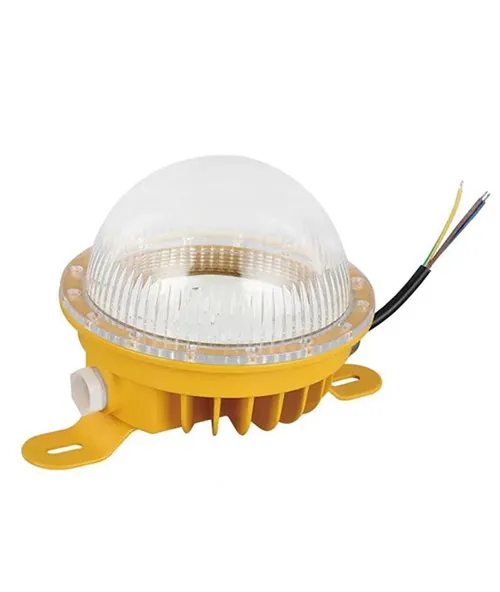
- A gas rating alone is not a dust rating: our BDE507 is marked for gas only, while the BED series and BAD8501B carry both gas and dust markings.
- For dust, check two limits: two-thirds of the cloud ignition temperature and the layer ignition temperature minus 75 K. The lower one caps the fitting's surface temperature.
The North American Class system sorts hazardous locations by what can burn before it asks how often it is there. Class 1 and Class 2 are the two you meet most: one is gas, the other is dust. Mixing them up is one of the most common reasons a quotation is returned, because a light built for one is not automatically suitable for the other. This guide sets the two side by side.
The three classes at a glance
| Class I | Class II | Class III | |
|---|---|---|---|
| Hazard | Flammable gas or vapour | Combustible dust | Ignitable fibres and flyings |
| Examples | Fuel depots, paint mixing, refineries, gas compressor houses | Grain silos, flour mills, sugar plants, coal handling, powder coating | Textile mills, cotton gins, sawmills |
| Groups | A, B, C, D | E, F, G | None |
| Zone equivalent | Zones 0, 1, 2 | Zones 20, 21, 22 | No direct equivalent |
| Main ignition risk from a light | Spark or hot surface igniting a gas cloud | Hot surface igniting a dust layer or cloud | Hot surface igniting lint |
Each class is then split into Division 1 (hazard present in normal operation) and Division 2 (hazard present only under abnormal conditions). Our class/division vs zone system article explains that mapping in full; here we stay with the difference between classes.
The groups inside each class
Class I groups are ranked by how easily the gas ignites and how hard it is to stop a flame escaping through a gap:
| Group | Typical gas | IEC equivalent |
|---|---|---|
| A | Acetylene | IIC |
| B | Hydrogen | IIC |
| C | Ethylene | IIB |
| D | Propane, petrol, methane (surface) | IIA |
Class II groups depend on the dust:
| Group | Typical dust | IEC equivalent |
|---|---|---|
| E | Metal dust (aluminium, magnesium) | IIIC (conductive) |
| F | Carbon dust (coal, coke, carbon black) | IIIC or IIIB depending on resistivity |
| G | Grain, flour, starch, sugar, plastics, wood | IIIB (non-conductive) |
Groups never cross classes: a light certified for Groups C and D says nothing about Group G dust.
How the protection differs
For gas (Class I) the danger is that gas gets inside the fitting. So a Class I Division 1 light is usually explosion-proof: the housing is strong enough to contain an internal explosion, and its joints are long and tight enough to cool the escaping gases. In IEC terms this is a flameproof enclosure, Ex d.
For dust (Class II) the aim is the opposite: keep the dust out entirely, because a dust explosion inside a closed box is less of a concern than dust settling on a hot surface. A Class II light is dust-ignition-proof: sealed against dust (IP6X in IEC terms) and designed so its outer surface stays cool even under a blanket of dust. In IEC terms this is protection by enclosure, Ex t.
That is why the two ratings are separate tests. A flameproof housing may still let fine dust in through a cable gland, and a dust-tight housing need not withstand an internal gas explosion.
Gas-only and dual-rated fittings in our range
| Fitting | Gas marking | Dust marking | Suits |
|---|---|---|---|
| BED series, 30–600 W | Ex db eb mb IIC T4 Gb | Ex tb IIIC T130 °C Db | Gas Zones 1/2 and dust Zones 21/22 |
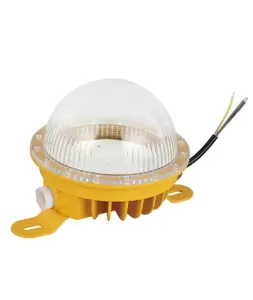
| BAD8501B ceiling light, 15–30 W | Ex d IIC T6 Gb | Ex tD A21 IP66 T80 °C | Gas Zones 1/2 and dust Zones 21/22 |
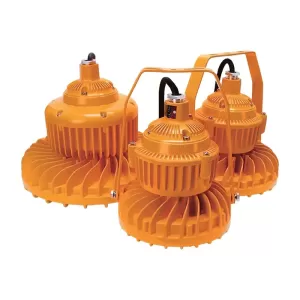
| BDE507, 20–70 W | Ex d IIC T6 Gb | None | Gas Zones 1/2 only |
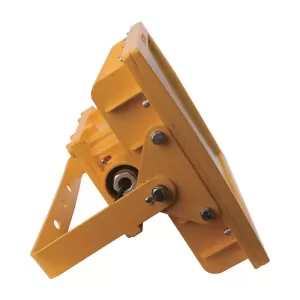
| ExF series, 50–150 W | Ex d IIB T6 Gb | None | Gas Zones 1/2, IIA and IIB gases only |
The BDE507 and ExF are good gas fittings, but neither may go into a grain store, because neither carries a dust marking. Our own certificate, ZJEx23.0914 (GB 3836, valid to July 2028), covers the BED series; for the other models we send the certificate that applies with the quotation.
Temperature: two different rules
For gas, the fitting’s temperature class must be below the gas’s auto-ignition temperature. T4 (135 °C) covers most hydrocarbons; T6 (85 °C) is needed for a few, such as carbon disulphide. Our T6 temperature class article lists where it matters.
For dust, there are two limits, and the lower one applies (IEC 60079-14):
- Cloud limit: maximum surface temperature ≤ two-thirds of the dust cloud’s minimum ignition temperature.
- Layer limit: maximum surface temperature ≤ the 5 mm layer ignition temperature minus 75 K. Thicker layers need a larger margin.
Worked example
Take a dust whose data sheet gives a cloud ignition temperature of 420 °C and a 5 mm layer ignition temperature of 280 °C (illustrative figures; use the values tested for your dust):
| Check | Calculation | Limit |
|---|---|---|
| Cloud | 420 × 2/3 | 280 °C |
| Layer | 280 − 75 | 205 °C |
| Governing limit | lower of the two | 205 °C |
The BED series is marked T130 °C for dust, which is below 205 °C, so it passes. The BAD8501B, at T80 °C, passes with a wider margin. If the layer ignition temperature were 190 °C, the limit would fall to 115 °C, and the BED series would no longer qualify; the BAD8501B still would. This is why we always ask for the dust’s ignition data, not just its name. Our combustible dust lighting guide covers layer thickness and housekeeping.
Sites that have both
Many plants contain both hazards: a feed mill with a solvent extraction plant, a pharmaceutical plant drying powder wetted with ethanol, or a coal handling area next to a gas-fired boiler house. Where gas and dust can occur together, each fitting must carry a marking for both, and the classification drawing shows both boundaries. A dual-rated fitting such as the BED series simplifies purchasing: one model, one spare-parts stock, one certificate.
Class III in brief
Fibres and flyings, such as cotton lint or sawdust, are too heavy to form an explosive cloud but can pile up on fittings and smoulder. Lights for Class III need to be closed against fibres and to keep a low surface temperature; a dust-rated fitting normally covers this. Keeping fittings clean matters more here than in any other class.
Installation points that differ
- Gas areas: conduit seals (in North American practice) or certified Ex d glands to stop gas travelling along the cable; flame paths kept clean and unpainted.
- Dust areas: glands that keep the fitting dust-tight; no horizontal ledges where dust collects; a cleaning schedule so layers never exceed the thickness assumed in the design.
- Both: fittings from the certified range only, installed and inspected by qualified people.
Our explosion-proof light installation guide covers the steps.
What to send us
Send the class or zone, the group (or gas and dust names), the temperature class, and for dust the cloud and layer ignition temperatures. Add the room size and mounting height, and we will propose fittings from our explosion-proof range with a quantity from our high bay lighting calculator.
Sources
Frequently asked questions
What is the difference between Class 1 and Class 2 locations?
Class 1 locations contain flammable gases or vapours, such as fuel, solvents or hydrogen. Class 2 locations contain combustible dust, such as grain, flour, sugar, coal or metal powder. The hazard, the groups and the design of the equipment differ.
Can a Class 1 light be used in a Class 2 area?
Only if it is also marked for Class 2 (or for Zone 21/22 dust). A gas-rated enclosure is not automatically dust-tight, and its temperature code is set for gas, not for dust layers.
What are Class 1 and Class 2 groups?
Class I has Groups A (acetylene), B (hydrogen), C (ethylene) and D (propane, petrol). Class II has Groups E (metal dust), F (carbon dust) and G (grain, flour, plastics and other non-conductive dust).
What is Class 3?
Class III covers ignitable fibres and flyings, such as cotton, sawdust and textile lint, which are too heavy to stay suspended in air but can collect on equipment and catch fire.
How do Class 1 and Class 2 map to zones?
Class I matches gas Zones 0, 1 and 2; Class II matches dust Zones 20, 21 and 22. Division 1 roughly matches Zones 0 and 1 or 20 and 21; Division 2 matches Zone 2 or 22.
Products in this guide
-
 Explosion-Proof LED Light 30–600 W, BED Series
BED Specifications and quote →
-
 Explosion-Proof LED Ceiling Light 15–30 W
BAD8501B Specifications and quote →
-
 Explosion-Proof Round LED Light 20–70 W, BDE507
BDE507 Specifications and quote →
-
 Explosion-Proof LED Flood & Street Light 50–150 W, ExF Series
ExF-1050B … ExF-1150B Specifications and quote →