Boat Building Plant Lighting: Styrene Zones and Light for Laminating
Lighting a fibreglass boat building plant: where styrene vapour makes Ex fittings necessary, why laminating needs 500 lux, and a calculated 40 × 20 m hall with Ex and standard high bays.

Key points
- Styrene, the solvent in polyester and vinyl ester resins, is gas group IIA, temperature class T1, flash point about 31 °C. Spray-up booths and gelcoat spraying are classified areas; open hand lay-up halls may be Zone 2 or unclassified depending on ventilation.
- Laminators have to see dry spots, air bubbles and fibre direction in translucent laminate, so around 500 lux with good colour rendering is a sensible target.
- For a 40 × 20 m laminating hall at 9 m and 500 lux, our calculator gives 50 BED explosion-proof fittings of 150 W (about 540 lux) if the hall is Zone 2, or 45 GKP40G high bays of 150 W (about 575 lux) if it is not.
- Acetone used for cleaning tools is IIA T1 too, with a flash point of about −18 °C; solvent stores and wash stations are usually classified.
A fibreglass boat is built in a mould, layer by layer: gelcoat sprayed first, then glass fibre wetted with polyester or vinyl ester resin, rolled out by hand or sprayed with a chopper gun, or drawn in by vacuum infusion. The resin’s solvent, styrene, evaporates as it cures and fills the hall with vapour. That vapour is the reason lighting in a boatyard is chosen more carefully than in an ordinary workshop, and the translucent laminate is the reason it needs to be bright.
The flammable materials
| Material | Gas group | Temperature class | Flash point | Where |
|---|---|---|---|---|
| Styrene (in resin and gelcoat) | IIA | T1 (AIT about 490 °C) | about 31 °C | Spray booths, laminating, curing |
| Acetone (tool cleaning) | IIA | T1 (AIT about 465 °C) | about −18 °C | Wash stations, solvent store |
| MEKP catalyst | — | — | Organic peroxide, fire and decomposition hazard | Catalyst store, dispensers |
Styrene’s flash point of about 31 °C means a warm laminating hall in summer can produce flammable vapour near open resin buckets and fresh laminate. Acetone is much more volatile and is the bigger fire risk at wash stations. Both have high ignition temperatures, so the fitting’s temperature class is rarely the problem; the zone is.
Where the zones are
| Area | Typical classification |
|---|---|
| Inside gelcoat and chopper-gun spray booths | Zone 1 |
| Around booth openings and exhaust | Zone 2 |
| Hand lay-up and infusion hall | Zone 2 or unclassified, depending on release rate and ventilation |
| Resin mixing and dispensing room | Zone 1 near open containers, Zone 2 around |
| Acetone wash stations and solvent store | Zone 1 inside cabinets and close to open solvent, Zone 2 around |
| Assembly, rigging, upholstery, carpentry | Usually unclassified |
| Final inspection and showroom | Unclassified |
NFPA 33 and EN 16985 deal with spray areas; IEC 60079-10-1 is used for the rest. Booths often come with their own certified lights from the booth supplier; if not, our paint booth lighting guide explains the choice of fittings through-the-glass or inside the booth.
Why laminating needs 500 lux
Glass fibre wetted with resin turns translucent. A laminator has to see:
- Dry spots, where fibre has not been fully wetted
- Air bubbles, which become voids and delaminations
- Fibre direction and overlaps, which carry the loads in the hull
- Gelcoat defects before the first layer goes on
This is visual inspection of a low-contrast detail, and EN 12464-1 values for similar tasks are in the 500 lux range. Light from several directions helps, because a single bright source casts the laminator’s own shadow into the mould. Colour rendering of Ra 80 or better helps distinguish wet and dry fibre and gelcoat colours.
Calculated layout: a 40 × 20 m laminating hall
Take a laminating hall of 40 × 20 m, fittings at 9 m, light surfaces (white walls are common for exactly this reason), 500 lux.
If the hall is classified Zone 2. With our BED explosion-proof LED light at 150 W and a conservative 110 lm/W, the high bay lighting calculator gives:
| Result | Value |
|---|---|
| Room index | 1.63 |
| Fittings | 50 (10 × 5) |
| Spacing | 4.0 m × 4.0 m |
| Average illuminance | about 540 lux |
| Power density | 9.4 W/m² |
The BED is marked Ex db eb mb IIC T4 Gb under certificate ZJEx23.0914, which covers Zone 1 and Zone 2 and any gas group.
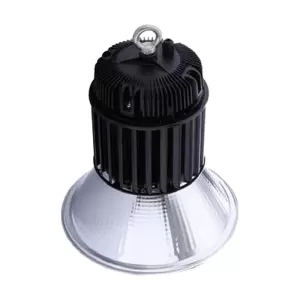
If the hall is unclassified. With GKP40G heat-pipe high bays at 150 W and 130 lm/W, the same calculation gives 45 fittings (9 × 5) at 4.4 m × 4.0 m spacing, about 575 lux.
The difference of five fittings is small; the difference in fitting and installation cost is not. It is worth getting a proper classification of the laminating hall, with the ventilation rate and resin consumption, before choosing. Our guide to Zone 1 vs Zone 2 explains the difference in requirements.
Inside the hull
Overhead lighting cannot reach the inside of a deep hull mould or a deck with returns. Laminators use portable lights inside the mould. In a classified hall these must be certified for the zone, and battery or low-voltage types reduce the risk from damaged cables. Our explosion-proof portable linear lights article covers the options.
Resin and overspray on fittings
Spray mist and resin dust settle on everything. Over months, a film on the lens can cut output noticeably, and styrene vapour attacks some plastics. Prefer fittings with glass lenses and metal housings, which tolerate solvent cleaning, and plan cleaning into the maintenance schedule. The BED’s flameproof chamber uses a glass window.
Curing, assembly and inspection
After laminating, hulls cure and are demoulded, trimmed, assembled and fitted out. These areas are usually unclassified. Grinding and trimming create glass and resin dust, which is an irritant but generally not treated as a combustible dust hazard in the same way as wood or flour; dust extraction is the main control. Final inspection of gelcoat is best done under high, even light with good colour rendering, often supplemented with angled light to show surface waves.
Fire safety and emergency lighting
Resin, catalyst and acetone make boat plants a high fire load. Emergency lighting along escape routes, rated for the zone where it passes through classified areas, is essential. Keep MEKP catalyst stores away from heat sources, including fittings, and follow the supplier’s storage guidance. For flammable liquid stores, see our flammable liquid storage room lighting guide.
What to send us
- Plant layout with heights and the area classification
- Which areas need inspection-level lighting (500 lux or more)
- Ventilation design for the laminating hall, if the classification is still open
- Supply voltage
We return a layout with Ex fittings where the classification requires them and standard high bays elsewhere.
Sources
Frequently asked questions
Do boat building plants need explosion-proof lighting?
In parts. Gelcoat and chopper-gun spray areas are classified hazardous areas, usually Zone 1 inside the booth and Zone 2 around it. Hand lay-up and infusion halls may be Zone 2 or unclassified, depending on how much styrene is released and how the hall is ventilated. The area classification decides.
What temperature class does styrene need?
Styrene's auto-ignition temperature is about 490 °C, which is temperature class T1. Almost every certified fitting is T1 or better. Acetone is also T1. The gas group for both is IIA.
How much light does fibreglass laminating need?
Laminators check wet-out, air bubbles and fibre orientation in translucent material, which needs good light from several directions. Around 500 lux with a colour rendering index of 80 or more is a practical target; final inspection and gelcoat repair benefit from more.
Does styrene damage light fittings?
Styrene vapour can attack some plastics and polycarbonate covers over time, and overspray and resin dust build up on lenses. Glass covers, metal housings and fittings that can be cleaned with solvent last longer in laminating halls.