Explosion-Proof Ceiling Lights for Low Rooms: Control Rooms, Corridors and Small Pump Rooms, Worked Out
Where a 15–30 W explosion-proof ceiling light fits, how many a control room, corridor or small pump room needs by our calculator, and the marking and cable entry to check.
Key points
- Explosion-proof ceiling lights are for rooms with ceilings of about 2.5–4 m, where a high bay or floodlight would be oversized and glaring.
- In our calculator, an 8 × 6 m control room with a 3.5 m ceiling needs nine 30 W BAD8501B fittings for 300 lux (310 lux achieved).
- A 20 m corridor, 2.4 m wide, needs nine 15 W fittings at 2.2 m spacing for 100 lux; a 6 × 4 m pump room needs four 30 W fittings for 200 lux.
- The BAD8501B is marked Ex d IIC T6 Gb and Ex tD A21 IP66 T80 °C, so it covers gas Zones 1/2 and dust Zones 21/22.
Most explosion-proof lighting guides talk about high bays and floodlights for process halls. Yet a large share of fittings on a chemical or fuel site go into small, low rooms: the control room next to a tank farm, the pump room under a loading rack, the corridor of an analyser house. In these rooms a 100 W high bay is too bright, too hot and too glaring. A compact ceiling fitting of 15–30 W does the job better. This guide works out how many you need, using our own fitting and calculator.
Where a ceiling fitting is the right choice
| Room | Typical ceiling | Typical target | Suitable power per fitting |
|---|---|---|---|
| Corridor, stairwell | 2.5–3 m | 100 lux | 15–20 W |
| Small pump or valve room | 3–4 m | 200 lux | 25–30 W |
| Control or analyser room | 3–3.5 m | 300 lux | 30 W |
| Battery room | 3–4 m | 200 lux | 20–30 W |
| Fuel station service room | 2.5–3 m | 200 lux | 20–30 W |
The targets follow EN 12464-1 practice for comparable rooms; your site standard may ask for more. Above about 4 m, the fitting count rises quickly and a mid-power light such as our BDE507 (20–70 W) becomes the better choice.
The fitting we used
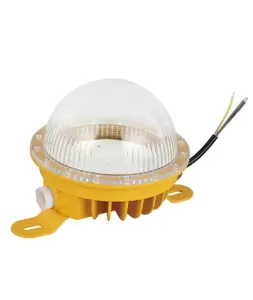
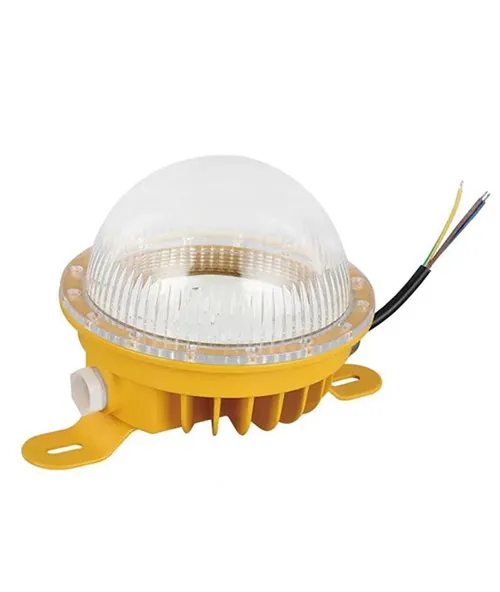
All examples use our BAD8501B explosion-proof ceiling light:
| Item | Value |
|---|---|
| Power | 15 / 20 / 25 / 30 W |
| Efficacy | ≥ 120 lm/W (1,800–3,600 lm) |
| Marking | Ex d IIC T6 Gb / Ex tD A21 IP66 T80 °C |
| Size and weight | Ø150 × 140 mm, 1.1 kg |
| Cable entry | G3/4″ for Ø10–14 mm cable |
| Supply | AC/DC 220 V; DC 24 V or AC/DC 36 V on request |
| Fasteners | 304 stainless steel |
Example 1: control room, 8 × 6 m, 3.5 m ceiling
A control room has screens and paperwork, so we aimed for 300 lux on the desk plane (0.8 m). Walls and ceiling are light, which helps. In our high bay lighting calculator (open the example):
| Result | Value |
|---|---|
| Room index | 1.27 |
| Utilisation factor | 0.57 |
| Fittings | 9 (3 × 3) |
| Spacing | 2.7 × 2.0 m |
| Average illuminance | 310 lux |
| Load | 5.6 W/m² |
Nine 30 W fittings give 310 lux at 270 W in total. With screens in the room, place the rows parallel to the desks and not directly above monitors, to keep reflections off the displays.
Example 2: corridor, 20 × 2.4 m, 3 m ceiling
For a corridor, 100 lux at floor level is a common target. Narrow rooms waste a lot of light on the walls, so the utilisation factor drops (open the example):
| Result | Value |
|---|---|
| Room index | 0.71 |
| Utilisation factor | 0.39 |
| Fittings | 9 in one row |
| Spacing | 2.2 m |
| Average illuminance | 105 lux |
Nine 15 W fittings, 135 W in total. The calculator shows that about 14 W per fitting would just reach 100 lux, so the smallest size is the right one. If you prefer fewer fittings, the 20 W size brings the count down to seven at about 2.9 m spacing, which is still well inside the spacing limit of 4.5 m for a wide beam at this height. Fewer fittings mean fewer glands and fewer flame paths to inspect, which on a hazardous site is worth more than the few watts saved.
Example 3: small pump room, 6 × 4 m, 3.5 m ceiling
Pump rooms need enough light to read gauges and work on seals: we used 200 lux at 0.8 m with medium reflectance, since pump room walls are rarely clean (open the example):
| Result | Value |
|---|---|
| Room index | 0.89 |
| Utilisation factor | 0.45 |
| Fittings | 4 (2 × 2) |
| Average illuminance | 214 lux |
| Load | 5.0 W/m² |
Four 30 W fittings. In practice, check the positions against pipework and motors: a fitting that ends up above a pump casing will leave the gauges on the far side in shadow. Moving one fitting to light the gauge panel directly is often better than a perfect grid.
Why the maintenance factor matters more in small rooms
All three examples use a maintenance factor of 0.8. In clean control rooms that is reasonable. In a pump room with oil mist, lens soiling is faster, and 0.7 is safer. Dropping to 0.7 in example 3 lowers the result by one eighth, to about 188 lux, which falls below target. You can then either clean more often or design for 0.7 from the start: the calculator then asks for six 30 W fittings (3 × 2), giving about 281 lux when new. Our explosion-proof light maintenance guide gives cleaning intervals.
Checks before ordering
- Marking against the zone drawing. Ex d IIC T6 Gb covers all gas groups and Zones 1 and 2. If the room is also a dust zone, check that 80 °C is below the dust limit; our class 1 vs class 2 hazardous locations article shows the calculation.
- Cable and gland. The G3/4″ entry takes Ø10–14 mm cable. Use a certified Ex d gland of the right size; never leave an unused entry open.
- Supply voltage. Control rooms on 24 V DC systems can use the DC 24 V version.
- Emergency lighting. Exit routes from hazardous-area rooms usually need emergency lighting too; our explosion-proof emergency exit lights article covers the options.
- Certificate. Our own certificate ZJEx23.0914 covers the BED series. For the BAD8501B we send the certificate that applies with the quotation, so you can check it against your area classification.
Ceiling fitting, panel or high bay?
| Option | Best for | Limitation |
|---|---|---|
| Ceiling fitting (15–30 W) | Rooms up to about 4 m, compact spaces | Many fittings needed in larger rooms |
| Explosion-proof panel | Offices and laboratories in Zone 2 with suspended ceilings | Needs a suitable ceiling grid |
| Mid-power round light (20–70 W) | Rooms of 4–6 m | Too bright for low corridors |
| High bay (100 W and up) | Halls above about 6 m | Glare and waste in low rooms |
Our explosion-proof panel light article compares the panel option for offices and labs.
What to send us
Send the room sizes, ceiling heights, the zone and gas group (and dust data if relevant), the supply voltage and the light level you need. We will reply with the fitting count and layout from our calculator and the marking of the fitting we propose.
Sources
Frequently asked questions
What is an explosion-proof ceiling light used for?
Lighting low rooms inside hazardous areas: control rooms, pump rooms, corridors, stairwells, battery rooms, analyser houses and fuel station service rooms. It mounts directly on the ceiling, so it suits ceilings of roughly 2.5–4 m.
How many explosion-proof ceiling lights does a room need?
Use the lumen method. In our calculator, an 8 × 6 m room with a 3.5 m ceiling needs nine 30 W fittings at 120 lm/W for 300 lux, and a 6 × 4 m room needs four for 200 lux.
What wattage explosion-proof ceiling light should I choose?
15–20 W for corridors and stairwells at about 100 lux; 25–30 W for pump rooms and control rooms at 200–300 lux. Above about 4 m, a higher-power fitting such as our BDE507 (20–70 W) is usually more economical.
Can an explosion-proof ceiling light be used in a dust area?
Only if it carries a dust marking. The BAD8501B is marked Ex tD A21 IP66 T80 °C, which covers Zone 21 and Zone 22. Check that 80 °C is below the limit set by your dust's ignition temperatures.
What voltage does the BAD8501B run on?
AC/DC 220 V as standard, with DC 24 V or AC/DC 36 V versions on request for low-voltage systems.