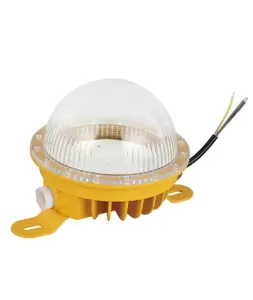
Explosion-Proof Panel and Ceiling Lights for Low Ceilings in Hazardous Rooms
Flat explosion-proof panel lights vs compact flameproof ceiling lights for control rooms, corridors and pump rooms under 4 m, with calculator layouts using our 15–30 W BAD8501B.
Key points
- Under a 3–4 m ceiling, a hazardous room needs low-wattage fittings at close spacing, not a few large high bays.
- Flat explosion-proof panels exist (mostly increased-safety or pressurised designs for clean rooms); compact flameproof ceiling lights are more common, cheaper and easier to certify for IIC.
- In our calculator, an 8 × 6 m control room with a 3 m ceiling reaches about 333 lux with nine 30 W BAD8501B fittings; a 20 × 2.5 m corridor reaches about 107 lux with seven 20 W fittings.
- 'Explosion-proof panel' can also mean a control panel or distribution board in an Ex enclosure, which is a different product from a light.
Most explosion-proof lighting guides assume a tall plant room where a 100 W or 200 W fitting hangs from the roof steel. Many hazardous rooms are nothing like that: control rooms in Zone 2, analyser shelters, solvent stores, battery rooms, pharmaceutical suites and corridors with a ceiling at 3 m. Buyers then search for an “explosion-proof panel light”, hoping for something like an office panel with a certificate. This guide sets out the real options for low ceilings and shows layouts from our calculator.
Two meanings of “explosion-proof panel”
Before choosing a light, check which product the drawing means:
- A panel light: a flat or shallow luminaire for a hazardous area.
- A control panel or distribution board in an explosion-proof enclosure, holding breakers, contactors or lighting controllers. That is an Ex d or Ex e box with equipment inside, closer to our explosion-proof junction box guide than to a light.
The rest of this article is about the first meaning.
Options for ceilings under 4 m
Flat explosion-proof panels
Flat panels for hazardous areas do exist. They are mostly used in clean rooms and laboratories where a flush, washable ceiling matters. To stay thin, they usually rely on increased safety (Ex e) for the housing, encapsulation (Ex m) for the driver, or pressurisation (Ex p) where the room has a purge system. Gas group IIB is common; IIC flat panels are rarer, because IIC places tight limits on flame paths and joints.
Compact flameproof ceiling lights
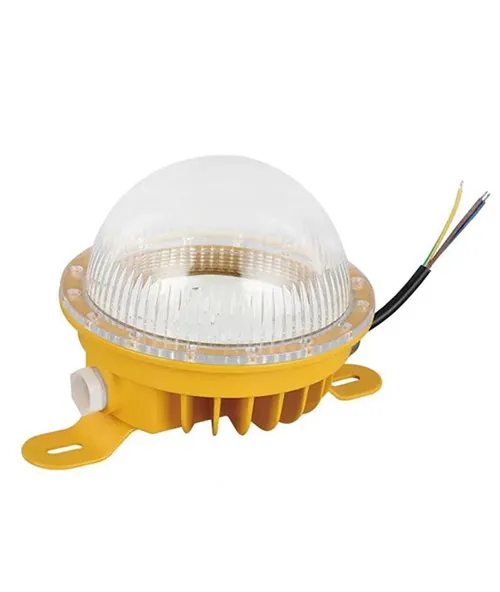
The more common choice is a small round or square flameproof (Ex d) fitting mounted directly to the ceiling. It is deeper than a panel, but it is robust, easy to certify for IIC and simple to maintain. Our BAD8501B ceiling light is this type:
| Item | BAD8501B |
|---|---|
| Power | 15, 20, 25, 30 W |
| Marking | Ex d IIC T6 Gb / Ex tD A21 IP66 T80 °C |
| Efficacy | ≥ 120 lm/W |
| Size | Ø150 × 140 mm, 1.1 kg |
| Supply | AC/DC 220 V (DC 24 V or AC/DC 36 V on request) |
| Fasteners | 304 stainless steel |
For larger rooms or taller ceilings, the BED series (30–600 W, Ex db eb mb IIC T4 Gb, our own certificate ZJEx23.0914) takes over.
Linear explosion-proof fittings
Linear tube-style fittings are a third option for corridors and long rooms. Our explosion-proof linear and work lights article covers them.
Layouts from our calculator
All three examples use the BAD8501B at its rated 120 lm/W and a wide beam in our high bay lighting calculator, which works for any room size. Maintenance factor is the default 0.8.
Control room, 8 × 6 m, 3 m ceiling, 300 lux
Control rooms in classified areas are usually Zone 2. With light-coloured walls and 30 W fittings (open the example):
- 9 fittings in a 3 × 3 grid, about 2.7 × 2.0 m apart;
- about 333 lux average;
- 5.6 W per m².
The calculator says 27 W per fitting would be enough for 300 lux on that grid, so 30 W gives a little headroom for dirt and ageing.
Corridor, 20 × 2.5 m, 3 m ceiling, 100 lux
For a corridor we set the working plane at floor level. With 20 W fittings (open the example):
- 7 fittings in one row, about 2.9 m apart;
- about 107 lux average.
A narrow corridor wastes a lot of light on the walls, so the fittings sit closer than their beam alone would suggest.
Pump room, 6 × 5 m, fittings at 3.5 m, 150 lux
With 25 W fittings (open the example):
- 4 fittings, 2 × 2;
- about 154 lux average.
If the room has tall equipment, add one or two fittings where shadows fall on gauges and valves.
Choosing between a panel and a ceiling fitting
| Question | Flat panel | Compact Ex d ceiling light |
|---|---|---|
| Ceiling finish matters (clean room)? | Better | Acceptable with a surface mount |
| Gas group IIC needed? | Limited choice | Common |
| Corridors, pump rooms, stores? | Over-specified | Good fit |
| Impact and wash-down? | Check rating | Robust, IP66 on BAD8501B |
| Replacement parts on site? | Specialist | Simple |
For most industrial rooms, compact ceiling fittings are the practical answer. Flat panels earn their cost where hygiene or ceiling appearance is part of the specification.
Installation points for low ceilings
- Keep clearance from the ceiling. Flameproof joints must not be blocked or painted, and the fitting needs some air around it to cool. Our explosion-proof light installation guide lists the steps.
- Use certified glands. A IIC light fed through a IIB gland makes a IIB installation.
- Plan switching. Switches in the room must also be certified, or placed outside; see hazardous area light switches.
- Emergency lighting. Low-ceiling rooms often need emergency fittings too; see explosion-proof emergency and exit lights.
Common mistakes
- Using one big fitting under a low ceiling. A single 100 W light at 3 m creates a hot spot and dark corners.
- Ignoring the temperature class of solvents. A T4 light in a carbon disulphide store is not acceptable.
- Buying an “Ex-look” panel without a certificate. Ask for the certificate number and check it with the issuing body.
What to send us
Room sizes, ceiling heights, zone, gas group and temperature class, and the target lux. We will reply with a layout from our calculator, the model, its marking and the certificate.
Sources
Frequently asked questions
What is an explosion-proof panel light?
A flat or low-profile luminaire certified for hazardous areas, used where the ceiling is low or a flush finish is wanted, such as clean rooms, control rooms and laboratories. Most use increased safety (Ex e) or encapsulation (Ex m) rather than a heavy flameproof housing.
Can I use a normal LED panel in a Zone 2 room?
No. Every luminaire in a classified zone must be certified for that zone, gas group and temperature class. A standard office panel has no such certification.
How many explosion-proof ceiling lights does a small room need?
In our calculator, a 6 × 5 m pump room with fittings at 3.5 m reaches about 154 lux with four 25 W BAD8501B lights. Larger or brighter rooms scale up from there.
Which temperature class do I need for a solvent store?
It depends on the solvents. Many common solvents are T3 or T4; carbon disulphide needs T6. The BAD8501B is marked T6, which covers all of them; check your area classification.
Is the BAD8501B certificate your own?
Our own explosion-proof certificate covers the BED series. For the BAD8501B, the certificate for the exact model is supplied with the quotation.