
Lighting for Aluminium and Metal Powder Areas: Why Conductive Dust Changes the Rules
Aluminium and other metal powders are conductive dusts (group IIIC, Class II Group E). What that means for lighting, why water makes it worse, and a 24 × 12 m powder room calculated.
Key points
- Metal dusts such as aluminium and magnesium are conductive, group IIIC. Equipment marked IIIA or IIIB is not suitable, and in Zone 22 the enclosure must still be dust-tight (IP6X).
- In the US National Electrical Code, areas with hazardous quantities of Group E metal dust are Class II, Division 1; there is no Division 2 relaxation for Group E.
- Wet aluminium or magnesium dust can release hydrogen, so a metal powder room may need gas protection for group IIC as well as dust protection.
- For a 24 × 12 m powder room at 7 m and 300 lux, our calculator gives 15 BED fittings of 120 W (about 312 lux), certified Ex db eb mb IIC T4 Gb and Ex tb IIIC T130 °C Db.
Most combustible dust guidance is written with grain, flour, wood or sugar in mind. Metal powders follow the same principles but add two complications: the dust conducts electricity, and some metals react with water. Both affect what lighting is allowed. This guide covers aluminium and similar powders in atomising and milling plants, powder coating and additive manufacturing rooms, and grinding and polishing shops.
Where metal dust occurs
| Process | Typical dust | Where it collects |
|---|---|---|
| Atomising and milling aluminium powder | Very fine aluminium | Inside process equipment, collectors, packing |
| Additive manufacturing (powder-bed printing) | Aluminium, titanium alloy powders | Powder handling, sieving, depowdering stations |
| Grinding, polishing, deburring aluminium parts | Fine aluminium, often mixed with abrasive | Dust collectors, ducts, around machines |
| Magnesium machining | Fine magnesium chips and dust | Under machines, in collectors |
| Metal pigment and paste production | Aluminium flake | Mixing and packing |
The highest-risk places are usually the dust collector and its ducting, where fine dust accumulates out of sight. Lighting fittings are seldom inside them, but they are in the rooms around them, and dust escapes.
Why conductive dust is different
IEC divides combustible dusts into three groups:
| Group | Dust type | Example |
|---|---|---|
| IIIA | Combustible flyings | Fibres, lint |
| IIIB | Non-conductive dust | Flour, sugar, wood |
| IIIC | Conductive dust | Aluminium, magnesium, carbon black |
Equipment is marked with the highest group it can be used in. A IIIC fitting may be used for IIIB and IIIA dusts, but not the other way round. Conductive dust that gets into an enclosure can bridge terminals and cause tracking or short circuits, so the requirements for IIIC are tighter. Under IEC 60079-14, Zone 22 with non-conductive dust allows IP5X, but Zone 22 with conductive dust needs IP6X.
In North America, metal dusts are Class II, Group E. The NEC treats locations with hazardous quantities of Group E dust as Division 1; the Division 2 relaxation available for other dusts does not apply. Our Class II Division 1 lighting guide explains the Division requirements.
The hydrogen problem
Finely divided aluminium and magnesium react with water and release hydrogen. Sources of water in a metal powder area include wet cleaning, roof leaks, condensation on cold surfaces and wet-type dust collectors. NFPA 484 restricts water in metal powder areas for this reason, and some sites classify a gas zone near wet collectors.
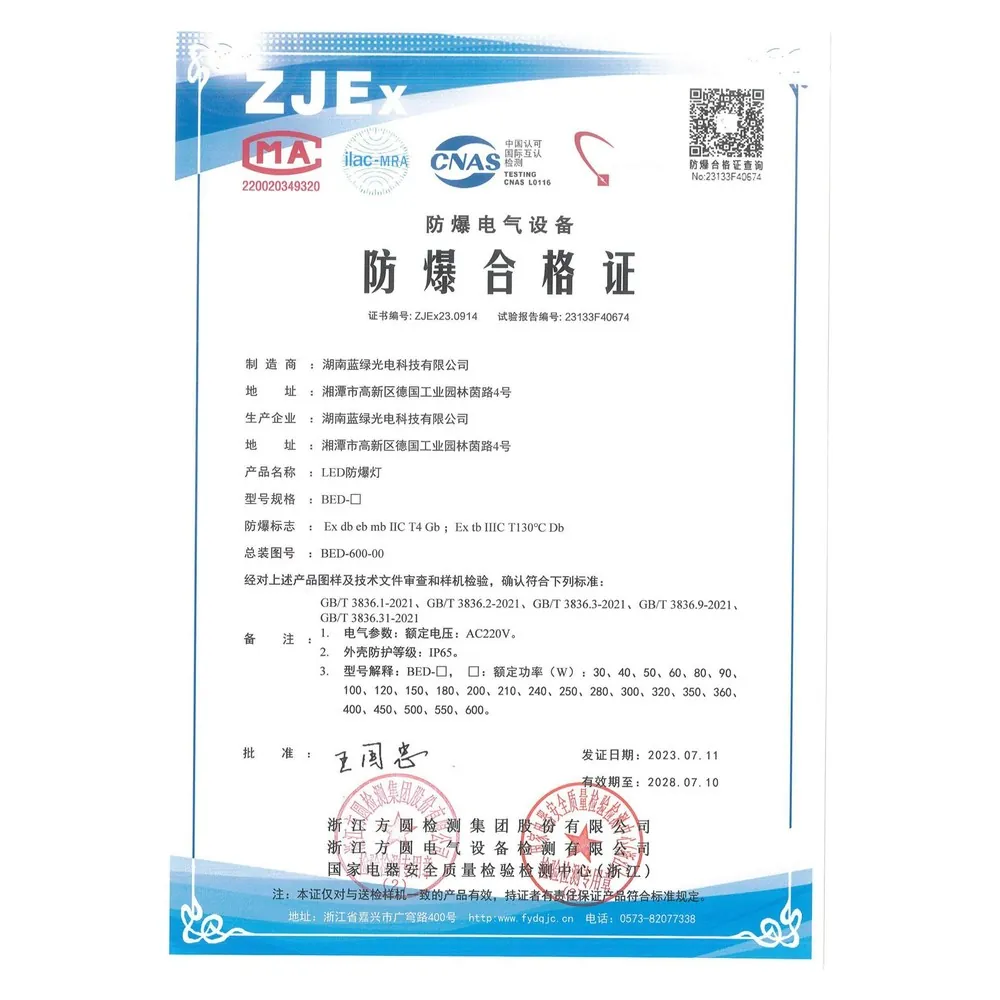
Hydrogen is gas group IIC, the most demanding group. A fitting that is certified only for dust, or only for gas groups IIA or IIB, would not cover it. Our BED explosion-proof LED light is certified for both:
| Marking | Meaning for a metal powder room |
|---|---|
| Ex db eb mb IIC T4 Gb | Zone 1 and 2 gas, including hydrogen (group IIC) |
| Ex tb IIIC T130 °C Db | Zone 21 and 22 dust, including conductive metal dust |
| IP65 | Dust-tight |
The certificate is ZJEx23.0914 under GB 3836, valid to July 2028. It is not an ATEX or IECEx certificate; tell us if your project needs one. Our hydrogen explosion-proof lighting guide covers the gas side in more detail.
Surface temperature
Metal dusts have their own ignition temperatures, and layers of some metal dusts ignite at lower temperatures than the cloud. Apply the IEC 60079-14 limits: maximum surface temperature no higher than two-thirds of the cloud ignition temperature, and no higher than the 5 mm layer ignition temperature minus 75 K. Use the test data for your powder, because particle size and oxide content change the results. The BED’s T130 °C rating gives a large margin for most published values, but check, and keep layers thin.
Calculating a powder handling room
Take a powder handling room of 24 × 12 m with a 7 m roof, medium reflectance and 300 lux on the working plane, enough for weighing, labelling and inspection. Using BED fittings at 120 W and a conservative 110 lm/W, our high bay lighting calculator gives:
| Result | Value |
|---|---|
| Room index | 1.29 |
| Fittings | 15 (5 × 3) |
| Spacing | 4.8 m × 4.0 m |
| Average illuminance | about 312 lux |
| Power density | 6.25 W/m² |
The calculator also reports that 116 W per fitting would just reach 300 lux with 15 fittings, so 120 W, one of the BED series’ certified power steps, is the right choice. Going up to 150 W would allow fewer fittings but larger gaps, which matters in a room where shadows hide dust.
Practical installation points
- Keep fittings out of the dust path. Do not mount directly above depowdering stations, sieves or bag openings.
- Seal every entry. Use certified glands and stopping plugs. Conductive dust in a terminal box is exactly the failure IIIC rules are meant to prevent.
- Bond everything. Metal powders charge easily. Fittings, brackets and conduit must be bonded to the site earthing system.
- Plan cleaning, not washing. Use approved vacuum cleaning; avoid hosing fittings down.
- Check heat around furnaces. Atomising and heat-treatment areas can be hot near the roof. The BED’s ambient rating should be checked against measured temperatures.
Grinding shops: classified or not?
An ordinary fabrication shop that grinds aluminium occasionally, with an effective dust collector and good housekeeping, is often unclassified around the machines, with the hazard confined to the collector. A shop doing continuous polishing of aluminium parts may be different. The area study decides. If the shop is unclassified, ordinary industrial high bays are allowed, and our explosion-proof requirement guide explains the reasoning.
Emergency and escape lighting
Metal powder fires are hard to fight, and evacuation needs to be quick. Emergency fittings in classified areas must carry the same IIIC and, if relevant, IIC protection as the normal ones. Light the route from each workstation to the nearest exit, and the emergency stops on process equipment.
What to send us
- Room plan and roof height
- The area classification, including any gas zones near wet collectors
- Powder type and, if available, ignition test data
- Supply voltage and emergency lighting needs
We reply with a fitting choice and layout. For the general dust-area method, see our Zone 21 and 22 guide.
Sources
Frequently asked questions
Is aluminium dust explosive?
Yes. Fine aluminium powder dispersed in air can explode, and metal dust explosions tend to be more violent than those of organic dusts. Coarse chips and turnings are much less hazardous, but grinding and polishing produce fine dust that collects in ducts and filters.
What group is aluminium dust in?
IEC classifies it as group IIIC, conductive dust. In the NEC it is Class II, Group E. Equipment for metal dust areas must be marked IIIC, or listed for Group E.
Why is water a problem with aluminium dust?
Aluminium and magnesium react with water, especially when finely divided, and release hydrogen. Wet cleaning, leaks or condensation can therefore add a flammable gas hazard to the dust hazard, and NFPA 484 restricts the use of water for this reason.
Can I use a IIIB dust-rated light in a metal powder room?
No. IIIB covers non-conductive dust only. Conductive dust can enter and bridge electrical parts, so IIIC equipment has stricter requirements. Check that the marking says IIIC.
