Explosion-Proof Lighting for Hydrogen: Electrolyser Halls, Compressor Rooms and Refuelling Stations
What hydrogen areas need from light fittings: gas group IIC or IIB+H2, why ceiling lights sit in the riskiest zone, temperature class, and a 24 × 12 m electrolyser hall worked example.
Key points
- Hydrogen is a group IIC gas; fittings must be marked IIC or IIB+H2. A plain IIB light is not acceptable.
- Hydrogen ignites at about 560 °C, so T1 is enough for hydrogen alone; most sites still specify T3 or T4 because other gases are present.
- Hydrogen rises: in an indoor hall the zone near the roof, where the lights hang, is often the most hazardous part of the room.
- By our lighting calculator, a 24 × 12 m hall with a 6 m roof needs 15 IIC fittings of 70 W for about 194 lux average.
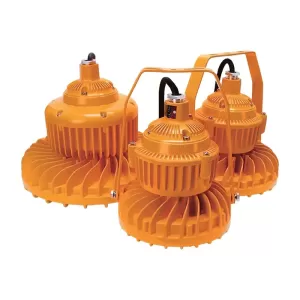
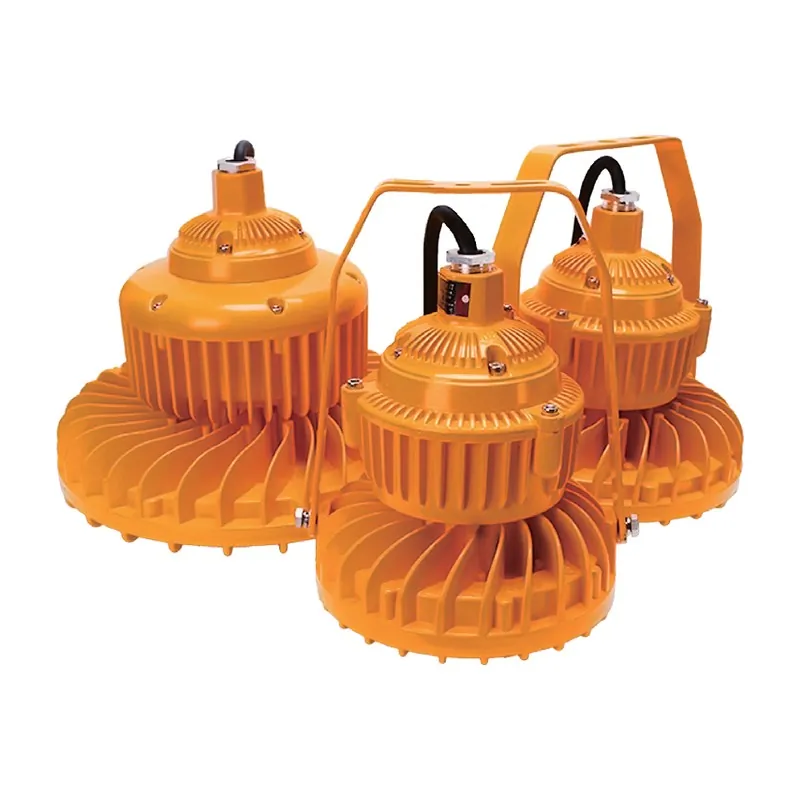
- Our BED series (Ex db eb mb IIC T4 Gb, certificate ZJEx23.0914) and BDE507 (Ex d IIC T6 Gb) are both IIC fittings.
Electrolysers, fuel-cell test benches, hydrogen compressors and refuelling stations are being built in places that have never had a hazardous-area drawing before. Lighting is usually one of the first items on the electrical list, and hydrogen changes the specification in a few specific ways. This guide explains what changes, where the lights should go, and how many fittings a typical hall needs.
Why hydrogen is different
| Property | Hydrogen | Propane (for comparison) |
|---|---|---|
| Gas group | IIC | IIA |
| Auto-ignition temperature | about 560 °C (T1) | about 450 °C (T2) |
| Flammable range in air | about 4–75 % by volume | about 2.1–9.5 % |
| Minimum ignition energy | about 0.017 mJ | about 0.25 mJ |
| Density relative to air | about 0.07 (rises) | about 1.5 (sinks) |
Three of these matter for lighting:
- Group IIC. Hydrogen flames pass through narrower gaps than other gases, so flameproof joints must be tighter. Only fittings tested for IIC (or IIB+H2) are acceptable. Our IIB vs IIC article shows which gases fall in which group.
- Wide flammable range and very low ignition energy. A small leak quickly forms an ignitable mixture, and a tiny spark is enough.
- It rises. Hydrogen escapes upward and collects under roofs and in ceiling pockets, which is where light fittings are usually hung.
IIC or IIB+H2?
The marking “IIB+H2” means the equipment passed the IIB tests plus hydrogen, but not acetylene or carbon disulphide. In a hydrogen plant without acetylene, IIB+H2 is acceptable. A plain IIC fitting covers all gases and avoids the question if the area list changes later. Our guide on reading an Ex marking explains where the group sits in the label.
Temperature class
Hydrogen alone needs only T1, because its ignition temperature is about 560 °C. In practice, most hydrogen sites specify T3 or T4 because:
- electrolyte mist, cleaning solvents or nearby process gases may have lower ignition temperatures;
- one specification for the whole site is simpler to manage.
Our T3 vs T4 article shows how to check the temperature class against each substance.
Where the zones end up in a hall
Area classification under IEC 60079-10-1 depends on release sources, release rates and ventilation, so every building is different. A common pattern in indoor hydrogen rooms is:
- Zone 2 around flanges, valves, compressor seals and vent stacks;
- an extended zone, sometimes Zone 1, in the roof void if hydrogen can collect there and ventilation does not clear it quickly;
- non-hazardous floor areas when ventilation is strong and well monitored.
Because hydrogen rises, the roof is often the worst place for a fitting, not the safest. Many designers:
- mount lights on walls or columns below the roof void;
- keep fittings away from roof ventilators and the discharge paths of vents;
- specify lights for the roof-level zone even if the floor is non-hazardous.
Battery rooms with lead-acid batteries release hydrogen too; our battery room lighting guide covers that smaller case.
Worked example: a 24 × 12 m electrolyser hall
Assume a hall 24 m long, 12 m wide, with lights mounted at 6 m and a target of 150 lux average on the floor for general operation and inspection. Using our BDE507 at 70 W and 110 lm/W, medium surface reflectance and a maintenance factor of 0.8, our lighting calculator gives:
| Result | Value |
|---|---|
| Room index | 1.54 |
| Utilisation factor | 0.60 |
| Fittings by the lumen method | 12 |
| Fittings after the spacing check | 15 (5 × 3) |
| Spacing | 4.8 m × 4.0 m |
| Average illuminance | about 194 lux |
| Lighting power density | 3.65 W/m² |
The spacing rule (no more than 1.2 times the mounting height for a medium beam) adds three fittings above the lumen-method minimum. The calculator also shows that about 54 W per fitting would meet 150 lux on the same grid, so the 60 W version of the BDE507 would also do. If a higher target is required around the stacks, for example 300 lux for maintenance, add local fittings there rather than raising the whole grid.
For a larger hall or a higher roof, our BED series runs from 30 W to 600 W under one certificate (ZJEx23.0914), marked Ex db eb mb IIC T4 Gb.
Outdoor hydrogen: refuelling stations and storage
Outdoors, hydrogen disperses quickly, and zones around dispensers, compressors and storage tubes are usually small. Lighting choices follow the same rules as for any forecourt:
- Canopy lights above dispensers sit where hydrogen would rise from a leak, so check them against the zone drawing.
- Floodlights for storage areas are best placed outside the zones and aimed in, which allows ordinary fittings.
- Emergency lighting along escape routes should keep the same IIC rating as the general lights inside the zone.
A note on hydrogen flames
Hydrogen burns with a nearly invisible flame in daylight. Good lighting does not make a hydrogen fire visible. That is the job of flame detectors and thermal cameras. Lighting matters for safe access, inspection and escape, so it should stay on, or switch to emergency mode, during an incident.
Checklist for your enquiry
- Area drawing with zones, including the roof void
- Gas list (hydrogen only, or other substances too)
- Required certificate scheme: IECEx, ATEX or national
- Mounting heights and target lux levels
- Ambient temperature range, indoors and out
Our oil and gas plant lighting guide and our Class/Division vs Zone comparison are useful if your project mixes hydrogen with other process units. Send us the five items above and we will reply with a fitting list and a layout check like the one shown here.
Sources
Frequently asked questions
What gas group is hydrogen?
Hydrogen is in group IIC, together with acetylene and carbon disulphide. Equipment must be marked IIC, or IIB+H2, which covers IIB gases plus hydrogen but not acetylene or carbon disulphide.
What temperature class does hydrogen need?
Hydrogen's auto-ignition temperature is about 560 °C, so T1 (450 °C) is enough for hydrogen alone. If other gases or vapours are present, the lowest ignition temperature among them decides, which is why T3 or T4 is common.
Where should lights go in a hydrogen room?
Hydrogen rises and collects under the roof. Fittings near the ceiling are therefore often in the most hazardous zone and must suit it. Many designers mount lights on walls below the roof void, away from vents and release points.
Are your explosion-proof lights suitable for hydrogen?
The BED series is marked Ex db eb mb IIC T4 Gb under our own certificate ZJEx23.0914 (GB 3836), and the BDE507 is marked Ex d IIC T6 Gb, with its certificate supplied with the quotation. Both cover group IIC. Whether they may be installed depends on the certificate scheme your site requires.