Oil and Gas Plant Lighting: Zones, Gas Groups, Temperature Classes and a Loading Rack Example
How to light refineries, tank farms, loading racks and fuel stations: matching zone, gas group and T-class to each area, a worked loading rack layout, emergency lighting and maintenance.

Key points
- Each area of an oil and gas site has its own classification: zone, gas group and temperature class. The lighting must match all three, area by area.
- Most hydrocarbons are gas group IIA and ignite above 200 °C, so IIA or IIB and T3 or T4 lights suit many areas; hydrogen units need group IIC.
- In our calculator, a 24 × 12 m loading rack canopy at 7 m reaches about 109 lux with 8 explosion-proof floodlights of 100 W at 110 lm/W.
- Plan explosion-proof emergency lighting for escape routes, and an inspection regime that keeps every fitting's protection intact.
Oil and gas sites mix large outdoor areas, process units, tank farms, loading facilities and ordinary buildings on one site. Some areas are hazardous all the time, some only occasionally, and many not at all. Lighting them well means choosing the right protection for each area, not putting the heaviest explosion-proof fitting everywhere. This guide walks through the classification, a worked layout and the practical points that keep a hazardous-area installation safe over the years.
Start from the area classification drawings
Every refinery, terminal and gas plant should have area classification drawings prepared to IEC 60079-10-1 or an equivalent code. For each area they give three things the lighting must match:
| Item | What it means | Typical values on an oil and gas site |
|---|---|---|
| Zone | How often an explosive atmosphere is present | Zone 1 near vents, pumps and loading arms; Zone 2 around them |
| Gas group | How easily the gas ignites | IIA (propane, petrol, most hydrocarbons), IIB (ethylene), IIC (hydrogen) |
| Temperature class | Maximum surface temperature allowed | T3 (200 °C) for most fuels; T4 (135 °C) for more margin |
A light certified for Zone 1, IIC, T4 can be used in Zone 2 IIA T3 areas too, because it exceeds each requirement. The reverse is not true. Our Zone 1 vs Zone 2 guide explains the difference in detail.
Typical areas and what they need
| Area | Usual classification | Lighting approach |
|---|---|---|
| Process units | Zone 1 and 2, IIA–IIB, IIC where hydrogen is used | Floodlights and linear fittings on structures |
| Hydrogen and reformer units | Zone 1 and 2, IIC | IIC-certified fittings only |
| Tank farms | Zone 1 inside bunds near vents, Zone 2 around | Floodlights on poles outside the bund, aimed in |
| Loading racks (road and rail) | Zone 1 near loading arms, Zone 2 under canopy | Canopy floodlights or linear fittings |
| Pump and compressor houses | Zone 1 or 2 depending on ventilation | High bays or floodlights inside |
| Fuel station forecourts | Zones around dispensers and vents | Canopy lights, certified where inside zones |
| Control rooms, offices, workshops | Usually unclassified | Normal industrial or commercial fittings |
Worked example: a loading rack canopy
Take a road tanker loading rack under a 24 × 12 m canopy, fittings at 7 m, a target of 100 lux at ground level, medium reflectances, a wide beam and a conservative maintenance factor of 0.7 for a dirty environment. Using the lumen method in our high bay calculator with explosion-proof floodlights at 110 lm/W:
| Option | Fittings | Layout | Average lux |
|---|---|---|---|
| 100 W | 8 | 4 × 2, 6 m × 6 m | 109 |
| 150 W | 6 | 3 × 2, 8 m × 6 m | 122 |
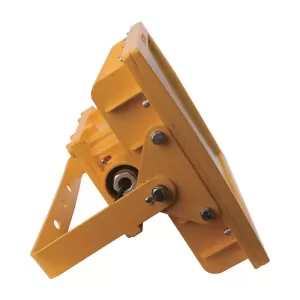
Our ExF explosion-proof floodlight, Ex d IIB T6 Gb, IP67, WF2 corrosion protection, 110 lm/W, 50–150 W, is marked for a petrol or diesel loading rack (group IIA–IIB) in Zone 1 or 2; we send the certificate that applies to the model with the quotation. Fewer, higher-power fittings mean fewer cable entries and glands to maintain; more fittings give better uniformity and a margin if one fails.
Where hydrogen or dust is involved
Hydrogen units, some chemical plants and sites with combustible dust need more. Our BED explosion-proof LED light is marked Ex db eb mb IIC T4 Gb for gas and Ex tb IIIC T130 °C Db for dust, IP65, 30–600 W, and holds certificate ZJEx23.0914 under GB 3836 (aligned with IEC 60079), valid to July 2028. IIC covers hydrogen and acetylene; the dust marking covers Zone 21 and 22.
A note on certificates: GB 3836 is the Chinese national scheme. Many projects outside China require ATEX, IECEx or a national scheme instead. We do not hold ATEX or IECEx certificates for these series, so check what your site accepts before ordering. Our explosion-proof vs flameproof guide explains how to read the markings.
Fuel stations
A petrol station is a small oil and gas site. Areas around dispensers, fill points and vents are classified; much of the canopy may not be. The station’s classification drawing decides which canopy lights must be certified. We supplied the forecourt lighting for a Sinopec petrol station in Xiangtan; our canopy lights guide covers forecourt design.
Emergency and escape lighting
Escape routes through classified areas need emergency lighting that is itself certified for the area. The BG-FBYJ10A explosion-proof emergency light, Ex d IIC T4, gives 2 hours of emergency operation from twin 10 W heads; as with the ExF, its certificate comes with the quotation. Our explosion-proof emergency exit lights guide covers duration, placement and testing.
Installation and inspection
Most hazardous-area faults are created after installation. IEC 60079-14 covers installation and IEC 60079-17 inspection. Key points:
- use certified cable glands and stopping plugs that match the fitting’s protection type;
- do not paint or damage flame-path joints, and refit covers with every bolt;
- keep the fitting’s certificate and installation instructions on file;
- inspect visually at regular intervals and in detail on a longer cycle;
- replace drivers or parts only with those the certificate allows.
Summary
Light an oil and gas site area by area, from the classification drawings: match zone, gas group and temperature class, and use normal fittings where the area is unclassified. In our example, 8 × 100 W explosion-proof floodlights light a 24 × 12 m loading rack to about 109 lux. Check that the certificate is one your site accepts, plan certified emergency lighting, and keep every fitting’s protection intact through proper installation and inspection.
Sources
Frequently asked questions
What lighting is used in refineries?
Explosion-protected floodlights, high bays, linear fittings and emergency lights, each certified for the zone, gas group and temperature class of the area where it is installed. Outside classified areas, normal industrial fittings can be used.
Do all lights in an oil and gas plant need to be explosion-proof?
No, only those inside classified hazardous areas. Offices, control rooms, workshops and many roads are often unclassified. The site's area classification drawings decide.
Which gas group is needed for hydrogen?
Group IIC. Hydrogen and acetylene ignite very easily, and equipment for them is tested to the strictest flame-path requirements. A IIB light is not suitable.
What temperature class do refinery lights need?
It depends on the lowest ignition temperature of the gases present. T3 (200 °C) covers most fuels and many hydrocarbons; T4 (135 °C) adds margin and covers more substances; T6 is needed only for a few, such as carbon disulfide.