Battery Room Lighting: When It Must Be Explosion-Proof, and How to Size the Hydrogen Risk
Charging batteries release hydrogen, a group IIC gas. How to work out the ventilation and the safety distance from IEC 62485-2, when the lights must be Ex rated, and a worked room layout.
Key points
- Lead-acid and nickel-cadmium batteries give off hydrogen while charging, most of all during boost or equalising charge. Hydrogen is in gas group IIC, so any Ex light used must be IIC.
- IEC 62485-2 gives the airflow needed to keep hydrogen well below its lower explosive limit: Q = 0.05 × n × Igas × Crt / 1000 m³/h. For 120 VRLA cells of 500 Ah that is 3 m³/h on float and 24 m³/h on boost.
- Even in a ventilated room, the standard keeps a safety distance around cell vents: about 0.46 m for 500 Ah VRLA cells on boost and 0.62 m for vented cells, by its formula. Keep lights and switches outside it.
- In our calculator, an 8 × 5 m battery room with fittings at 3.5 m reaches about 217 lux with six 30 W IIC-rated lights.
A UPS room, a telecom shelter, a substation battery room or a forklift charging bay all have one thing in common: batteries that release hydrogen while they charge. Whether the lights in that room must be explosion-proof depends on how much hydrogen is produced, how well it is removed, and how close the fittings sit to the cells. This guide works through all three with the formulas from IEC 62485-2, then lays out a typical room.
Where the hydrogen comes from
Vented lead-acid, valve-regulated lead-acid (VRLA) and nickel-cadmium batteries all electrolyse a little water into hydrogen and oxygen while charging, especially near full charge. The rate rises sharply during a boost or equalising charge. VRLA cells recombine most of the gas internally, so they release less than vented cells, but not zero, and much more if they are overcharged or overheated.
Hydrogen has three properties that matter for lighting:
- It is in gas group IIC, the most easily ignited group, together with acetylene.
- Its lower explosive limit is 4 % by volume in air.
- It is very light, so it collects at the ceiling, exactly where the lights are.
Step 1: how much ventilation is needed
IEC 62485-2 gives the airflow needed to keep hydrogen well below the lower explosive limit:
Q = 0.05 × n × Igas × Crt / 1000 (m³/h)
where n is the number of cells, Crt the rated capacity in Ah, and Igas the gas-producing current per Ah, taken from the standard’s tables. The usual values are 1 mA/Ah on float and 8 mA/Ah on boost for VRLA cells, and 5 and 20 mA/Ah for vented cells.
Worked for a 240 V UPS string of 120 cells at 500 Ah:
| Battery type | Charge mode | Igas (mA/Ah) | Airflow Q |
|---|---|---|---|
| VRLA | Float | 1 | 3 m³/h |
| VRLA | Boost | 8 | 24 m³/h |
| Vented | Float | 5 | 15 m³/h |
| Vented | Boost | 20 | 60 m³/h |
These are modest flows; natural ventilation through high and low openings often achieves them, and a small extract fan certainly does. When ventilation of this kind is in place and monitored, most authorities do not classify the whole room as a hazardous area.
Step 2: the safety distance around the cells
Ventilation dilutes hydrogen across the room, but right at a cell vent the concentration is higher. The same standard sets a safety distance within which no sparking or hot equipment should be placed:
d = 28.8 × ∛(Igas × Crt) (mm)
For the 500 Ah example:
| Battery type | Mode | Igas × Crt | Safety distance |
|---|---|---|---|
| VRLA | Boost | 4,000 | about 0.46 m |
| Vented | Boost | 10,000 | about 0.62 m |
In practice this means: do not mount a light, switch, socket or junction box directly over the cell vents within that distance. With lights at ceiling height above racks, the distance is normally met with room to spare, but a low pendant fitting over a tall rack may not meet it.
Step 3: decide whether the lights must be Ex
| Situation | Usual lighting choice |
|---|---|
| Ventilation to IEC 62485-2, lights outside the safety distance | Sealed industrial fittings (IP54 or better) are generally accepted |
| Ventilation uncertain, sealed room, or the authority classifies the room Zone 2 | Ex lights with EPL Gc or better, gas group IIC |
| Room classified Zone 1 (poor ventilation, large vented banks, frequent boost charging) | Ex lights with EPL Gb, gas group IIC |
| Any light inside the safety distance | Avoid; relocate the fitting |
The decision belongs to the site’s risk assessment and the local code, but the pattern above is common. Our guide on when explosion-proof lighting is required explains the classification duty in general.
Choosing an IIC light
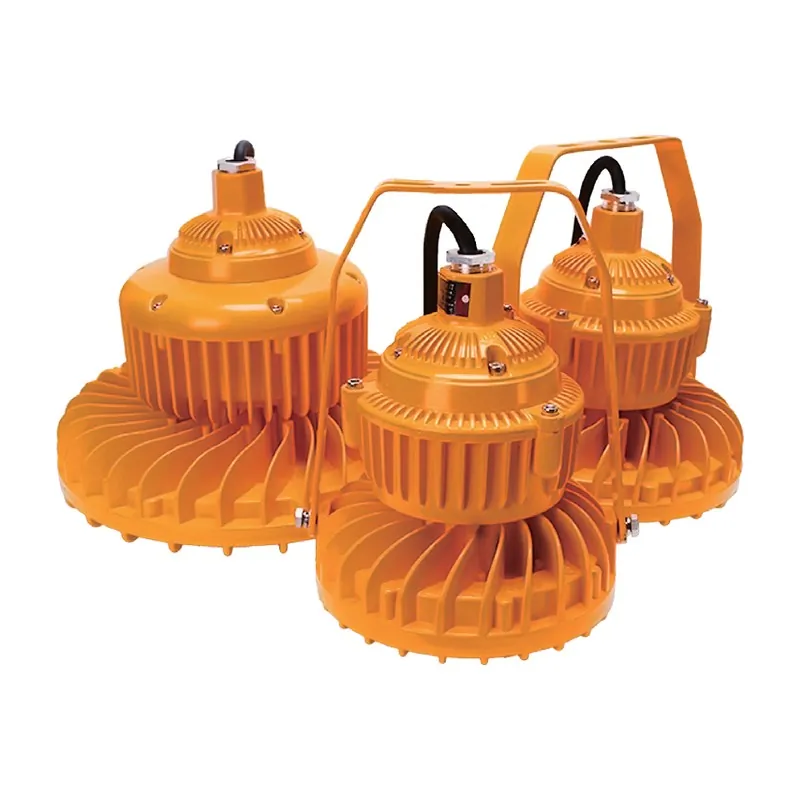
If Ex lights are needed, the marking must include IIC. Hydrogen’s ignition temperature is high (about 560 °C), so any temperature class is acceptable. Two of our series fit:
- BDE507, 20–70 W, marked Ex d IIC T6 Gb, IP66, 110 lm/W. A compact round fitting for ceiling, wall or pendant mounting; its certificate is supplied with the quotation.
- BED series, 30–600 W, marked Ex db eb mb IIC T4 Gb, covered by our own certificate ZJEx23.0914 (valid to July 2028).
Both are Gb, so they cover Zone 1 and Zone 2. Our IIB vs IIC gas groups article explains why a IIB light is not enough here.
Worked layout: an 8 × 5 m battery room
A UPS battery room of 8 × 5 m, light-coloured walls, fittings at 3.5 m, target 200 lux at 0.8 m for reading cell labels and taking voltage readings.
With 30 W BDE507 lights at 110 lm/W and a wide beam, our high bay and warehouse lighting calculator gives (open the example):
- 6 fittings in a 3 × 2 grid, about 2.7 × 2.5 m apart;
- about 217 lux average;
- 4.5 W per m².
With the 40 W size, the same six fittings give about 289 lux. A larger room of 15 × 8 m at 4.5 m needs twelve 50 W fittings for about 262 lux.
Place the fittings over the aisles between the racks, not over the cells. That keeps them outside the safety distance, lights the cell fronts where technicians read the labels, and makes relamping possible without leaning over live terminals.
Other details that matter
- Switches outside the room. Put the light switch at the entrance, outside the door, so nobody operates a switch inside during a boost charge.
- Interlock the boost charge with the fan. Many sites allow a boost charge only while the extract fan runs.
- Emergency lighting. A battery room is often an escape route for maintenance staff; see explosion-proof emergency exit lights if the room is classified.
- Corrosion. Vented lead-acid rooms carry acid mist; choose powder-coated or corrosion-graded housings and stainless fixings. The BDE507 is rated WF2.
- Installation. Glands, conduit seals and earthing must follow IEC 60079-14 if the room is classified; our explosion-proof light installation guide lists the steps.
What to send us
The battery type, number of cells and capacity, the charging regime (float only, or regular boost), the ventilation design, the room size and mounting height, and the area classification if one exists. We will return a fitting count and the certificate for the proposed IIC series.
Sources
Frequently asked questions
Does a battery room need explosion-proof lighting?
Not always. If the ventilation meets IEC 62485-2 (or the local equivalent), the room is usually not classified, except within a safety distance around the cell vents. Where ventilation cannot be guaranteed, or the authority classifies the room as Zone 1 or 2, use lights certified for gas group IIC.
Why must battery room lights be IIC?
Because the gas is hydrogen, which ignites very easily and passes through narrow gaps that stop other gases. Only IIC equipment is tested for it. A IIA or IIB light is not acceptable.
Which temperature class is needed for hydrogen?
Hydrogen's ignition temperature is about 560 °C, so T1 is technically enough. Any T class (T1 to T6) is acceptable; most LED Ex lights are T4 or better anyway.
Do lithium-ion battery rooms need explosion-proof lights?
Lithium-ion cells do not vent hydrogen during normal charging, so the room is usually not classified for that reason. Their hazard is gas released during thermal runaway, handled by fire codes such as NFPA 855 with detection and ventilation. Follow the system's own risk assessment.