When Is Explosion-Proof Lighting Required? The Rule, the Triggers and the Exceptions
Explosion-proof lighting is required inside a classified hazardous area, and only there. How areas get classified, what triggers it, and how a petrol station forecourt splits.
Key points
- Explosion-proof (Ex) lighting is required wherever the area classification drawing shows a hazardous zone or division; outside those boundaries, ordinary industrial fittings are allowed.
- Three things trigger a classification: flammable gas or vapour, flammable liquids handled near or above their flash point, and combustible dust that can form a cloud or layer.
- The site owner or operator is responsible for classifying the areas (under the ATEX workplace directive in the EU, OSHA and the NEC in the USA); the light supplier works from that drawing.
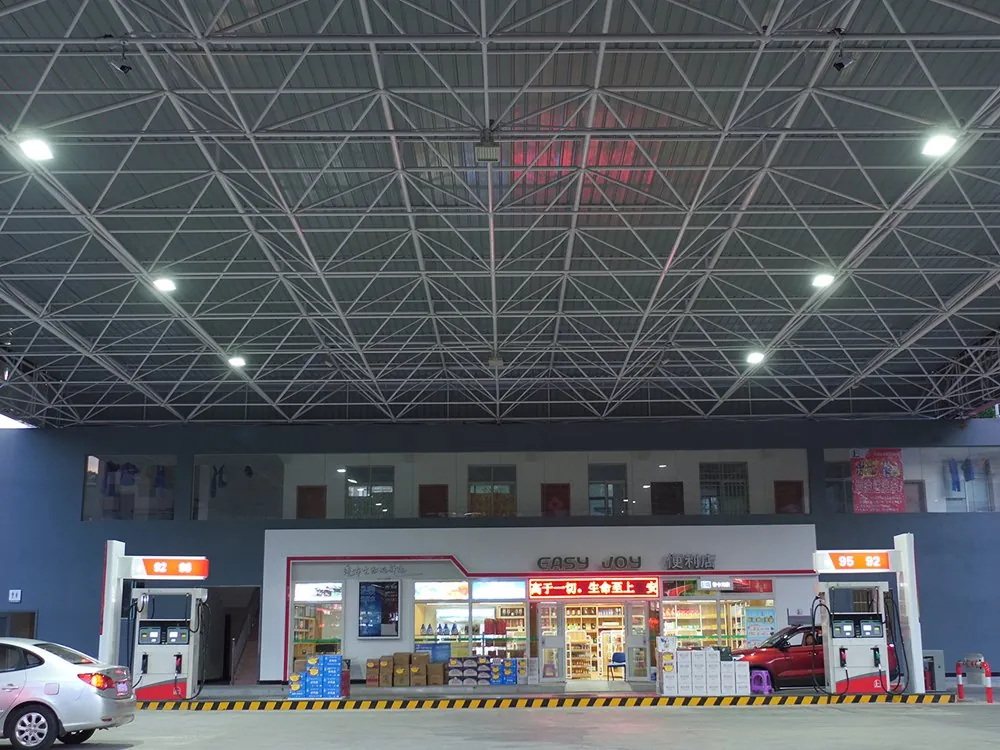
- A petrol station shows the split clearly: dispensers, fill points and vents are classified, while much of the canopy can use sealed standard fittings, as the design notes of our Sinopec forecourt project describe.
Buyers often ask whether a site “needs explosion-proof lights”. The honest answer is that a building does not need them: an area does. Explosion-proof (Ex) lighting is required inside the boundaries drawn on a hazardous-area classification, and nowhere else. This guide explains how those boundaries come about, what triggers them, and how a single site, a petrol station, ends up with both Ex and standard fittings.
The rule in one sentence
If a luminaire is installed inside an area classified as Zone 0, 1, 2, 20, 21 or 22, or as Class I, II or III Division 1 or 2, it must be certified for that area. Outside the classified area, ordinary fittings with a suitable IP rating may be used. Our what explosion proof means guide explains the protection itself; this article is about where it is needed.
Who draws the boundaries
The legal duty sits with the site operator, not the equipment supplier:
- EU: Directive 1999/92/EC requires employers to assess explosion risks, classify zones, and choose equipment of the matching ATEX category.
- UK: the DSEAR regulations implement the same duty.
- USA: OSHA 29 CFR 1910.307 requires equipment in hazardous locations to be approved for the class, division or zone, and the NEC sets the installation rules.
- Elsewhere: most countries adopt IEC 60079-10-1 (gas) and -10-2 (dust) directly or through national codes.
The result is an area classification drawing: plan views with shaded zones around each release source. The light supplier, us included, works from that drawing. If there is no drawing, ask for one before anyone chooses fittings.
What triggers a classification
1. Flammable gas or vapour
Natural gas, LPG, hydrogen, solvent vapours and process gases. Any place they can be released in a flammable concentration (between the lower and upper explosive limits) is a candidate: pump and compressor seals, valves, sample points, vents, loading arms, analyser houses.
2. Flammable liquids near or above their flash point
A liquid only forms a flammable vapour above its flash point. Petrol’s flash point is far below zero, so it gives off flammable vapour in any climate. Diesel under EN 590 has a minimum flash point of 55 °C, above normal ambient temperatures, so a diesel tank in the open often has no zone at all, unless the liquid is heated, sprayed as a mist, or stored with lighter fuels. This is why two tank farms that look alike can have very different lighting requirements.
3. Combustible dust
Grain, flour, sugar, starch, wood, coal, plastics, pharmaceutical powders and metal powders can all form explosive clouds, and layers on hot surfaces can smoulder. Silos, mills, bag filters, bucket elevators and bagging stations are typical dust zones. Our Class 2 Division 1 lighting guide covers the North American side of dust areas.
What usually does not trigger it
Areas with only non-flammable liquids, sealed welded pipework without flanges or valves, and well-ventilated rooms where releases are prevented by design. The classification process also considers ventilation: good ventilation can shrink a zone or reduce it from Zone 1 to Zone 2.
A real example: a petrol station forecourt
We supplied the forecourt lighting for a Sinopec petrol station in Hexi, Xiangtan. The design notes for that type of site describe the split that applies to most forecourts:
- Classified: the space around dispensers, fill points for the underground tanks and the tank vent pipes. Lights inside those zones must be certified for them.
- Often not classified: the upper canopy area away from those sources. Sealed IP65 canopy fittings are commonly used there.
- Deciding factor: the site’s own area classification drawing, which follows the oil company’s standard and the national code.
So a forecourt is a mixed site. Putting Ex fittings everywhere is allowed but costs more; putting standard fittings inside a zone is never allowed. Our guide to gas station canopy and fascia lighting covers light levels and glare for the non-hazardous part.
Other sites, other answers
| Site | Typically classified | Typically not classified |
|---|---|---|
| Refinery or chemical plant | Process units, pump areas, loading racks | Control rooms, offices, workshops outside the units |
| Paint shop | Spray booth and mixing room | Assembly hall beyond the zone boundary |
| Grain or flour plant | Inside elevators, silos, mills; around transfer points | Offices, clean warehouses for bagged product |
| Battery charging room | Space near vented cells during charging | The rest of a well-ventilated room |
| Wastewater plant | Inlet works, digesters, gas holders | Pump halls handling only treated water |
Our application guides cover several of these: oil and gas plant lighting, explosion-proof lighting for paint booths and wastewater treatment plant lighting.
Choosing the light once you know the zone
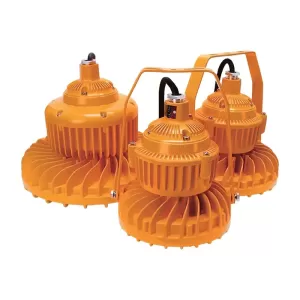
When a light must be Ex, three numbers on the drawing decide which product qualifies: the zone (or division), the gas or dust group, and the temperature class. Any product whose marking meets or exceeds all three qualifies. As an example, our BED series, marked Ex db eb mb IIC T4 Gb and Ex tb IIIC T130 °C Db under certificate ZJEx23.0914, covers Zone 1 and 2 gas areas in all gas groups up to T4, and Zone 21 and 22 dust areas. For smaller rooms the BDE507, marked Ex d IIC T6 Gb, is a compact option; its certificate is supplied with the quotation.
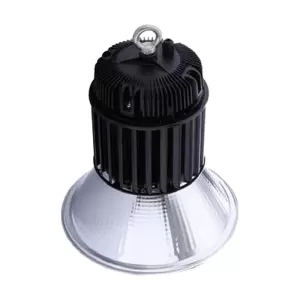
Outside the zones, a sealed industrial fitting does the job. In a hall at 6–12 m, that might be an IP65 heat-pipe high bay. The high bay and warehouse lighting calculator gives the count for either type.
Common mistakes
- Classifying by building name. “It’s a chemical plant, so everything is Zone 1” wastes money; “it’s only a warehouse” can miss a solvent store. Use the drawing.
- Forgetting changes of use. A warehouse that starts storing aerosols or solvents may need reclassification.
- Overlooking temporary lighting. Portable lights carried into a zone during maintenance need the same rating.
- Mixing up IP and Ex. IP66 means dust-tight and water-resistant. It does not mean explosion-proof.
What to send us
The area classification drawing, or for each area the zone, gas or dust group and temperature class, plus room sizes and mounting heights. We will separate the Ex and non-Ex positions and quote each with the fittings and certificates that apply.
Sources
- IEC 60079-10-1 — Classification of areas: explosive gas atmospheres
- IEC 60079-10-2 — Classification of areas: explosive dust atmospheres
- Directive 1999/92/EC (ATEX workplace directive)
- OSHA 29 CFR 1910.307 — Hazardous (classified) locations
- EN 590 — Automotive diesel fuel specification (minimum flash point)
Frequently asked questions
When is explosion-proof equipment required?
When it is installed inside an area classified as hazardous: Zone 0, 1 or 2 for gas, Zone 20, 21 or 22 for dust, or Class I, II or III Division 1 or 2 in North America. The classification drawing decides it, not the type of building.
Who decides whether an area is hazardous?
The site owner or operator, usually through a process safety engineer, using IEC 60079-10-1 and -10-2, NFPA 497 and 499, API RP 505 or a national code. Inspectors and insurers check the result.
Does a diesel storage area need explosion-proof lights?
Often not, because diesel's flash point (at least 55 °C under EN 590) is above normal ambient temperatures, so it does not form a flammable vapour unless heated or sprayed. Mixed sites that also store petrol, or heated tanks, are classified differently.
Is a garage or workshop a hazardous area?
A general vehicle workshop is usually not classified throughout, but pits, spray booths, fuel-handling points and battery-charging areas may be. Check the local code and the site's risk assessment.
Can I use explosion-proof lights where they are not required?
Yes. They are allowed anywhere, but they cost more and weigh more than standard fittings, so most sites use them only inside the zones and sealed industrial fittings elsewhere.