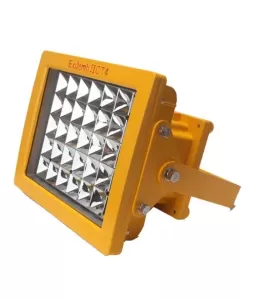
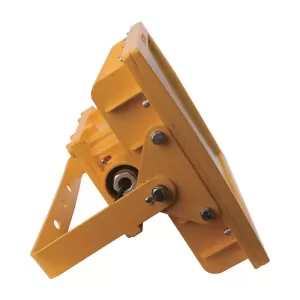
What Does Explosion Proof Mean? Definition, Design Rules and What the Label Promises
Explosion proof means an enclosure that contains an internal ignition, stops flame escaping and stays below the gas's ignition temperature. What the term covers, and what it does not.

Key points
- Explosion proof does not mean the equipment survives an explosion outside it. It means an explosion inside the housing cannot ignite the gas or dust around it.
- Three things earn the designation: a housing strong enough to contain the internal pressure, joints long and tight enough to cool escaping gas, and outer surfaces kept below the ignition temperature of the surrounding atmosphere.
- The word alone proves nothing. A certificate and a marking such as Ex db IIC T4 Gb state which zones, gas groups and temperatures the product was tested for.
- Our BED series is marked Ex db eb mb IIC T4 Gb under certificate ZJEx23.0914: T4 keeps the surface below 135 °C, safe for petrol vapour (about 280 °C ignition) with a wide margin.
“Explosion proof” is one of the most misunderstood phrases in industrial buying. People read it as “survives an explosion”, as “sealed against gas”, or as a general mark of toughness. None of these is right. This guide gives the working definition used by the standards, explains the three design rules that earn it, and shows how to read it on a real product, using the markings of our own explosion-proof lights.
The short definition
Explosion-proof equipment is built so that an ignition inside it cannot ignite the explosive atmosphere outside it.
The standards accept that gas or vapour will eventually seep into any enclosure through cable entries, breathing joints or temperature cycling. They also accept that something inside, a relay, a driver fault or an LED chip at end of life, may ignite that gas. The aim is not to stop this internal ignition. The aim is to make sure it stays a small, contained event.
In IEC language the most common form is the flameproof enclosure, protection type “d”. In North America, “explosion-proof” is the legal term used in the NEC for Class I locations. The two describe the same idea. Our article on explosion proof vs flameproof covers the naming in more detail.
What explosion proof does not mean
- It does not mean blast resistant. An explosion-proof light next to a vessel that ruptures will be damaged like anything else.
- It does not mean gas-tight. Most flameproof housings are deliberately not airtight; they breathe through controlled joints.
- It does not mean intrinsically safe. Intrinsic safety limits the energy in a circuit so it cannot spark hard enough to ignite anything. That is a different method, used for instruments, not floodlights. See intrinsically safe vs explosion proof.
- It does not cover every hazard. A product tested for gas group IIB is not safe in hydrogen; one tested for gas is not automatically safe in dust.
The three design rules
1. Contain the pressure
When a gas mixture burns inside a closed box, pressure rises in milliseconds. A flameproof housing is designed and type-tested to withstand that internal explosion pressure with a safety factor, without permanent deformation. That is why these housings are thick die-cast aluminium or steel, with toughened glass held in a heavy frame.
2. Cool the escaping flame
Hot gas must leave the housing somewhere. It does so through flame paths: the machined joints between the body and the cover, or along threaded entries. Each flame path is long enough and narrow enough that the hot gas cools below its ignition point before it reaches the outside air. The permitted gap shrinks as the gas becomes easier to ignite, which is why a housing certified for hydrogen (group IIC) has tighter joints than one for propane (group IIA).
3. Stay cool on the outside
Even without any internal fault, a hot outer surface can ignite gas by itself. The temperature class caps the maximum surface temperature:
| Class | Max surface temperature | Example gas and approximate ignition temperature |
|---|---|---|
| T1 | 450 °C | Methane, about 595 °C |
| T2 | 300 °C | Acetylene, about 305 °C |
| T3 | 200 °C | Petrol vapour, about 280 °C |
| T4 | 135 °C | Diethyl ether, about 160 °C |
| T5 | 100 °C | — |
| T6 | 85 °C | Carbon disulphide, about 90 °C |
A product is safe for a gas when its temperature class is equal to or cooler than the class the area requires. For LEDs this is mostly a heat-sink question: the driver and LED board must stay cool enough at the highest ambient temperature named on the certificate.
Reading the definition on a real product
Here is how the three rules appear on our own explosion-proof lights.
| Product | Marking | What it tells you |
|---|---|---|
| BED series, 30–600 W | Ex db eb mb IIC T4 Gb; Ex tb IIIC T130 °C Db | Flameproof LED chamber (db), increased-safety terminal box (eb), encapsulated driver (mb); hydrogen-capable group IIC; surface below 135 °C; Zone 1 gas and Zone 21 dust |
| BAD8599 floodlight, 50–600 W | Ex d IIC T6 Gb | Fully flameproof; group IIC; surface below 85 °C |
| ExF series, 50–150 W | Ex d IIB T6 Gb | Flameproof; groups IIA and IIB only, not hydrogen or acetylene |
The BED series is covered by our own certificate, ZJEx23.0914, issued under GB/T 3836 (aligned with IEC 60079) and valid to July 2028. For the other series, the certificate that applies is supplied with the quotation.
A quick margin check on the BED: T4 keeps every outer surface below 135 °C. Petrol vapour ignites at about 280 °C, so the margin is around 145 °C. For carbon disulphide, which ignites near 90 °C, T4 is not enough and a T6 product is needed.
Why one word is never enough
Because “explosion proof” is a general term, it appears on catalogue pages for products that have never been tested, or that were tested for a different zone. The only proof is the paperwork:
- A certificate from a recognised body under a named standard (IEC 60079, ATEX, UL 844 / UL 1203, GB/T 3836 and others). Our guide to who certifies explosion-proof lights lists the main bodies.
- A marking on the nameplate that matches the certificate.
- A match between that marking and your hazardous area drawing: zone, gas group, temperature class.
If any of the three is missing, treat the product as ordinary equipment, whatever the brochure says. Our explosion-proof light ratings guide explains each part of the marking.
Explosion proof in other products
The same idea applies well beyond lighting: motors, junction boxes, switches, heaters, fans, pressure sensors and even refrigerators for laboratories. A “spark-free” or “lab-safe” refrigerator is not the same as one certified for a classified zone, and the same caution applies to “explosion-proof” phone cases and torches sold online without a certificate number.
How installation can undo the definition
A certified housing stays explosion proof only while its flame paths and entries are intact:
- the wrong cable gland, or a gland not rated for the zone, breaks the protection at the entry;
- a scratched or painted flame path, or a missing cover bolt, can widen the gap;
- replacing toughened glass with a non-certified part voids the certificate;
- unused entries must be closed with certified stopping plugs.
This is why inspection and maintenance in hazardous areas are done by trained people under IEC 60079-14 and 60079-17 or local equivalents. See explosion-proof light installation.
For buyers
When you send an inquiry, include the zone, the gas group and the temperature class from your area classification, plus the ambient temperature range. We will propose the series whose marking covers all three and send the matching certificate with the quotation.
Sources
Frequently asked questions
What does explosion proof mean in simple terms?
It means that if a spark or hot part inside the equipment ignites gas that has leaked into it, the resulting explosion stays inside the housing and cannot set off the atmosphere outside.
Is explosion proof the same as explosion resistant?
No. Explosion resistant usually describes buildings or panels built to withstand a blast from outside. Explosion proof is about not causing an explosion: the equipment contains its own ignition.
Does explosion proof mean waterproof?
Not by itself. Water and dust protection is a separate IP rating. Most explosion-proof lights also carry IP65 to IP67, but you must check both ratings.
How do I know a product is really explosion proof?
Ask for the certificate and read the marking on the nameplate. It must name a recognised standard, the protection type, the gas group, the temperature class and the protection level, and these must match your area classification.
Can any LED light be made explosion proof by sealing it?
No. Sealing alone is not a recognised protection method. The design must be tested and certified as a whole, including the housing, glass, joints, cable entry and temperature rise.