Warehouse Lighting Lux Levels: How Much Light Each Area Needs
Recommended lux levels for warehouse areas, from storage and aisles to packing and loading bays, what they mean in high bays for a 60 × 40 m building, and how zoning saves energy.
Key points
- Typical maintained lux levels from EN 12464-1: 100 lux for stores, 150 lux for manned rack aisles and loading bays, 300 lux for packing and dispatch.
- Doubling the target from 150 to 300 lux doubles the number of lights: in a 60 × 40 m warehouse with 10 m ceilings, 35 high bays become 70.
- Zoning saves more than any fixture choice: 300 lux only in a 15 m packing strip and 150 lux elsewhere needs about 46 high bays instead of 70.
- Rack aisles need narrow-beam or aisle optics and enough vertical light on the rack faces, not just lux on the floor.
“How bright should the warehouse be?” is the first question in any high bay project, and the answer drives everything else: the number of lights, their wattage and the energy bill. The right answer is rarely one number for the whole building. Different areas have different tasks, and lighting each one to its task is the easiest saving in warehouse lighting.
Recommended lux levels by area
The European standard EN 12464-1 (lighting of indoor work places) gives maintained illuminance values for typical warehouse areas. Many other countries use similar figures. Typical values are:
| Area | Maintained illuminance | About (foot-candles) | Notes |
|---|---|---|---|
| Rack aisles, unmanned (automated) | 20 lux | 2 fc | For maintenance access only |
| Stores and stockrooms | 100 lux | 9 fc | Bulk storage, low activity |
| Rack aisles, manned (forklifts, picking) | 150 lux | 14 fc | Plus vertical light on rack faces |
| Loading bays and ramps | 150 lux | 14 fc | Glare control for drivers |
| Control stations | 150 lux | 14 fc | |
| Packing and dispatch | 300 lux | 28 fc | Reading labels, checking goods |
| Inspection, fine picking, small labels | 300–500 lux | 28–46 fc | Check the specific task |
“Maintained” means the level at the end of the maintenance cycle, after the lights have aged and collected dust. That is why lighting designs start with more light than the target, using a maintenance factor (often 0.8). See LM-80 and TM-21 explained for why the LED’s rated lifetime matters here.
The standard also sets uniformity (often at least 0.4 for storage and 0.6 for work areas), glare limits (UGR) and colour rendering (Ra ≥ 80 for most work areas). Check the current edition and any local rules for your project.
What the lux level means in lights
Take a warehouse 60 × 40 m with 10 m ceilings, lit with 150 W LED high bays at 140 lm/W and a medium beam. Our high bay lighting calculator gives:
| Target | High bays | Layout | Average lux | Power density |
|---|---|---|---|---|
| 100 lux | 24 | 6 × 4 | about 119 lux | 1.5 W/m² |
| 150 lux | 35 | 7 × 5 | about 173 lux | 2.2 W/m² |
| 200 lux | 48 | 8 × 6 | about 237 lux | 3.0 W/m² |
| 300 lux | 70 | 10 × 7 | about 346 lux | 4.4 W/m² |
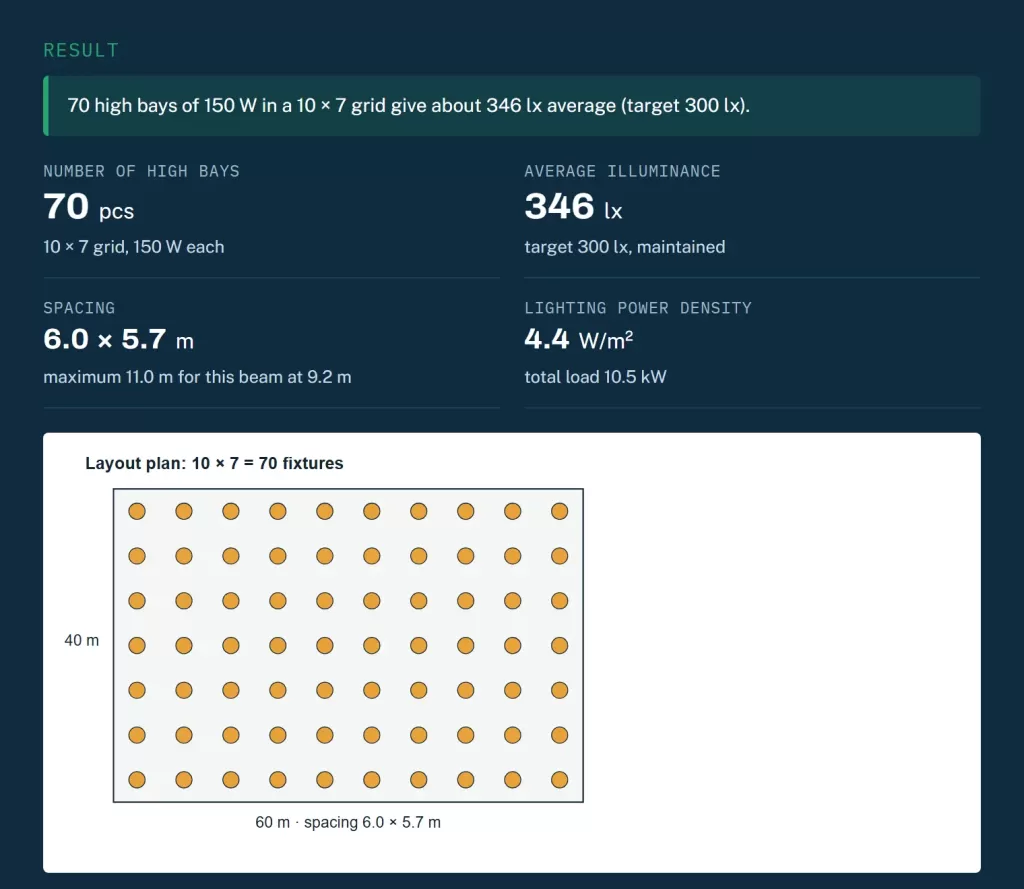
Open the 300 lux example and change the target to 150 to compare.
The relationship is simple: light needed is proportional to the target. Doubling from 150 to 300 lux doubles the lights and the energy.
Zone the light levels
Most warehouses have one area that needs 300 lux (packing, dispatch, the office edge) and much more that needs 150. In our example, suppose a 15 m strip along one 40 m side is packing and dispatch, and the rest (45 × 40 m) is racking and storage:
| Design | High bays | Connected load |
|---|---|---|
| 300 lux everywhere | 70 | 10.5 kW |
| 150 lux everywhere | 35 | 5.25 kW |
| Zoned: 300 lux packing, 150 lux storage | 21 + 25 = 46 | 6.9 kW |
The zoned design gives packing staff the full 300 lux and saves 24 lights, about 3.6 kW, compared with lighting everything to 300. At 4,000 hours a year and US$0.15/kWh, that is about 14,400 kWh and US$2,160 a year, before any sensors.
Rack aisles need different optics
In a racked warehouse, the floor lux tells only half the story. Pickers and forklift drivers need to read labels on the rack faces, from the bottom beam to the top. A wide beam hitting the top of the racks wastes light and leaves the lower faces dark.
- Mount lights over the centre of each aisle, not on a regular grid that ignores the racks
- Use narrow beams (60°) or aisle optics for aisles under about 3–4 m wide and racks above 6–8 m
- Check vertical illuminance on the rack faces if the supplier can calculate it
- Linear high bays suit long aisles; UFO high bays suit open floors. See UFO vs linear high bay lights
Use sensors in low-traffic areas
Storage aisles are empty most of the time. Microwave motion sensors that dim a light to 10–20% when the aisle is empty and bring it back to full in a fraction of a second can save another 30–60% in those zones. For full upgrade economics, see our warehouse LED lighting upgrade guide.
Other factors that change the number of lights
- Ceiling height: higher mounting spreads light over a bigger area but loses more to the walls; see how many LED high bay lights do I need
- Surface reflectance: dark floors, unpainted steel and dark goods absorb light
- Dust and temperature: dirty or hot environments need a lower maintenance factor; for hot buildings see high-temperature high bays
- Cold stores: LEDs work well in the cold, but check the driver’s rated temperature and the condensation protection
How to specify it
- Divide the floor plan into zones and give each a maintained lux, uniformity and UGR
- State the maintenance factor and the luminaire’s L-rating for the period
- State the mounting height, rack heights and aisle widths
- Ask for a lighting calculation (DIALux or Relux) with the actual photometric file
- State any sensor and dimming requirements per zone
Our LED high bay lights range from economy models such as the GKP40L to heat-pipe high bays for hot buildings, with beams from 45° to 120° (25° on heat-pipe models). Send us your floor plan with the zones marked, and we will calculate the layout and lux for each one.
Sources
Frequently asked questions
How many lux does a warehouse need?
It depends on the area. EN 12464-1 gives typical maintained values of 100 lux for stores and stockrooms, 150 lux for manned rack aisles and loading bays, and 300 lux for packing and dispatch. Areas where people read small labels or inspect goods may need 300–500 lux.
How many foot-candles is 300 lux?
About 28 foot-candles. One foot-candle is 10.76 lux, so 150 lux is about 14 fc and 500 lux about 46 fc.
Is more light in a warehouse always better?
No. Above what the task needs, extra light costs energy and can add glare. It is better to light each zone to its task, keep the light even, and use sensors to dim aisles and storage areas when nobody is there.