
Foot-Candles to Candela: The Inverse-Square Conversion, With Floodlight Examples
Convert foot-candles to candela with E = I ÷ d²: candela = foot-candles × distance in feet squared. Tables, the cosine correction, and what our floodlight beams give at 20–40 m.
Key points
- Foot-candles and candela measure different things: foot-candles are light arriving on a surface, candela is light leaving a source in one direction. Distance links them.
- Candela = foot-candles × (distance in feet)²; foot-candles = candela ÷ (distance in feet)². In metric, lux = candela ÷ (distance in metres)².
- 50 fc at 100 ft needs 500,000 cd aimed at that point; the same target at 50 ft needs only 125,000 cd.
- For a 110,000 lm floodlight with 70 % of its light in the beam (our assumption), a 25° beam averages about 517,000 cd and gives about 53 fc at 30 m; a 60° beam about 9 fc.
Foot-candles and candela appear together on many lighting specifications, and they are easy to confuse. One describes how much light lands on a surface, the other how strongly a source shines in a particular direction. You cannot convert between them without a distance. This guide gives the formula, tables you can use directly, the correction for light arriving at an angle, and a worked example with our own floodlight beams.
What each unit measures
| Unit | Measures | Symbol | Depends on distance? |
|---|---|---|---|
| Candela | Luminous intensity: light leaving a source in one direction | cd | No |
| Foot-candle | Illuminance: light falling on one square foot | fc | Yes |
| Lux | Illuminance in metric: light falling on one square metre | lx | Yes |
| Lumen | Total light output of a source | lm | No |
1 fc = 1 lumen per square foot = 10.764 lux. Our foot-candles to lux article covers that conversion, and foot-candles to lumens covers the area-based one.
The formula
For a point source and a surface facing it directly, illuminance falls with the square of the distance:
- fc = cd ÷ d² (d in feet)
- cd = fc × d²
- lux = cd ÷ d² (d in metres)
Double the distance and the illuminance drops to a quarter. That is why a floodlight that looks overwhelming at 10 m can leave a pitch underlit at 40 m.
Conversion tables
Candela needed for a target in foot-candles:
| Target | 25 ft | 50 ft | 75 ft | 100 ft |
|---|---|---|---|---|
| 5 fc | 3,125 cd | 12,500 cd | 28,125 cd | 50,000 cd |
| 20 fc | 12,500 cd | 50,000 cd | 112,500 cd | 200,000 cd |
| 50 fc | 31,250 cd | 125,000 cd | 281,250 cd | 500,000 cd |
| 100 fc | 62,500 cd | 250,000 cd | 562,500 cd | 1,000,000 cd |
Foot-candles from a given intensity:
| Intensity | 20 ft | 40 ft | 60 ft | 80 ft |
|---|---|---|---|---|
| 10,000 cd | 25 fc | 6.3 fc | 2.8 fc | 1.6 fc |
| 50,000 cd | 125 fc | 31 fc | 13.9 fc | 7.8 fc |
| 200,000 cd | 500 fc | 125 fc | 56 fc | 31 fc |
The cosine correction
The formula above assumes light hits the surface head-on. On a sports pitch or a car park, light from a pole arrives at an angle. The horizontal illuminance then becomes:
fc = cd × cos θ ÷ d²
where θ is the angle between the ray and the vertical (for a horizontal surface). At 40°, cos θ is 0.77, so the floor receives 77 % of the head-on value. At 60°, only half. This is one reason poles are made taller: a steeper angle puts more of each candela onto the ground. Our stadium light pole design article uses this to set pole height.
Worked example: what our floodlight beams give
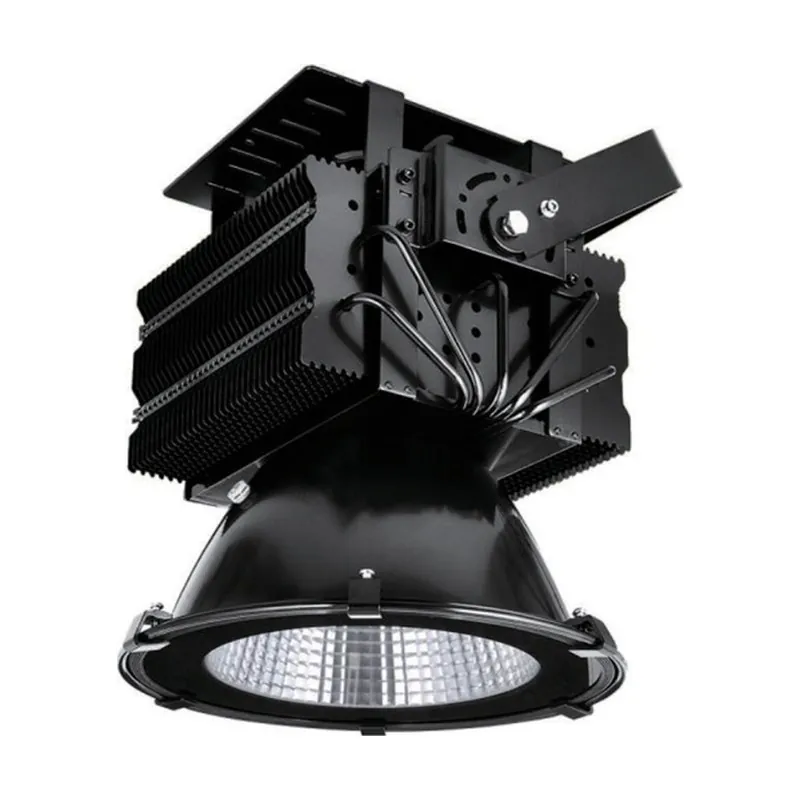
Real candela values come from a light’s photometric file. To show how beam angle changes the result, we estimated the average intensity inside the beam for a 1,000 W version of our heat-pipe stadium floodlight, rated above 110 lm/W (110,000 lm), which is offered with 25°, 40°, 60° and 90° beams.
Method:
1. Lumens in the beam. We assumed 70 % of the lumens fall inside the beam angle. This is our assumption for illustration; the IES file gives the true figure for each optic.
2. Solid angle of the beam. Ω = 2π × (1 − cos(beam ÷ 2)), in steradians.
3. Average intensity. cd = lumens in beam ÷ Ω.
4. Illuminance. lux = cd ÷ d², straight on.
| Beam | Solid angle | Average intensity | At 20 m | At 30 m | At 40 m |
|---|---|---|---|---|---|
| 25° | 0.149 sr | 517,000 cd | 1,292 lux (120 fc) | 574 lux (53 fc) | 323 lux (30 fc) |
| 40° | 0.379 sr | 203,000 cd | 508 lux (47 fc) | 226 lux (21 fc) | 127 lux (12 fc) |
| 60° | 0.842 sr | 91,500 cd | 229 lux (21 fc) | 102 lux (9.4 fc) | 57 lux (5.3 fc) |
| 90° | 1.840 sr | 41,800 cd | 105 lux (9.7 fc) | 46 lux (4.3 fc) | 26 lux (2.4 fc) |
Same lumens, very different results: the 25° beam delivers more than twelve times the intensity of the 90° beam, but covers a much smaller patch. Long throws, such as from the far side of a pitch or a port mast, need narrow beams; short throws to nearby areas need wide ones. Our LED flood light beam angle article gives spot sizes for each angle.
Adding the angle: if the 40° beam reaches the pitch at 30 m but arrives at 40° from vertical, horizontal illuminance at that point is 226 × 0.77, about 173 lux.
A small floodlight for comparison
A 100 W floodlight at 110 lm/W (11,000 lm) with a 120° beam, using the same 70 % assumption, averages about 2,450 cd. Straight on, that gives 98 lux at 5 m, 38 lux at 8 m and 25 lux at 10 m. That is plenty for a yard or a building facade at close range and very little at a distance, which is why wattage alone tells you little about how far a light reaches.
Common mistakes
- Converting without a distance. Foot-candles always belong to a distance.
- Mixing feet and metres. cd ÷ d² with d in metres gives lux; with d in feet it gives foot-candles. Using metres and calling the result foot-candles is off by a factor of 10.76.
- Using peak candela for the whole beam. The centre of a beam is brighter than its edge; the beam angle is defined where intensity falls to half the peak. Use the photometric file for point-by-point design.
- Applying the inverse-square law too close. It holds well once the distance is at least five times the size of the light’s emitting area. For a 0.5 m floodlight, that is beyond about 2.5 m.
Where the conversion is used
- Sports lighting: checking how much intensity is needed from a pole to reach a target on the far side of the field.
- Security and perimeter lighting: ensuring a minimum illuminance at the fence line.
- Signs and facades: working out whether a narrow-beam projector can reach the top of a building.
- Specification checks: verifying a supplier’s claim of “X fc at Y ft”.
Our foot-candles measurement guide explains how to check the result with a meter, and candlepower to lumens covers older candlepower ratings.
What to send us
Send the distance from the pole to the target area, the mounting height, and the illuminance you need in lux or foot-candles. We will choose a beam angle and wattage and send the photometric file so you can check the candela values yourself.
Sources
Frequently asked questions
How do you convert foot-candles to candela?
Multiply the foot-candles by the square of the distance in feet: cd = fc × d². For 20 fc at 30 ft, that is 20 × 900 = 18,000 cd. The formula applies to a point straight in front of the source.
How do you convert candela to foot-candles?
Divide the candela by the square of the distance in feet: fc = cd ÷ d². A 40,000 cd beam at 20 ft gives 40,000 ÷ 400 = 100 fc.
Can I convert foot-candles to candela without a distance?
No. Foot-candles depend on how far the surface is from the source; the same candela gives a quarter of the foot-candles at twice the distance.
What about light that arrives at an angle?
Multiply by the cosine of the angle between the light ray and the surface's perpendicular: fc = cd × cos θ ÷ d². At 40°, the surface receives about 77 % of the straight-on value.
How do I find a floodlight's candela?
From its photometric file (IES or LDT), which lists candela by angle. Without it, you can estimate an average beam intensity from the lumens inside the beam divided by the beam's solid angle, but that is only an estimate.
