5 Foot-Candles: What It Looks Like and What It Takes to Light to It
What 5 foot-candles (about 54 lux) looks like compared with moonlight, streets and offices, and how many fixtures it takes in a parking lot and a warehouse, from our calculators.
Key points
- 5 foot-candles is about 54 lux: brighter than any normal street, but dim for indoor work.
- Outdoors, 5 fc average is demanding: in our calculator a 20 m wide lot with 10 m poles and 150 W lights needs a pair of poles every 12 m, against 35 m for the 15 lux pedestrian class P1.
- Indoors, 5 fc suits bulk storage and standby levels: a 40 × 20 m store at 8 m reaches about 64 lux with fifteen 60 W high bays.
- To estimate fixture lumens for 5 fc, multiply the area in square feet by 5 and divide by about 0.4–0.5 for real-world losses.
“5 foot-candles” turns up in parking lot specifications, security lighting briefs and warehouse tenders, usually as a single number with no explanation. Some people read it as “bright”, others as “dim”, and both are right depending on where you stand. This guide puts 5 foot-candles in context, shows what it takes to achieve it outdoors and indoors with our own calculators, and gives a quick way to estimate the lumens. For the unit conversion itself, see foot-candles to lux.
5 foot-candles in lux and in real life
One foot-candle (fc) is one lumen per square foot, which equals 10.764 lux. So:
5 fc ≈ 53.8 lux
Some reference points, in round numbers:
| Situation | Approx. lux | Approx. fc |
|---|---|---|
| Full moon on a clear night | 0.1–0.3 | < 0.03 |
| Residential street (class P4) | 5 | 0.5 |
| Pedestrian area (class P1) | 15 | 1.4 |
| Main traffic route (class M1) | 30 | 2.8 |
| 5 foot-candles | 54 | 5 |
| Office desk | 300–500 | 28–46 |
| Overcast daylight outdoors | 1,000+ | 100+ |
The road values are the average illuminance levels used in our calculator for EN 13201 classes. Even the brightest of them is about half of 5 fc. So outdoors, 5 fc is a high level, the kind you see on a busy retail lot or a well-lit loading yard. Indoors, it is low, roughly the level of a corridor at night.
Outdoors: what 5 fc takes in a parking lot
Take a lot 20 m wide (about 65 ft) with poles on both sides at 10 m, and our 150 W LED area lights at a conservative 110 lm/W. Our pole height and spacing calculator lets you set a custom target, here 54 lux (open the example):
- poles opposite each other on both sides;
- a pair every 12 m, giving about 55.7 lux average;
- that is 168 fittings and 25 kW per kilometre of lot length.
Now set the same lot to class P1, 15 lux (open the example):
- a pair every 35 m, about 19 lux average;
- 58 fittings and 8.7 kW per kilometre.
Moving from 1.4 fc to 5 fc roughly triples the number of poles. The calculator also shows that keeping 35 m spacing at 5 fc would need about 420 W per fitting. That is why a 5 fc requirement should be questioned on large lots: it may be meant for a small, high-risk part of the site, such as an entrance or a cash-handling area, not the whole surface. Our parking lot lighting design guide covers zoning a lot into different levels.
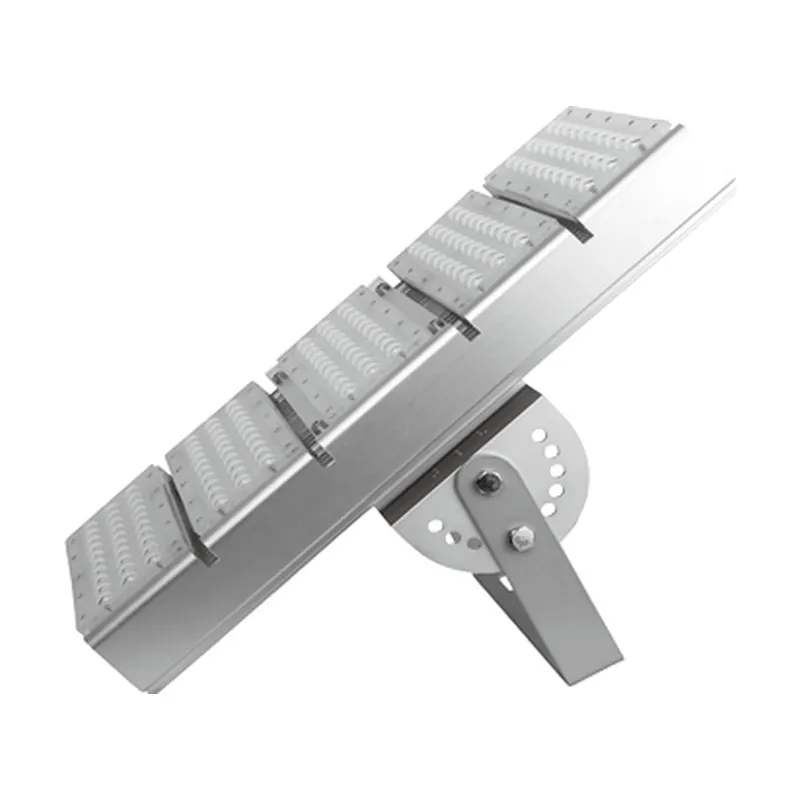
For high levels over a small area, floodlights on fewer, taller poles are often cheaper than many area lights. Our TLM30C modular flood light is a common choice for yards.
Indoors: what 5 fc takes in a store
Indoors the picture flips. A 40 × 20 m bulk store with fittings at 8 m, lit to 54 lux using 60 W high bays at 110 lm/W. Our high bay lighting calculator gives (open the example):
- 15 fittings (5 × 3), about 8 × 6.7 m apart;
- about 64 lux average;
- just 1.1 W per m².
The count is set by spacing, not by light: at 8 m, fittings cannot be much more than about 8.6 m apart without dark patches. For comparison, the same store at 200 lux (about 19 fc) needs 18 fittings of 150 W (open the example). Our warehouse lux levels guide explains which tasks need which level.
5 fc as a standby level
One useful indoor role for 5 fc is the dimmed level of sensor-controlled lighting. A 200 lux aisle that drops to about 25 % when empty sits near 5 fc: enough to see the aisle and the racking, with full light returning when a truck or a picker enters. See high bay occupancy sensors for how this is set up.
Estimating lumens for 5 fc
A quick rule for any space:
Fixture lumens ≈ area (sq ft) × 5 ÷ (utilisation × maintenance)
The utilisation factor (how much of the light reaches the surface) is typically 0.5–0.7 indoors and 0.3–0.5 outdoors, and the maintenance factor about 0.8. Together that is roughly 0.4–0.5 indoors.
Example: a 1,000 sq ft (93 m²) storeroom at 5 fc needs about 1,000 × 5 ÷ 0.45 ≈ 11,000 fixture lumens, for instance two 60 W LED fittings at 100 lm/W or more. Our foot-candles to lumens guide shows the method step by step.
Measuring 5 fc on site
A light meter set to foot-candles reads it directly. Measure at the height the specification states, usually ground level outdoors and working-plane height indoors, and take a grid of readings rather than one point. Averages hide dark spots. Our foot-candle measurement guide explains the grid.
Common mistakes
- Reading 5 fc as minimum when it is average (or the other way round). A 5 fc minimum outdoors is a very different job from a 5 fc average.
- Applying one number to the whole site. Entrances, paths and parking bays rarely need the same level.
- Ignoring uniformity. A lot with 5 fc average and dark gaps between poles feels worse than an even 2 fc.
What to send us
The site plan, the foot-candle targets (average and minimum) and the pole or mounting heights you have in mind. We will reply with a layout from our calculators and the fixtures that meet it.
Sources
Frequently asked questions
How much is 5 foot-candles in lux?
One foot-candle is 10.764 lux, so 5 foot-candles is about 53.8 lux.
Is 5 foot-candles bright?
For outdoor areas, yes: it is several times brighter than typical street lighting. For indoor work such as reading or assembly, no: offices are usually lit to around 30–50 foot-candles.
Where is 5 foot-candles used?
As an average for brightly lit outdoor areas such as busy retail car parks, fuel forecourt approaches or loading yards, and indoors for bulk storage, little-used aisles or the dimmed standby level of sensor-controlled lighting. Always check the local code or standard for the actual target.
How many lumens do I need for 5 foot-candles?
Roughly the area in square feet times 5, divided by 0.4–0.5. For a 1,000 sq ft space that is about 10,000–12,500 fixture lumens.