How Many Lumens Is a Street Light? Average Output by Road Type
Typical street light lumens for lanes, estate roads, collectors and arterials, worked out with our spacing calculator, plus how LED fixture lumens compare with old sodium lamp lumens.
Key points
- Street lights range from about 1,500 lumens on a residential lane to 15,000–25,000 lumens on a main road; there is no single average.
- In our calculator, a 7 m road with 10 m poles at 35 m spacing needs about 7,800 fixture lumens for class M4 and about 10,700 for M3.
- Compare fixture lumens, not lamp lumens: a sodium lamp loses roughly a fifth to a third of its rated lumens inside the fitting, while LED street lights are rated as a complete luminaire.
- Lumens per metre of road (fixture lumens divided by spacing) is a quick way to compare layouts with different pole spacings.
“How many lumens is a street light?” has no single answer, because a lane behind houses and a six-lane arterial need very different amounts of light. What we can give is a reliable range for each kind of road, worked out from the lighting class, the pole height and the spacing rather than guessed. This article does that with our own calculator and our own luminaire data, and then shows how to compare a new LED quote with the sodium lamps it replaces. For a general introduction to the unit, see what is a lumen.
Why there is no single average
The light a road needs is set as illuminance (lux) on the road surface, or as luminance for traffic routes. The lumens a street light must emit then depend on three things:
- The lighting class. A P4 residential street needs an average of about 5 lux; an M3 traffic route about 15 lux. Our EN 13201 road lighting classes guide lists them.
- Spacing and width. Each light serves a rectangle of road: spacing × width. Wider roads and longer spacings need more lumens per light.
- How much light reaches the road. The utilisation factor (the share of lumens that lands on the carriageway) and the maintenance factor (allowance for dirt and ageing) together usually leave 30–40 % of the fixture lumens on the road surface.
Typical lumens by road type, calculated
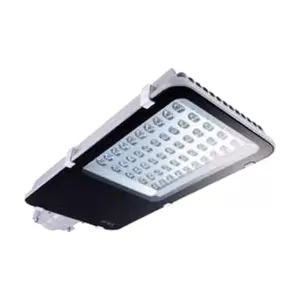
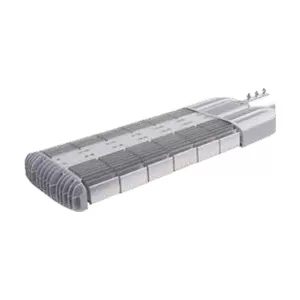
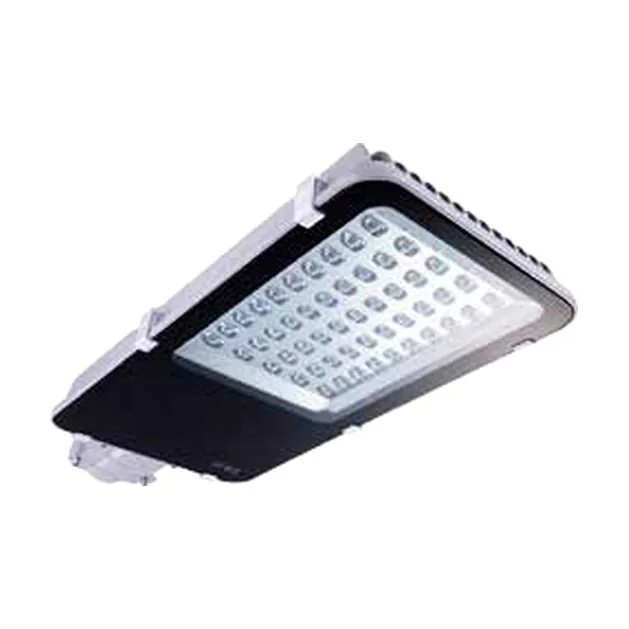
We ran five common roads through our pole height and spacing calculator with a maintenance factor of 0.8. The luminaire data are those of our LDZ30J compact street light (above 90 lm/W) for the lane and our LDM30C modular street light (above 110 lm/W) for the rest.
| Road | Width / pole | Class | Head | Fixture lumens | Spacing | Average lux | Lumens actually needed |
|---|---|---|---|---|---|---|---|
| Residential lane | 5 m / 6 m | P4 | 30 W | 2,700 | 21 m | 9.7 | ≈ 1,400 |
| Estate road | 6 m / 8 m | P2 | 60 W | 6,600 | 28 m | 14.0 | ≈ 4,700 |
| Collector road | 7 m / 10 m | M4 | 100 W | 11,000 | 35 m | 15.5 | ≈ 7,800 |
| Main road | 10.5 m / 12 m | M3 | 200 W | 22,000 | 42 m | 19.2 | ≈ 17,200 |
| Wide main road, staggered | 14 m / 12 m | M2 | 150 W × 2 rows | 16,500 each | 33 m | 22.3 | — |
Open any row to change the inputs: lane, estate road, collector, main road, wide road.
The last column is the interesting one. The calculator caps spacing at 3.5 times the pole height so the road stays even, and then reports the wattage that would just meet the class at that spacing. Multiplying by the efficacy gives the fixture lumens actually needed:
- the lane needs only about 1,400 lumens per light, so even a 20 W head is generous;
- the collector road needs about 7,800 lumens for M4; for M3 (15 lux) the same layout needs about 10,700 lumens, which is why 100 W is a common choice there;
- the main road needs about 17,200 lumens, so a 160–180 W head at 110 lm/W would do the job that we gave to a 200 W head.
So a fair summary is: about 1,500–7,000 lumens for residential streets and 8,000–25,000 lumens for traffic routes, with the exact figure set by the class and the layout.
Lumens per metre of road
When two suppliers propose different spacings, compare lumens per metre of road: fixture lumens × rows ÷ spacing.
| Layout | Lumens per metre |
|---|---|
| Lane: 2,700 lm ÷ 21 m | ≈ 130 |
| Estate road: 6,600 ÷ 28 | ≈ 236 |
| Collector: 11,000 ÷ 35 | ≈ 314 |
| Main road: 22,000 ÷ 42 | ≈ 524 |
| Wide road: 16,500 × 2 ÷ 33 | ≈ 1,000 |
A proposal with far fewer lumens per metre than this for the same road and class should be checked for optics and uniformity claims; one with far more is probably over-lit.
LED fixture lumens vs sodium lamp lumens
Retrofit tenders often list the old lamp as “150 W HPS, 15,000 lm” and ask for an LED “with the same lumens”. That comparison is unfair to the LED.
- Sodium lamps are rated as bare lamps. Typical catalogue values for high-pressure sodium are about 6,000–6,600 lm at 70 W, 9,500–10,700 lm at 100 W, 15,000–17,500 lm at 150 W and 28,000–33,000 lm at 250 W.
- The fitting loses part of that. A sodium lantern’s reflector and bowl typically pass on around 65–80 % of the lamp lumens, and much of the rest goes behind the pole or into the sky.
- LED street lights are rated as a complete fitting, with optics that send more of the light onto the road.
In practice, an LED head with 60–70 % of the sodium lamp’s rated lumens often matches or exceeds the old illuminance on the road. Always confirm with a calculation on the real spacing. Our guide to replacing high-pressure sodium lights with LED works through a 13 km example, and how many watts an LED street light needs turns the lumen figure into a wattage.
Lumens drop over time
Rated lumens are for a new fitting. LEDs lose output slowly, and dirt on the lens takes more. That is what the maintenance factor of 0.8 in the table allows for. On dusty industrial roads or with long cleaning intervals, use 0.7 and expect one size larger. Our LED street light lifespan guide explains how long the lumens hold.
Colour temperature and lumens
A 5,000 K LED usually has slightly higher lm/W than a 3,000 K version of the same fitting. Many cities now choose 3,000 K or 4,000 K for residential streets despite the small loss, to reduce glare and blue light. If the specification fixes the colour temperature, use the efficacy for that colour in the calculation.
Our street lights at a glance
| Model | Power range | Efficacy | Fixture lumens range |
|---|---|---|---|
| LDZ30J compact | 20–80 W | > 90 lm/W | ≈ 1,800–7,200 |
| LDM30C modular | 30–350 W | > 110 lm/W | ≈ 3,300–38,500 |
What to send us
Road width, pole height, spacing (if poles exist) and the lighting class or target lux. We will reply with the lumens and wattage that meet it from our calculator, rather than a catalogue number.
Sources
- EN 13201-2 — Road lighting, Part 2: Performance requirements
- IES RP-8 — Recommended Practice for Design and Maintenance of Roadway and Parking Facility Lighting
- CIE 115 — Lighting of roads for motor and pedestrian traffic
- BlueGreen OE — LDM30C modular LED street light and LDZ30J compact street light product data
Frequently asked questions
How many lumens does a typical street light have?
On residential streets, about 1,500–7,000 lumens; on collector and main roads, about 8,000–25,000 lumens. The right figure depends on road width, pole height, spacing and the lighting class.
How many lumens is a 100 W LED street light?
At the efficacy of our LDM30C (over 110 lm/W), a 100 W head gives at least 11,000 fixture lumens. Lower-cost heads at 90 lm/W give about 9,000.
How many lumens did old sodium street lights have?
Typical catalogue figures for high-pressure sodium lamps are about 6,000–6,600 lumens at 70 W, 9,500–10,700 at 100 W, 15,000–17,500 at 150 W and 28,000–33,000 at 250 W. These are lamp lumens; the fitting delivers less.
Is more lumens always better on a street?
No. Too many lumens raise glare and energy use and can exceed the lighting class without improving safety. Uniformity, which depends on spacing and optics, matters as much as total output.