Horizontal vs Vertical Foot-Candles: What Each Measures and When It Matters
The difference between horizontal and vertical foot-candles, the point formulas behind them, and a warehouse rack example showing why a layout that meets 20 fc on the floor can leave labels at 4 fc.
Key points
- Horizontal foot-candles measure light falling on a flat, upward-facing surface such as a floor, desk or road; vertical foot-candles measure light on an upright surface such as a rack face, a sign or a face.
- From one fitting at angle θ from straight below: horizontal illuminance is I·cos θ ÷ r², vertical is I·sin θ ÷ r², so light from nearly overhead is mostly horizontal.
- In our warehouse example, one 150 W high bay at 10 m gives about 25 fc horizontal but only about 4 fc vertical on a rack label 1 m above the floor, 1.5 m to the side.
- Most design targets (EN 12464-1, IES tables) are horizontal; tasks such as reading rack labels, sports and security cameras need vertical values as well.
- To raise vertical light, move fittings closer to the face, use aisle optics or add more, lower-power fittings rather than one powerful one.
A lighting layout can meet its target “on paper” and still leave staff squinting at rack labels. The reason is usually the difference between horizontal and vertical foot-candles. Almost every target and calculator works with horizontal values: the light landing on the floor or the desk. But many real tasks happen on vertical surfaces. This guide explains both, gives the formulas and runs a warehouse example that shows how big the gap can be.
Two directions, one light source
Illuminance is the light falling on a surface. Its value depends on which way the surface faces.
| Measure | Surface | Typical uses |
|---|---|---|
| Horizontal illuminance (Eh) | Flat, facing up | Floors, desks, workbenches, roads, car parks |
| Vertical illuminance (Ev) | Upright, facing a direction | Rack faces, shelves, signs, walls, faces, goal mouths |
| Cylindrical / semi-cylindrical | Average over a vertical cylinder | Recognising people, used in EN 12464-1 and EN 13201 |
In foot-candles (fc) or lux, it is the same unit. A light meter reads horizontal illuminance when held flat and vertical illuminance when held upright. Our foot-candles to lux guide covers the conversion, and how to measure foot-candles covers survey grids.
The point formulas
For one fitting with intensity I (in candela) towards a point, at a straight-line distance r, and at an angle θ from straight below the fitting:
- Horizontal: Eh = I × cos θ ÷ r²
- Vertical (surface facing the fitting’s side): Ev = I × sin θ ÷ r²
Two things follow:
- Directly below a fitting, θ is close to 0°, so cos θ is close to 1 and sin θ is close to 0. Nearly all the light counts as horizontal; almost none lands on a vertical face.
- Further to the side, θ grows, so the vertical share rises, but r grows as well and the total falls.
If I is in candela and r in feet, the result is in foot-candles. With r in metres, the result is in lux; divide by 10.76 for foot-candles.
Worked example: rack labels in a high-bay warehouse
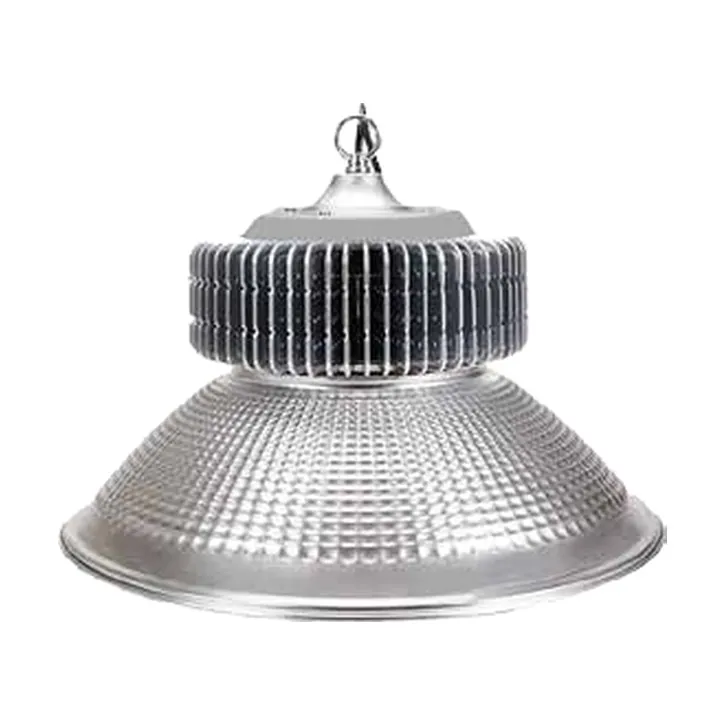
The layout. A warehouse 60 m × 30 m with fittings at 10 m, a 200 lux target and narrow-aisle racking. Our high bay lighting calculator with 150 W fittings at 130 lm/W and a 60° beam gives:
- 40 fittings in an 8 × 5 grid, 7.5 m × 6 m apart
- Average about 244 lux (22.7 fc) horizontal
Open the example. On horizontal values, the target is met.
The vertical check. Now look at a label on a rack face, 1.5 m to the side of a fitting that hangs over the aisle. For a simple estimate, treat the fitting’s 19,500 lm (150 W × 130 lm/W) as spread evenly in its 60° cone. The cone’s solid angle is 2π × (1 − cos 30°) = 0.842 sr, so the intensity is about 23,200 cd. Real fittings have a shaped distribution, so use the photometric file for design; this is for understanding.
| Label height | Vertical distance to fitting | Angle θ | Eh | Ev |
|---|---|---|---|---|
| 1 m above floor | 9 m | 9.5° | 275 lux (25.5 fc) | 46 lux (4.2 fc) |
| 6 m above floor | 4 m | 20.6° | 1,189 lux (110 fc) | 446 lux (41.4 fc) |
From this one fitting, the bottom-shelf label gets about 4 fc on its face, while the floor beside it gets about 25 fc. The top-shelf label, closer and at a steeper side angle, gets ten times more vertical light than the bottom one. Neighbouring fittings add some light, but the pattern holds: low labels in narrow aisles are the darkest task in the building, even when the floor average looks fine.
How to raise vertical illuminance
- Put fittings over the aisles, not over the racks. Light from above the rack top cannot reach the lower faces.
- Use aisle or batwing optics that throw light sideways onto the rack faces, rather than a round spot down onto the floor.
- Use more, lower-power fittings closer together along the aisle. More fittings means more light arriving from the side at shallower angles.
- Choose light-coloured rack uprights and floors where possible; reflected light reaches vertical faces.
- Check vertical values in the design software at the label heights that matter, typically the bottom shelf.
Our GKP40J LED high bay and other high bays are available with different beam angles; tell us the aisle width and rack height and we will choose the optic. Our warehouse lighting lux levels guide lists horizontal targets by area.
Where vertical foot-candles are in the rules
| Application | Why vertical matters | Where it appears |
|---|---|---|
| Offices and schools | Faces and whiteboards | EN 12464-1 wall, ceiling and cylindrical illuminance |
| Warehouses with racking | Reading labels and barcodes | Design practice; check at label heights |
| Sports | Seeing the ball in the air, TV cameras | Sports lighting standards, broadcast specs |
| Security and CCTV | Recognising faces | Camera and security guides; semi-cylindrical values |
| Roads and pedestrian areas | Recognising people | EN 13201 semi-cylindrical illuminance for some classes |
Measuring both on site
- Measure horizontal values on a grid at task height, with the sensor flat.
- At the critical vertical tasks (bottom shelf labels, signs), hold the sensor flat against the surface, facing where people stand.
- Note both values. A good aisle shows a vertical value at the lowest label that is still workable for reading, not just a good floor average.
What to send us
Send the building plan, rack height, aisle width and the label heights that matter. We will run the layout and report horizontal values and vertical values at the rack faces, so you know both before you buy.
Sources
Frequently asked questions
What are horizontal foot-candles?
Horizontal foot-candles are the illuminance on a horizontal plane facing up, such as a floor, desk or road surface. Most lighting standards and calculations, including warehouse and office targets, are given as horizontal values.
What are vertical foot-candles?
Vertical foot-candles are the illuminance on an upright plane facing a given direction, such as a shelf face, a wall, a goal mouth or a person's face. They matter when people need to see vertical things.
How do you measure vertical foot-candles?
Hold the light meter's sensor upright, facing the direction you care about, at the height of the task. For a rack label, hold it flat against the rack face at label height, facing the aisle.
Why is vertical illuminance lower than horizontal?
Because overhead fittings send most of their light steeply downwards. Light arriving nearly straight down hits a vertical surface at a grazing angle, so little of it lands on that surface. Light arriving from the side does better.
How many foot-candles is 1 lux?
1 foot-candle equals about 10.76 lux, so 1 lux is about 0.093 foot-candles. A 200 lux warehouse target is about 18.6 fc.