Foot-Candle Measurement: How to Measure Light Levels on Site and Read the Result
How to measure foot-candles properly: the unit, the meter, the measuring grid, and a worked survey of a 30 × 20 m hall compared with the value our calculator predicted.
Key points
- A foot-candle is one lumen per square foot, equal to 10.76 lux. Measure it with a cosine- and colour-corrected meter held at the working height, at night or with daylight excluded.
- Use a grid, not a few spot readings. EN 12464-1 sets the maximum grid spacing as p = 0.2 × 5^log10(d): about 1 m for a 10 m room, 2.2 m for a 30 m hall, 5 m for a 100 m warehouse.
- For a 30 × 20 m hall with sixteen 150 W high bays at 8 m, our calculator predicts about 258 lux (24 fc) maintained, so a new installation should read about 322 lux (30 fc) on day one.
- Report the average, the minimum and the uniformity (minimum ÷ average), with the meter model, its calibration date and the conditions.
A light level on a drawing is a prediction. A light level measured on site is evidence. The two only agree when the measurement is done properly: right meter, right height, a proper grid, and the right conditions. This guide covers the foot-candle unit, the equipment, the method, and a worked survey of a 30 × 20 m hall set against the value our calculator predicted.
The unit
One foot-candle (fc) is one lumen spread over one square foot. One lux is one lumen over one square metre. Because a square metre is 10.764 square feet:
- 1 fc = 10.764 lux
- 1 lux = 0.0929 fc
- Quick check: 10 fc ≈ 108 lux, 30 fc ≈ 323 lux, 50 fc ≈ 538 lux
North American specifications use foot-candles; most of the rest of the world uses lux. For a full table and the link to lamp lumens, see our foot-candles to lux and foot-candles to lumens guides. This article is about measuring.
The meter
A cheap phone app is fine for curiosity, not for acceptance. A usable illuminance meter has:
- Cosine correction, so light arriving at an angle is weighted correctly. Without it, readings under widely spaced high bays come out low.
- Photopic (V-lambda) correction, so the sensor responds like the eye. LED spectra differ from incandescent, and an uncorrected sensor can be off by a noticeable margin.
- A calibration certificate, typically renewed every year or two, for contractual tests.
- A detached sensor head on a cable, so your body does not shade the sensor.
Conditions before you start
- Exclude daylight. Measure at night, or with blinds closed and skylights covered. Otherwise you are measuring the sun.
- Let the lights stabilise. LED fittings need a few minutes to reach stable output; metal halide and sodium lamps need much longer. Allow at least 15–30 minutes for LED, longer for discharge lamps.
- Check the supply voltage. Note it. A low voltage reduces the output of some older fittings.
- Record the state of the installation. New, cleaned, or in service for how long. This decides how to compare with the design.
The grid
Spot readings directly under fittings always look good. The dark areas are between them. Use a regular grid over the task area. EN 12464-1 gives the maximum spacing between points:
p = 0.2 × 5^log10(d), where d is the longer side of the area in metres.
| Longer side d | Maximum grid spacing p |
|---|---|
| 10 m | 1.0 m |
| 20 m | 1.6 m |
| 30 m | 2.2 m |
| 50 m | 3.1 m |
| 100 m | 5.0 m |
Leave a border of about half a grid step from the walls, and avoid grid spacings that coincide with the fitting spacing, which would place every point directly under a fitting.
Height: hold the sensor at the task height: around 0.8 m for benches and desks, floor level for car parks and roadways, and vertically on rack faces or at shelf height in a warehouse where the task is reading labels. For roads, IES LM-50 sets a separate measuring layout between two poles.
The three numbers to report
- Average illuminance (Eavg): the mean of all grid readings.
- Minimum illuminance (Emin): the lowest single reading.
- Uniformity (U0 = Emin ÷ Eavg): EN 12464-1 asks for 0.4 to 0.7 depending on the task; a warehouse aisle may accept 0.4, an office desk area 0.6.
Add the meter model and calibration date, the time and conditions, and a marked-up plan with the grid and readings.
Worked survey: a 30 × 20 m hall
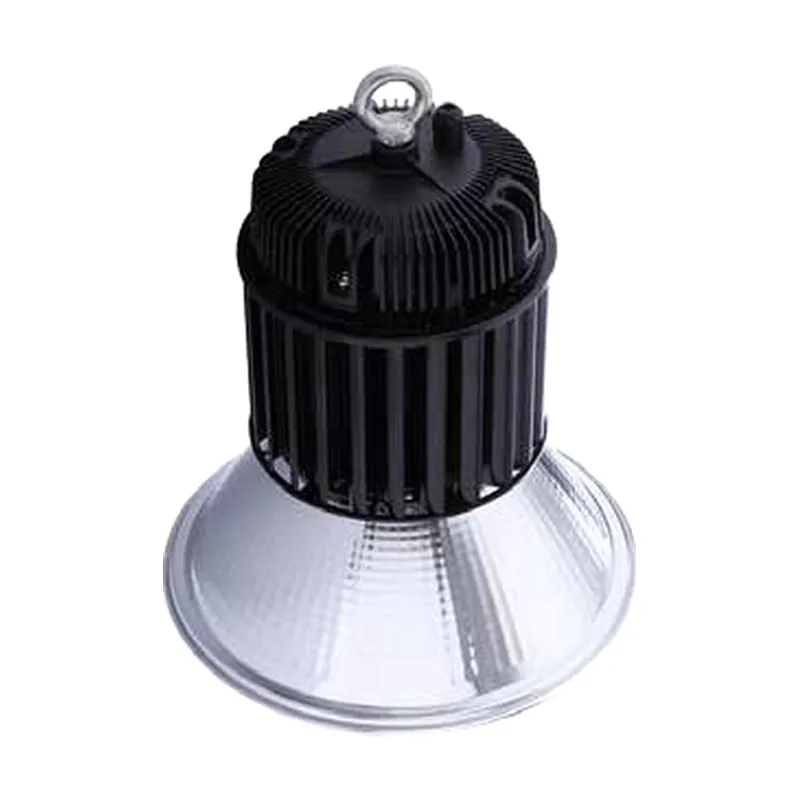
A workshop of 30 × 20 m with sixteen 150 W heat-pipe high bays (GKP40G) at 8 m, design target 200 lux (about 19 fc) at 0.8 m.
The prediction. In our high bay and warehouse lighting calculator, at 130 lm/W, medium reflectances, a medium beam and a maintenance factor of 0.8 (open the example):
- 16 fittings in a 4 × 4 grid, 7.5 × 5 m apart;
- about 258 lux maintained, or 24 fc;
- 4 W per m².
What to expect on day one. The maintained value already allows for 20 % loss. A new, clean installation should therefore read about 258 ÷ 0.8 ≈ 322 lux (30 fc) on average.
The grid. The longer side is 30 m, so the grid spacing must not exceed about 2.2 m. A grid of 14 × 10 points, about 2.1 × 2.0 m, gives 140 readings.
Reading the result. If the 140 readings average 300–340 lux with a minimum above about 160 lux (U0 ≥ 0.5), the installation matches the design. If the average is near 258 lux on a new installation, something is already costing 20 %: dirty reflectors from construction dust, a lower efficacy than declared, or the wrong beam. If the minimum is very low between rows, the spacing is too wide for the beam; the calculator caps spacing at 1.2 times the mounting height for a medium beam to prevent exactly this.
Common mistakes
- Measuring with daylight present. The most common reason for “excellent” results that customers later dispute.
- Holding the meter at chest height. About 1.4 m instead of 0.8 m; closer to the fittings and not where the task is.
- Shading the sensor. Stand to one side and use the detached head.
- Comparing initial readings with maintained design values. Correct with the maintenance factor first.
- Reporting only the average. A good average with poor uniformity still leaves dark spots between racks. Our warehouse lighting lux levels guide gives targets for each zone.
Using measurements in a retrofit
Before replacing old fittings, measure the existing installation on the same grid. It gives you a real baseline, shows where the old layout was under-lit, and lets you prove the improvement afterwards. Combine it with the energy figures from the LED retrofit savings calculator and the result is a report a finance department can sign off.
If you send us a plan of your hall and the grid readings, we will compare them with a calculation for the proposed layout and tell you how many fittings the new design needs, using the method in how many LED high bay lights do I need.
Sources
- EN 12464-1:2021 — Light and lighting: lighting of work places, indoor work places
- IES — Illuminating Engineering Society, lighting measurement guidance and LM-50 for roadway measurement
- NIST — SI units of illuminance (lux, foot-candle conversion)
- BlueGreen OE — High bay and warehouse lighting calculator
Frequently asked questions
What is a foot-candle?
The illuminance produced when one lumen falls evenly on one square foot. One foot-candle equals 10.764 lux, so 50 fc is about 538 lux.
What instrument measures foot-candles?
A light meter (illuminance meter or lux meter) with cosine correction and a photopic (eye-response) filter. Most switch between lux and foot-candles. For acceptance tests, use one with a current calibration certificate.
At what height should foot-candles be measured?
At the height of the task: about 0.75–0.85 m for desks and benches, at floor level for car parks and roads, and on the vertical face for rack labels or sports where vertical light matters.
How many readings do I need?
Enough to cover the area on a regular grid. By EN 12464-1, a 30 × 20 m hall needs points no more than about 2.2 m apart, roughly 140 readings. Fewer, widely spaced readings can miss dark spots between fittings.
Why is my new installation brighter than the design value?
Designs quote maintained illuminance, which allows for dirt and lumen depreciation through a maintenance factor (often 0.8). A new, clean installation should read about 1 ÷ 0.8 = 1.25 times the design value.