Parking Lot Light Lumens: How Many Lumens per Pole, per Fixture and per Space
How many lumens a parking lot light needs, by pole height and target lux: per-pole tables for 6–12 m poles, lumens per parking space, and the LED wattage at 110 lm/W.
Key points
- Lumens per pole = area served by the pole × target lux ÷ 0.4, where 0.4 combines a utilisation factor of 0.5 and a maintenance factor of 0.8.
- With poles on a grid at 3.5 times their height, a 10 lux lot needs about 11,000 lm per 6 m pole, 19,600 lm per 8 m pole, 30,600 lm per 10 m pole and 44,100 lm per 12 m pole.
- At 110 lm/W those figures are about 100 W, 180 W, 280 W and 400 W of LED per pole, split across one to four heads.
- Per parking space (about 30 m² including the aisle), 10 lux needs roughly 750 lumens at the fixtures.
“How many lumens do I need?” is a common first question about parking lot lighting. The answer depends on three things: how bright the lot should be, how far apart the poles are, and how high the lights are mounted. This guide turns those into lumen figures per pole, per fixture and per parking space, then converts them to LED watts.
If you want the full design method with uniformity and pole layout, our parking lot lighting design guide works through a complete lot. Here we focus on the lumen numbers.
The formula
The lumen method gives the light needed at the fixtures:
Lumens = area × target lux ÷ (utilisation factor × maintenance factor)
For open parking lots with modern area optics, a utilisation factor of about 0.5 (half the light lands on the lot) and a maintenance factor of 0.8 (dirt and lumen depreciation over time) are reasonable starting values. Their product is 0.4, so:
Lumens = area × lux ÷ 0.4
That is 2.5 lumens per square metre for every lux you want. In foot-candles, multiply by about 10.76 to convert to lux first; our foot-candles to lumens article covers the conversion.
Target lux
Common targets for open parking areas, by traffic level, are 5, 10 and 20 lux average under EN 12464-2. North American practice for parking sets minimum illuminance rather than averages, with higher values where security matters. Pick the target first; everything else follows from it.
Lumens per pole by height
Poles can usually be spaced at up to about 3.5 times their mounting height while keeping uniformity acceptable, the same limit our pole height and spacing calculator uses. On a square grid, each pole then serves a square of that side:
| Pole height | Grid spacing | Area per pole | 5 lux | 10 lux | 20 lux |
|---|---|---|---|---|---|
| 6 m | 21 m | 441 m² | 5,500 lm | 11,000 lm | 22,100 lm |
| 8 m | 28 m | 784 m² | 9,800 lm | 19,600 lm | 39,200 lm |
| 10 m | 35 m | 1,225 m² | 15,300 lm | 30,600 lm | 61,300 lm |
| 12 m | 42 m | 1,764 m² | 22,100 lm | 44,100 lm | 88,200 lm |
Poles along the edge of the lot serve less area, because half their light falls outside. Reduce their lumens or aim them inward with asymmetric optics.
Converting to LED watts
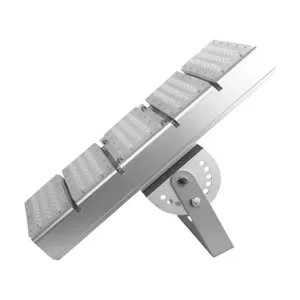
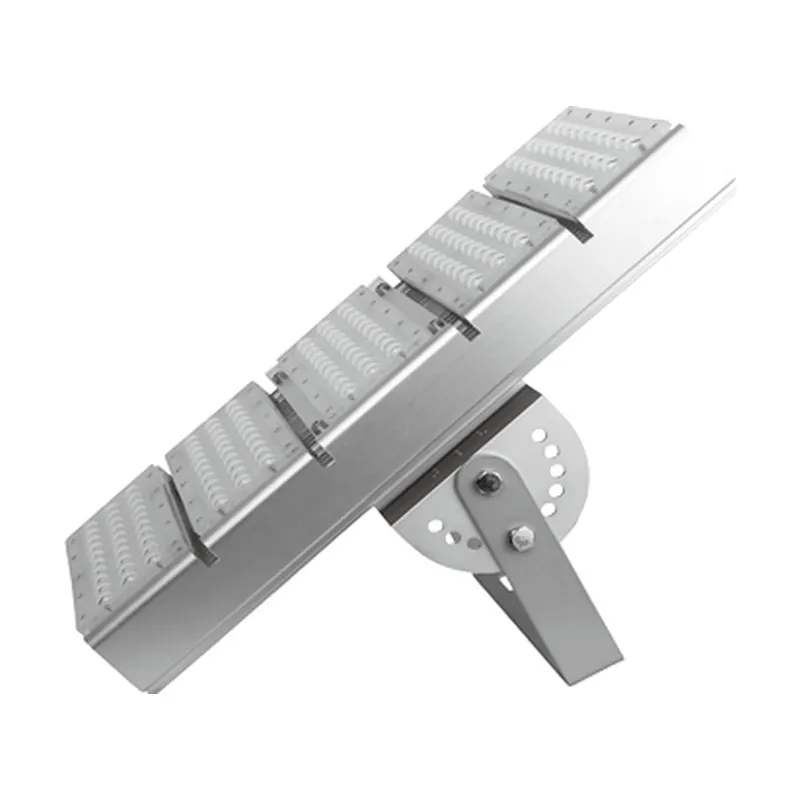
At 110 lm/W, the rated efficacy of our TLM30C modular flood light and LDM30C modular street light:
| Pole height | 5 lux | 10 lux | 20 lux | Typical head arrangement at 10 lux |
|---|---|---|---|---|
| 6 m | 50 W | 100 W | 200 W | 1 × 100 W |
| 8 m | 90 W | 180 W | 360 W | 1 × 180 W or 2 × 90 W |
| 10 m | 140 W | 280 W | 560 W | 2 × 150 W |
| 12 m | 200 W | 400 W | 800 W | 2 × 200 W or 4 × 100 W |
A single head on an interior pole lights all around it; twin heads back-to-back on a double arm give better coverage on both sides of an aisle. Our high mast parking lot lights article covers the very large lots where 15–25 m masts carry many heads.
Lumens per parking space
Buyers who count spaces rather than square metres can use a rule of thumb. A standard space of about 2.5 × 5 m plus its share of the drive aisle comes to roughly 25–30 m²:
| Area per space | 5 lux | 10 lux | 20 lux |
|---|---|---|---|
| 25 m² | 310 lm | 625 lm | 1,250 lm |
| 30 m² | 375 lm | 750 lm | 1,500 lm |
So a 200-space lot at 10 lux needs about 150,000 lm at the fixtures (200 × 750), or around 1,360 W of LED at 110 lm/W. Laid out on 10 m poles at 35 m spacing, that is about five poles of 280 W. Check this against the real shape of the lot: long narrow lots need more poles for the same area.
Replacing metal halide: compare lumens, not watts
Most older lots use 250 W or 400 W metal halide. A 400 W system draws about 460 W with its ballast, and its output falls well below its rated lamp lumens within the first year. Matching the delivered lumens, not the lamp rating, usually puts the LED replacement at 150–200 W per head. Our LED retrofit savings calculator shows 20 heads of 400 W metal halide replaced by 150 W LED saving about 27,000 kWh a year at 12 hours a night, 67 %.
Lumens are only half the answer
- Uniformity. A lot with the right average can still have dark patches between poles. Keep spacing within 3.5 times the height and use area optics.
- Glare. High lumens from a low pole dazzle drivers. Use full cut-off fittings and avoid tilting the heads up.
- Light trespass. Edge poles near houses should use back-light shields or house-side optics. Our shielded street lights article covers the options.
- Colour temperature. 3000–4000 K is common; warmer light is preferred near homes.
Quick check before you buy
- Measure the lot and choose the target lux.
- Choose pole height and a spacing of up to 3.5 × height.
- Work out lumens per pole from the table or the formula.
- Divide by the luminaire’s tested efficacy to get watts.
- Ask for a photometric layout with the real IES file to confirm uniformity.
What to send us
A site plan or the lot’s dimensions, the number of spaces, existing pole heights and positions, and the target lux or standard. We will reply with the lumens and wattage per pole, and a layout from our calculator.
Sources
Frequently asked questions
How many lumens does a parking lot light need?
It depends on pole height and spacing. For 10 lux with poles at 3.5 times their height, about 11,000 lm per pole at 6 m, 19,600 lm at 8 m, 30,600 lm at 10 m and 44,100 lm at 12 m.
How many lumens per parking space?
Allowing about 30 m² per space including its share of the aisle, roughly 375 lm for 5 lux, 750 lm for 10 lux and 1,500 lm for 20 lux, measured at the fixtures.
How many watts is a 20,000 lumen LED parking lot light?
At 110 lm/W, about 180 W. At 130 lm/W, about 155 W. Use the tested luminaire efficacy, not the LED chip rating.
Are more lumens always better in a parking lot?
No. Above the target, extra lumens add glare, light trespass onto neighbours and energy cost. Uniformity matters as much as the total.