High Mast Parking Lot Lights: When Two Masts Beat Twenty-Four Poles
High mast lighting for large parking lots: mast height and spacing, a worked 120 × 80 m car park comparing two 25 m masts with 24 poles, energy, uniformity, glare and maintenance trade-offs.
Key points
- For a 120 × 80 m car park at 20 lux, our lumen-method estimate needs about 11 floodlights of 400 W on high masts, or about 22–24 pole-top area lights of 200 W on 10 m poles.
- The connected load is almost the same, about 4.8 kW either way. The difference is in foundations, obstructions, uniformity and maintenance, not energy.
- Masts can be spaced up to about 3.5 times their height: two 25 m masts about 60 m apart cover this lot, with six 400 W floodlights each.
- High masts suit lots above roughly 10,000 m², truck and bus parks, and sites where poles would block parking bays or vehicle movements.
Most parking lots are lit with rows of 8–12 m poles. On very large lots, such as truck stops, bus depots, logistics centres, stadium car parks and port marshalling areas, a few high masts can replace dozens of poles. This guide shows when that trade makes sense, with a worked comparison for one car park and the numbers behind it.
When to consider high masts
High masts are worth comparing with poles when one or more of these apply:
- The lot is large, roughly 10,000 m² and up, so a few masts can cover it.
- Poles would get in the way of trucks, buses, trailers or snow clearing, or would cost parking bays.
- Trenching is expensive, for example on an existing paved surface, so fewer cable runs save money.
- The lot is also an operations yard, where cranes, reach stackers or high vehicles need clear space.
For a typical shopping centre or office car park of a few thousand square metres, poles are usually cheaper and give more even light. Our guide to LED parking lot lights covers that case.
The worked example
A truck and car park of 120 × 80 m (9,600 m²), with a target of 20 lux average, a typical value for busy outdoor car parks in EN 12464-2.
The lumen method:
Number of luminaires = target lux × area ÷ (lumens per luminaire × UF × MF)
with a maintenance factor (MF) of 0.8. The utilisation factor (UF) differs: about 0.45 for high mast floodlights, because light reaching the edges of a large pool partly falls outside the area, and about 0.5 for pole-top area lights with a type V or type III optic.
| Option | Luminaire | Lumens each | UF | Calculated number | Chosen layout | Connected load |
|---|---|---|---|---|---|---|
| A: High masts | 400 W floodlight, 130 lm/W | 52,000 | 0.45 | 10.3 | 2 masts × 6 = 12 | 4.8 kW |
| B: Poles | 200 W area light, 110 lm/W | 22,000 | 0.5 | 21.8 | 24 poles, 6 × 4 grid | 4.8 kW |
| C: Poles | 150 W area light, 110 lm/W | 16,500 | 0.5 | 29.1 | 30 poles | 4.5 kW |
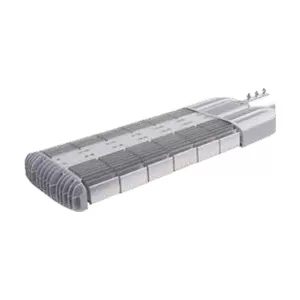
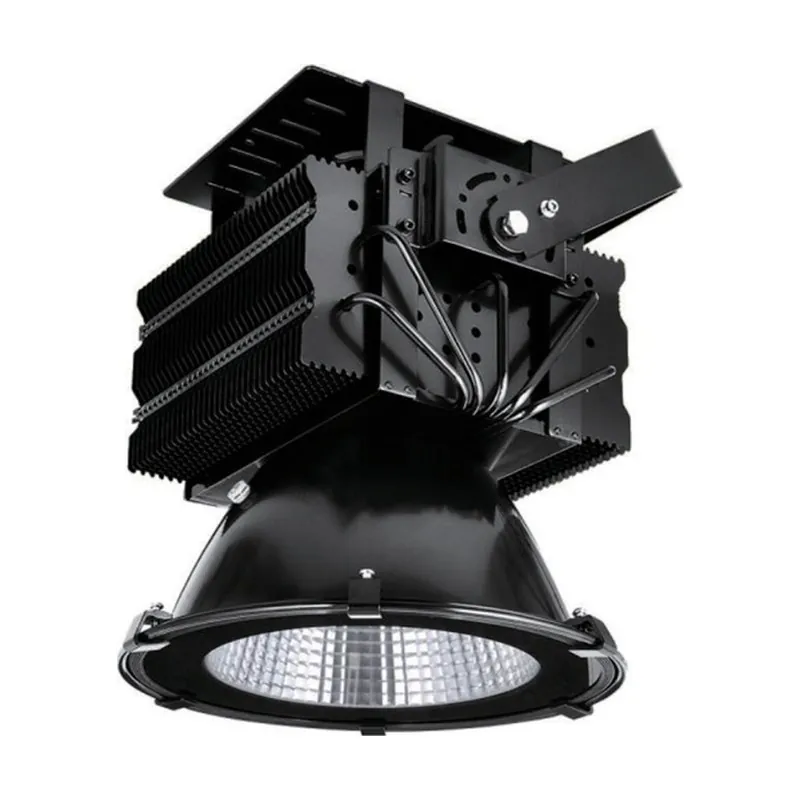
The 400 W floodlight is our port and apron floodlight BG-TS400H, rated above 130 lm/W, with 25°, 40°, 60° and 90° reflectors. The 200 W pole option assumes a 110 lm/W area light such as our LDM30C on a pole-top bracket.
The energy is a draw. Option A and option B both connect about 4.8 kW. The decision rests on the other factors.
Mast height and spacing
The high mast lighting guide uses a rule of thumb that masts can be spaced up to about 3.5 times their height while keeping acceptable uniformity. For this lot:
| Mast height | Maximum spacing | Masts needed for 120 × 80 m | Comment |
|---|---|---|---|
| 18 m | 63 m | 2 (tight) or 3 | Short throw to the corners; 3 masts give better edges |
| 25 m | 87 m | 2, about 60 m apart | Balanced choice |
| 30 m | 105 m | 2 | Heavier mast and foundation for little gain |
With two 25 m masts placed on the long centre line, 30 m in from each short end, the farthest corner is about 50 m from a mast. Floodlights aimed at the corners use the narrower 40° reflector; those aimed at the near ground use 60° or 90°. Our LED flood light distance chart shows that a 400 W light with a 40° beam delivers about 46 lux on a surface facing it at 40 m, falling to about 21 lux at 60 m, so the corners need careful aiming and overlapping beams.
The trade-offs
| Factor | Two 25 m high masts | 24 poles at 10 m |
|---|---|---|
| Foundations | 2 large | 24 small |
| Cable trenching | Short runs to 2 points | Runs to every pole |
| Obstructions on the lot | Almost none | 24 poles, each a collision risk |
| Parking bays lost | Almost none | Typically one bay or island per pole |
| Uniformity | Good in the centre, weaker at far edges | Easier to keep even |
| Glare and spill | Higher risk; needs visors and aiming | Lower with full cut-off optics |
| Maintenance access | Lowering ring, from the ground | Platform lift for each pole |
| Wind load and structure | Mast designed for site wind speed | Standard poles |
| Light on vertical surfaces (faces, plates, cameras) | Good, light from several directions | Depends on pole layout |
Spill light and glare deserve attention. A high mast next to a public road or homes can cause complaints if floodlights are aimed too high. Asymmetric reflectors, visors and keeping aiming angles low solve most of this, but it must be part of the design, not an afterthought.
Choosing the mast height
The keyword many buyers search for is the high mast pole height. In practice it follows from the site:
- Area and shape. Height sets the spacing (about 3.5 × height). Choose the lowest height that covers the area with the number of masts you can accept.
- Obstructions. Masts must be tall enough for floodlights to see over parked trucks and trailers without deep shadows.
- Neighbours. Taller masts spread light further; near homes, more, lower masts may be better.
- Aviation. Near airports, height limits apply and taller masts may need obstruction lights; see our article on airport high mast lighting.
- Wind. The mast, ring and floodlights are designed together for the local wind speed. Floodlight weight and projected area matter: our 400 W BG-TS weighs 13.2 kg and the 1000 W model 32.2 kg.
A real installation
Our largest recent masts are at a steel pipe plant in Xiangtan: two 32 m masts with 600 W LED floodlights, one full ring of 10 floodlights and one three-quarter ring of 8, lighting an open storage and loading yard where poles would obstruct cranes and trucks. The project page has the configuration. A truck park is a simpler task than a steel yard, which is why 25 m masts with 400 W floodlights are enough in the example above.
What about solar?
For remote lots without a grid connection, solar high masts exist, but the battery and panel for 4.8 kW of floodlights over a full night are very large. Our guide to solar high mast lights explains where they work. For most parking lots, a grid supply with LED floodlights and a timer or dimming profile is far cheaper.
Installation notes
- The mast foundation is designed from soil data and wind load; do not reuse a foundation designed for a different mast.
- Lowering systems need annual inspection of the winch, cable and ring.
- Run separate circuits for half the floodlights on each mast, so one fault or maintenance task does not black out the whole area.
Our guide to high mast installation covers foundations, erection and commissioning, and our high mast flood light system article covers the electrical side.
Send us a site plan with the lot dimensions, surroundings and any height limits, and we will compare a mast layout with a pole layout for your lot, including a lux plot of each.
Sources
Frequently asked questions
What height is a high mast for a parking lot?
Usually 18–25 m. Lower than about 18 m, a conventional pole layout is normally cheaper. Higher than 25 m is used for very large truck parks and logistics yards where fewer, taller masts keep the ground clear.
How many floodlights does a high mast parking lot need?
Use the lumen method: target lux × area ÷ (floodlight lumens × utilisation factor × maintenance factor). For 9,600 m² at 20 lux with 400 W floodlights at about 52,000 lm, a utilisation factor of 0.45 and a maintenance factor of 0.8, that is about 11, rounded to 12 on two masts.
Are high mast lights more efficient than parking lot poles?
Not by themselves. Light from a high mast travels further and more of it falls outside the area, so the utilisation factor is lower. Because LED floodlights are efficient, the total load ends up close to a pole layout. The savings come from fewer foundations, cables and obstructions.
How are high mast floodlights maintained?
Most high masts have a winch and lowering ring, so the floodlight ring is brought down to the ground for cleaning and repairs. This avoids a platform lift but requires the lowering system itself to be inspected regularly.