
Airport High Mast Lighting: Apron Floodlighting Levels, Glare and Mast Height Limits
ICAO asks for at least 20 lux average on aircraft stands with 4:1 uniformity. How apron high masts are placed, mast height limits, glare control and a lumen estimate.
Key points
- Airport aprons are lit from high masts placed behind the aircraft stands, so that light reaches the aircraft sides without masts obstructing taxiing.
- ICAO recommends an average horizontal illuminance of at least 20 lux on aircraft stands, with an average-to-minimum uniformity of no more than 4:1, plus vertical light at 2 m height.
- Glare toward pilots and the control tower is controlled by flat-glass, asymmetric floodlights aimed below the horizontal.
- Mast heights are limited by obstacle limitation surfaces; masts that penetrate them need approval and obstacle lighting.
At night an airport apron is a busy workplace: aircraft are towed and parked, baggage and fuel vehicles move between them, and ground staff work under the wings. The lighting must let everyone see clearly without dazzling pilots or controllers, and the masts that carry it must not become obstacles. This guide explains how airport aprons are lit with high masts, which light levels apply and what to specify.
Why high masts on aprons
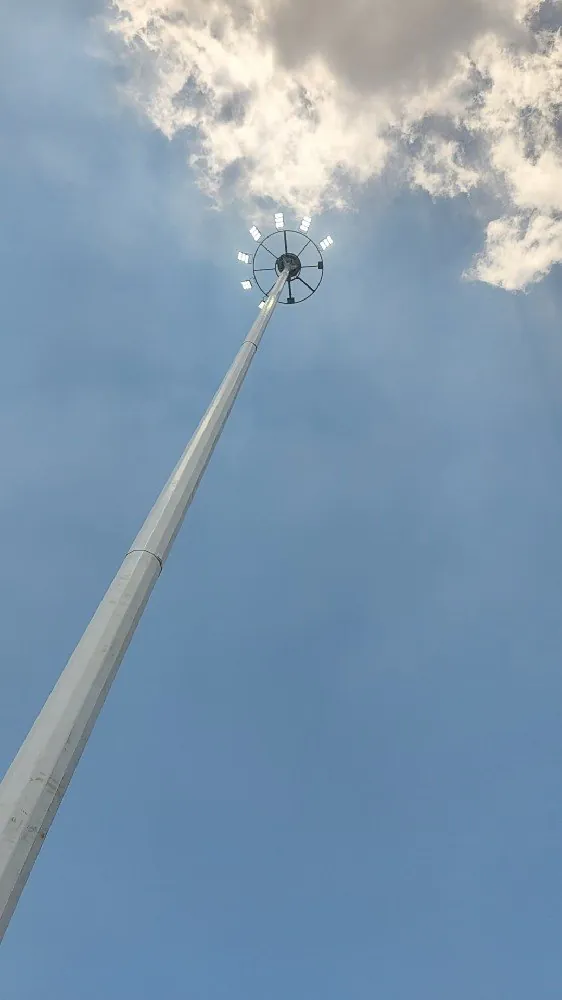
Aprons are large open areas where poles cannot stand among the aircraft. High masts solve this: a few tall masts, placed behind the aircraft stands or along the apron edge, carry rings or headframes of floodlights that throw light across the stands. Compared with many shorter poles, high masts:
- Keep the apron clear for aircraft and vehicles
- Light the sides of aircraft from several directions, reducing shadows
- Concentrate maintenance at a few points, usually with a lowering system
- Allow precise aiming from above, keeping light low and off the sky
The same approach is used at seaports and container terminals, which share the problem of large working areas with moving equipment. For general high mast design, see our high mast lighting guide.
Light levels: ICAO recommendations
ICAO Annex 14 recommends apron floodlighting for aprons used at night, with these values:
- Aircraft stands: average horizontal illuminance of at least 20 lux, with a uniformity ratio (average to minimum) of no more than 4 to 1
- Vertical illuminance: about 20 lux at 2 m above the apron, in the directions relevant to the work around the aircraft
- Other apron areas: horizontal illuminance of about 50% of the stand average, with the same uniformity
National aviation authorities and airports may set higher values, particularly on stands where refuelling and maintenance take place, and for CCTV. Always confirm the governing standard for the airport.
Vertical light matters as much as horizontal. Ground staff need to see the sides of the aircraft, the cargo doors, the wheels and the fuel points, so floodlights must be placed to light the stand from more than one direction.
Glare control
Glare is the main constraint on apron lighting:
- Pilots taxiing in and out of stands must not be dazzled; light from floodlights must not be confused with aeronautical ground lights
- The control tower needs a clear view of the apron and taxiways; floodlights must not shine toward it
- Approach and departure paths must stay free of upward light
Practical measures:
- Floodlights with flat glass and asymmetric optics, mounted horizontal, so that almost no light leaves above the horizontal
- Aiming from behind the stands toward the aircraft, away from the taxi lanes and the tower
- Mast positions agreed with the airport’s operations and air traffic services
- Night commissioning to check glare from the cockpit and tower positions
Mast height and obstacle limits
Every airport has obstacle limitation surfaces, imaginary surfaces around runways and approach paths that structures must not penetrate. Apron masts are typically 20–35 m high, chosen so that:
- They are tall enough to light the stands evenly at a reasonable spacing
- They stay below the transitional and inner horizontal surfaces
- They are far enough from taxiways and taxilanes to keep wingtip clearance
Where a mast must penetrate a surface, it needs approval and is usually marked and fitted with obstacle lights. These constraints often set the mast height before the lighting design starts.
Worked estimate: lumens for a group of stands
The lumen method gives an order of magnitude. Consider an apron strip of 10 narrow-body stands, about 450 × 60 m (27,000 m²), lit to 20 lux average. For high mast floodlighting, a utilisation factor of about 0.4 and a maintenance factor of 0.8 are reasonable:
Lumens = 20 × 27,000 ÷ (0.4 × 0.8) ≈ 1.7 million lm
At 130 lm/W, that is about 13 kW of LED floodlights. In practice the requirement for vertical illuminance and uniformity on every stand usually raises the number of floodlights and spreads them over more masts, so a real design may come out higher. A full photometric calculation, with the actual stand layout, mast positions and aiming, is essential.
The same method can be applied to a single stand: a stand of about 45 × 50 m at 20 lux needs roughly 140,000 lm, about 1.1 kW of LED, from at least two directions.
Choosing the floodlights
- Optics: asymmetric distributions with sharp cut-off; several beam types for near and far parts of the stand
- Flat glass, mounted horizontal, for minimal upward light
- Efficacy: 130 lm/W or more reduces load and cable sizes
- Colour: 4000–5000 K and CRI 70 or higher, so markings, signs and fuel colour codes are easy to see; CRI 80 helps CCTV
- Robustness: IP66, impact-resistant glass, vibration-resistant brackets for masts exposed to jet blast and wind
- Controls: dimming of unused stands, and instant restrike after a power interruption, which LED provides and metal halide did not
Our heat-pipe stadium and port floodlight is designed for high-mast use at ports and large yards, and we have supplied complete high masts with LED floodlights for industrial sites such as the 32 m high mast lighting at a steel pipe plant.
Masts, lowering systems and maintenance
On a live apron, maintenance windows are short and access is controlled. Masts above about 20 m usually have a motorised lowering system that brings the floodlight ring to ground level, so work does not need a tall platform among parked aircraft. Plan:
- Mast positions with space for the lowering ring and a service vehicle
- Foundations designed for the local wind code and soil
- Hot-dip galvanizing, with a duplex coating in coastal airports; see galvanized steel light poles
- Earthing and lightning protection on every mast
See high mast installation for foundation, erection and lowering system steps.
Upgrading from metal halide or sodium
Many airports still light aprons with 1,000–2,000 W metal halide floodlights. LED replacements reduce energy, remove long restrike times after power dips and allow stands to be dimmed when unused. Check that the mast, headframe and lowering system can carry the new floodlights’ weight and wind area, and repeat the glare check from the tower and cockpit positions after the change. See metal halide vs high pressure sodium for the old lamp types and their replacement.
What to specify
- Governing standard (ICAO, national authority, airport standard) and target horizontal and vertical lux and uniformity for stands and other areas
- Glare limits toward the tower, taxiways and approach paths
- Maximum mast heights from the obstacle limitation surfaces, and obstacle lighting requirements
- Mast positions, foundation and lowering system
- Floodlight optics, efficacy, colour temperature and CRI
- Controls, dimming and integration with the airport’s systems
- Night commissioning, including glare checks from cockpit and tower
For apron and large-area projects, send us the layout, the stand types and the governing standard, and we will prepare the mast and floodlight proposal with a photometric calculation.
Sources
Frequently asked questions
How much light does an airport apron need?
ICAO recommends an average horizontal illuminance of at least 20 lux on aircraft stands, with an average-to-minimum uniformity no worse than 4:1, and vertical illuminance of about 20 lux at 2 m above the apron in the relevant directions. Other apron areas are lit to about half the stand level. National rules and the airport's own standard may set higher values.
How tall are airport high masts?
Typically 20–35 m, chosen to light the stands evenly from behind while staying below the obstacle limitation surfaces. Masts closer to runways and taxiways must be lower or need special approval.
Why are airport floodlights aimed so carefully?
Light above the horizontal can dazzle pilots taxiing or landing and controllers in the tower. Apron floodlights use flat glass and asymmetric optics aimed downward so that almost no light goes above the horizontal.
Do airport high masts need obstacle lights?
Masts that penetrate an obstacle limitation surface, or that the authority considers a hazard, must be marked and lit with obstacle lights according to ICAO Annex 14 or national rules.
