Metal Halide vs High Pressure Sodium: Differences, Costs and What Replaces Them
High pressure sodium vs metal halide in 8 points: efficacy, colour, life, restrike. What HPS lights are, why 'sodium halide' is not a lamp type, and LED swaps saving 57–65%.
Key points
- High pressure sodium gives more lumens per watt and lasts longer; metal halide gives white light with far better colour rendering.
- HPS suited roads and car parks where colour did not matter; metal halide suited sports fields, shops, warehouses and anywhere colours had to be seen.
- Both need a ballast, take minutes to warm up and several minutes to restrike after a power cut; metal halide also loses light faster with age.
- LED now replaces both: in our worked example, 40 lights of 400 W (460 W with ballast) replaced by 200 W LED cut energy use by about 57%.
For forty years, two lamp types lit most of the world’s roads, car parks, stadiums and warehouses: high pressure sodium (HPS), with its orange glow, and metal halide (MH), with its white light. Both are now being replaced by LED, but millions are still in service, and the choice between them shaped how those sites were designed. This guide compares the two lamps and shows what replacing them with LED involves.
Metal halide vs high pressure sodium: the short answer
High pressure sodium is the more efficient lamp: more lumens per watt, longer life and better lumen maintenance, but an orange light (about 2,000 K, CRI 20–25) that makes colours hard to see. Metal halide gives white light (3,000–5,700 K, CRI 65–90) that shows colours properly, but it uses more power for the same lumens, loses light faster with age and takes up to 15 minutes to restrike after a power cut. HPS was the road and car park lamp; metal halide was the sports, shop and warehouse lamp. Today LED replaces both with 57–65% less energy in our examples below.
What are high pressure sodium lights?
High pressure sodium lights are discharge lamps in which an arc runs through sodium vapour at high pressure inside a narrow ceramic tube. They were made in sizes from about 35 W to 1,000 W. Approximate lamp output for common tubular clear lamps:
| HPS lamp | Approximate lamp lumens | Typical use |
|---|---|---|
| 70 W | about 6,000 lm | Residential streets, wall packs |
| 100 W | about 9,000–10,000 lm | Streets, car parks |
| 150 W | about 15,000–17,000 lm | Main streets, yards |
| 250 W | about 28,000–33,000 lm | Main roads, floodlights |
| 400 W | about 48,000–56,000 lm | Highways, high masts, high bays |
| 1,000 W | about 125,000–130,000 lm | High masts, large floodlights |
Values vary by manufacturer and lamp version. Lamp lumens are not delivered lumens: the reflector of an HPS fitting loses part of the light, which is why an LED fitting with fewer rated lumens can put the same or more light on the road.
“Sodium halide” lights: what people usually mean
Searches for “sodium halide lamp” or “sodium halide lights” mix the two names. There is no standard lamp class by that name. If you have a lamp marked SON, HPS or with an orange glow, it is high pressure sodium. If it is marked MH, MHN, MS or CDM and gives white light, it is metal halide; its arc tube does contain sodium iodide as one of several halide salts, which may be where the name comes from. The lamp and ballast must match, so identify the type before ordering replacements or converting.
How each lamp works
Both are high-intensity discharge (HID) lamps: an electric arc runs through a gas-filled arc tube inside an outer bulb.
- High pressure sodium uses sodium vapour, with mercury and xenon, in a translucent ceramic (alumina) arc tube. The sodium emits mostly yellow-orange light.
- Metal halide uses mercury and a mix of metal halide salts (sodium, scandium, thallium, indium and others) in a quartz or ceramic arc tube. The mix of metals fills in the spectrum and gives white light.
Both need a ballast to limit the current, and HPS and pulse-start metal halide need an ignitor to strike the arc.
Side-by-side comparison
| Property | High pressure sodium | Metal halide |
|---|---|---|
| Lamp efficacy | about 90–140 lm/W | about 70–110 lm/W |
| Colour temperature | about 2000–2100 K (orange) | about 3000–5700 K (white) |
| Colour rendering (CRI) | about 20–25 | about 65–90 |
| Rated life | about 24,000–30,000 h | about 10,000–20,000 h |
| Lumen maintenance | good; about 90% at mid-life | poorer; often 65–80% at mid-life |
| Warm-up | 3–5 minutes | 3–5 minutes |
| Restrike after power cut | about 1 minute | 5–15 minutes |
| Typical uses | roads, car parks, yards, warehouses | stadiums, shops, warehouses, floodlighting |
Values vary by wattage and manufacturer; ceramic metal halide (CMH) sits at the better end of the metal halide column. See ceramic metal halide for that lamp type.
Light quality: why colour matters
HPS turned night into shades of orange and grey. Cars, clothes and faces were hard to tell apart, and CCTV images were poor. For roads where the only task was seeing obstacles, engineers accepted that in exchange for efficiency and long life.
Metal halide gave white light that looked like daylight. It was the choice wherever colour mattered: sports broadcasts, car dealerships, shops, warehouses where labels had to be read, and building floodlighting.
There is also a visibility effect. At the low light levels of night-time roads, the eye’s sensitivity shifts toward blue-green, so white light at the same measured lux can appear brighter and improve peripheral vision. That was one argument for white light on roads even before LED.
Efficiency in practice
On paper HPS wins on lumens per watt. In practice the gap is smaller:
- Ballast losses add about 10–20% to the lamp wattage for both types
- Lumen depreciation is steeper for metal halide, so designers oversized MH installations to keep light levels at the end of lamp life
- Optics: both lamps emit light in all directions, and a reflector loses part of it before it reaches the ground
A 400 W HPS or MH luminaire typically draws about 440–470 W from the supply once the ballast is counted.
Lamp life and maintenance
HPS lamps last longer and fail gradually; at end of life they often start “cycling”, turning on and off as the arc voltage rises. Metal halide lamps lose light and can shift colour with age, so neighbouring lamps of different ages look different. Many sites group-relamped metal halide every two to three years to keep colour and light consistent.
Both lamp types contain mercury and must be recycled as hazardous waste.
Can you swap one lamp for the other?
Not in general. HPS and metal halide lamps need different ballasts and ignitors, and only special lamps designed to run on the other type’s ballast work. Fitting the wrong lamp can shorten its life or damage the ballast. If you want to change from orange to white light, converting the fitting to LED is usually simpler and cheaper to run than changing the ballast for metal halide.
Warm-up and restrike
Neither lamp gives full light at switch-on. After a brief power interruption, the hot lamp must cool before the arc can restrike: about a minute for HPS, but often 10 minutes or more for metal halide. In a sports hall or stadium that can stop a match. Some venues kept a few halogen lamps or used hot-restrike systems for that reason. LED starts instantly, which removes the problem.
Where each was used
- Roads and streets: HPS dominated for decades, after low pressure sodium
- Car parks and yards: mostly HPS; metal halide where security cameras mattered
- Warehouses and factories: both; metal halide high bays where colour or labels mattered
- Sports fields and stadiums: metal halide almost exclusively
- Shops, forecourts and showrooms: metal halide
- Greenhouses: HPS for flowering, metal halide for vegetative growth
Replacing either lamp with LED
LED does better than both on almost every count: efficacy of 110–160 lm/W for complete luminaires, CRI 70–80 or higher, instant start, dimming, and a life of 50,000 hours or more. Its directional light also means less is wasted in reflectors.
A worked example in our LED retrofit savings calculator: 40 floodlights of 400 W metal halide, with 15% ballast losses, running 12 hours a day.
- Old system: 460 W each, about 80,600 kWh a year
- LED replacement at 200 W: about 35,000 kWh a year
- Saving: about 45,600 kWh a year, or 57%
- At $0.15/kWh that is about $6,800 a year in energy, plus lamp replacements no longer needed
A second example for street lighting: 100 HPS street lights of 250 W (287.5 W with 15% ballast losses) replaced by 100 W LED, 12 hours a day, at $0.15/kWh, with an assumed $120 luminaire and $30 installation per point. The retrofit calculator gives:
| Result | Value |
|---|---|
| HPS energy | about 125,900 kWh a year |
| LED energy | about 43,800 kWh a year |
| Saving | about 82,100 kWh (65%) |
| Money saved | about $14,100 a year including lamp changes |
| Simple payback | about 13 months |
The same logic applies to 400 W HPS, because the calculation is based on the power drawn. With HPS the LED often needs to be chosen a little more carefully for light output, since the HPS lamp produced more lumens per watt; with metal halide, whose output has usually dropped well below its rating, a 150–200 W LED often matches or exceeds the existing light. See our metal halide to LED guide and HPS to LED conversion chart.
Choosing the LED replacement
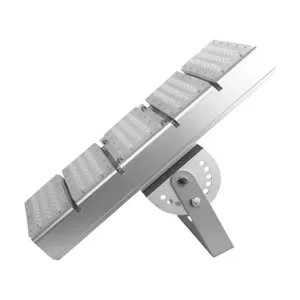
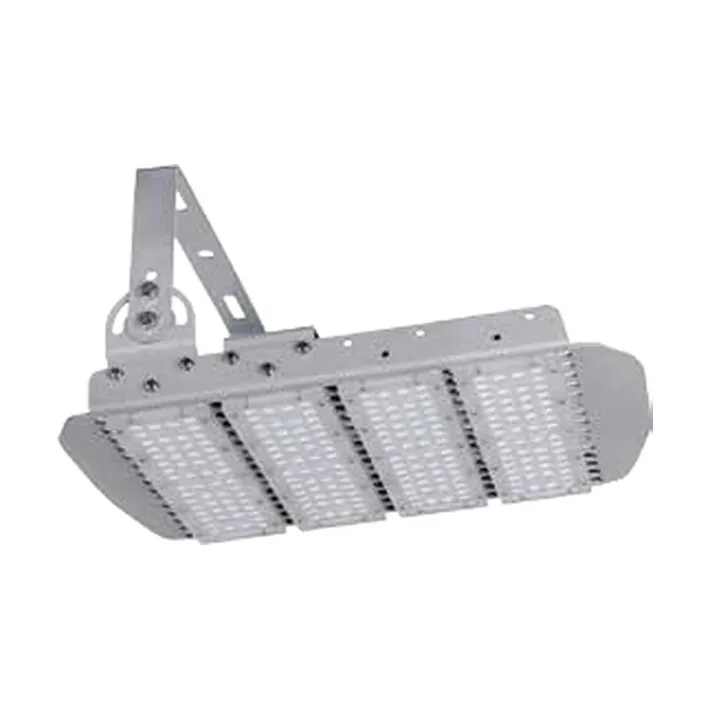
- Floodlights and sports lighting: match the beam angle and aiming of the old fittings; our modular LED flood light TLM30C adds one 50 W module per step, up to 300 W, with a rotatable bracket
- Street lights: choose a road optic for the existing spacing; see street light reflectors and lenses
- High bays: check mounting height and the light level the task needs
- Colour temperature: 3000–4000 K for roads and outdoor areas; 4000–5000 K for warehouses and sports
Are retrofit LED lamps a good idea?
LED “corn” lamps that screw into the old socket are tempting because they avoid replacing the luminaire. They can work in enclosed post-tops and low bays, but the old reflector was designed for a point source, and heat build-up inside a closed fitting shortens LED life. For high-power floods and street lights, a complete LED luminaire usually performs better. See corn cob LED bulbs for when they make sense.
Tell us how many HPS or metal halide lights you have, their wattage and the hours they run, and we will propose LED replacements and calculate the saving.
Sources
Frequently asked questions
What is a sodium halide lamp?
There is no standard lamp type called sodium halide. The term usually means either a high pressure sodium (HPS) lamp or a metal halide lamp, whose arc tube contains sodium iodide among other metal halides. Check the lamp code: SON or HPS for sodium, MH, MHN or CDM for metal halide.
Which is brighter, metal halide or high pressure sodium?
Per watt, high pressure sodium produces more lumens: typically 90–140 lm/W for the lamp against about 70–110 lm/W for metal halide. But metal halide's white light makes objects and colours easier to see, so for the same lux many people judge it brighter.
Why is high pressure sodium light orange?
Sodium vapour emits most of its light in the yellow-orange part of the spectrum. That gives a colour temperature of about 2000–2100 K and a colour rendering index around 20–25, so colours look washed out.
What replaces metal halide and HPS lamps?
LED floodlights, street lights and high bays. They typically use 40–60% less energy for the same useful light, start instantly, can be dimmed and last 50,000 hours or more.