Barn Security Lights: Dusk-to-Dawn or Motion, Wattage and Where to Mount Them
Lighting a barnyard for security: dusk-to-dawn or motion, how many LED floodlights a 30 × 20 m yard needs, mounting height, and running cost.
Key points
- A 30 × 20 m barnyard at 20 lux needs about 12,000 lumens on the ground, which works out at four 100 W LED floodlights when allowing for spill and ageing.
- Four 100 W floods running dusk to dawn use about 1,750 kWh a year, about $263 at $0.15/kWh; with motion control at an average of 2 hours a night, about $44.
- Mount floodlights at 5–7 m on the barn walls or poles, aimed down at 30–45° to light the yard without dazzling people or animals.
- Choose IP65 or better, die-cast housings and a surge-protected driver; farms have dust, moisture and long cable runs.
Barns and farmyards were once lit by a single mercury vapour lamp on a pole, glowing orange-white from dusk to dawn. Those lamps are now phased out in many countries, and LED floodlights have replaced them. They give more light for a fraction of the power, can be controlled by motion, and do not take minutes to warm up. This guide covers how many to fit, where to mount them and what they cost to run.
What a barn security light needs to do
- Show movement: people, vehicles or animals in the yard, at the doors and gates.
- Light the way: for evening and early-morning chores, checks and deliveries.
- Deter intrusion: theft of fuel, tools and machinery is common on farms.
- Survive: dust, rain, cold, insects and long cable runs from the house.
How much light a yard needs
For general security and walking, about 10–20 lux on the ground is plenty. Work areas such as loading points and machinery yards benefit from 50 lux or more when in use. EN 12464-2 gives values for outdoor work places; for security alone, uniformity matters more than brightness: no dark patches where someone can hide.
How many floodlights: a 30 × 20 m yard
Take a 30 × 20 m yard at 20 lux, lit from the barn walls and one pole.
- Area: 30 × 20 = 600 m²
- Lumens needed on the ground: 600 × 20 = 12,000 lm
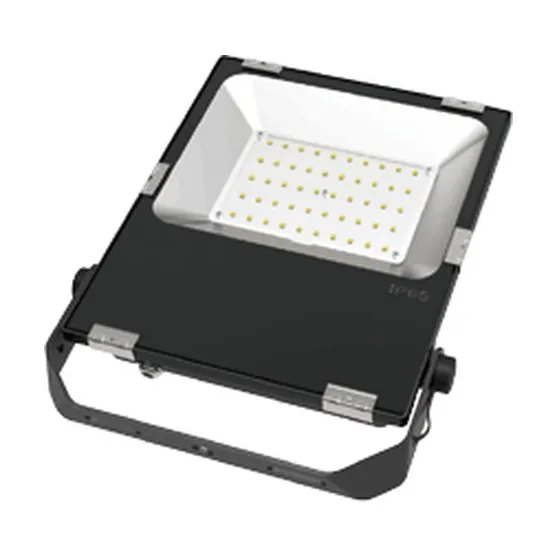
- A 100 W TLZ30J slim LED floodlight at more than 100 lm/W gives at least 10,000 lm
- Floodlights aimed from the edge lose much of their output beyond the yard and on walls. Assume 40 % lands on the yard and a maintenance factor of 0.8: 10,000 × 0.4 × 0.8 = 3,200 lm per fitting
- 12,000 ÷ 3,200 = 3.75, so four floodlights of 100 W
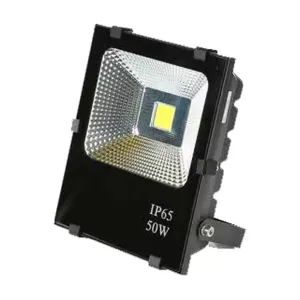
The 40 % figure is a planning assumption, not a measured value. For a smaller yard or a single door area, one 50 W floodlight is often enough. For larger yards, our typical flood light height guide helps decide pole positions.
Where to mount them
- Height: 5–7 m, usually on the eave of the barn or on a pole. Higher spreads the light and keeps the fitting out of reach.
- Aim: tilt down 30–45° towards the yard. A floodlight pointing horizontally throws glare into the eyes of anyone approaching and lights the sky.
- Coverage: put lights on at least two sides of the yard so there are no deep shadows behind vehicles and machinery.
- Doors and gates: each entrance should be lit from the inside of the yard, so a person at the gate is visible.
Our guide to eave-mounted flood lights covers brackets and aiming on buildings.
Dusk to dawn, motion or both?
| Control | How it works | Good for |
|---|---|---|
| Photocell (dusk to dawn) | On all night | Constant visibility, cameras |
| Motion sensor | On when movement is detected | Saving energy, alerting to activity |
| Photocell + motion (dim-to-bright) | Low level all night, full output on movement | Best of both |
A light that comes on suddenly is noticed by people and draws attention to an intruder. A constantly lit yard helps security cameras. Many farms combine both: a low level all night, full output on movement. Our guide to LED flood lights with photocells explains the controls.
Running cost
Four 100 W floodlights running dusk to dawn, an average of 12 hours a night:
- 4 × 100 W × 4,380 h = 1,752 kWh a year
- At $0.15/kWh: about $263 a year
With motion control, if the lights run at full output for an average of 2 hours a night:
- 4 × 100 W × 730 h = 292 kWh a year
- At $0.15/kWh: about $44 a year
The 2 hours is an assumption; a busy yard runs longer. An old 400 W mercury vapour lamp running dusk to dawn used about 1,750 kWh a year on its own, as much as all four LED floodlights left on all night. The tariff is an example; use your own.
Durability on a farm
- IP65 or better: keeps out rain, dust and wash-down spray. The TLZ30J is IP65 with tempered glass.
- Die-cast aluminium: resists knocks and corrosion better than thin steel.
- Wide temperature range: the TLZ30J is rated from −30 °C to +50 °C.
- Surge protection: long overhead or buried cables from the farmhouse pick up lightning surges; specify a surge-protected driver.
- Insects: warmer colour temperatures attract fewer insects; 3000 K or 4000 K is a good compromise for a yard.
Animals and neighbours
Aim floodlights at the yard, not into pens and paddocks. Sudden bright light into a stall can startle animals. Inside livestock housing, the lighting regime is set by welfare guidance for the species, which is a separate subject. Shielded, downward-aimed fittings also avoid light reaching neighbours’ windows and the night sky.
Barn interiors
Inside a pole barn or machine shed, high bays rather than floodlights are usually the right choice. Our guide to LED high bay lights for pole barns covers wattage and spacing for interiors.
Solar options
Where the barn has no power, solar floodlights can light a door or gate. Their output is limited by panel and battery size, so check the real panel watts and battery capacity rather than the nominal wattage on the box.
For farm suppliers and installers
Agricultural suppliers and electricians fitting many farms can order floodlights in bulk with chosen colour temperature, beam and control options. Send us the typical yard sizes and mounting heights, and we will recommend wattages and supply quantities.
Sources
Frequently asked questions
What is the best light for a barn yard?
A sealed LED floodlight of 50–100 W mounted on the barn wall or a pole, with a photocell, a motion sensor or both. It gives far more light per watt than old mercury or sodium barn lamps.
Should barn security lights stay on all night?
Many farms keep a low level on all night and add motion sensors to brighten the yard when something moves. That balances security, livestock checks and energy.
How high should a barn security light be?
Usually 5–7 m, on the eave or a pole. Higher mounting spreads the light more evenly and keeps the fitting out of reach; aim it down to avoid glare.
Do bright lights at night affect livestock?
Animals react to sudden glare and constant light, so aim floodlights at the yard, not into pens, and avoid lighting resting areas all night. Lighting regimes inside livestock housing are a separate topic set by animal welfare guidance.