Dimmable LED Flood Lights and Flood Bulbs: Dimming Methods, Compatibility and Savings
How dimmable LED flood lights and flood bulbs work: triac, 0-10 V, DALI and timer dimming, what must match, and a 20-flood example where dimming adds 4,380 kWh a year of savings.
Key points
- A flood light dims only if its driver is designed for it; a non-dimmable driver on a dimmer flickers, buzzes or fails early.
- Household flood bulbs (PAR30, PAR38, BR30) dim on phase-cut (triac) wall dimmers; commercial floods dim by 0-10 V, DALI or a built-in timer profile.
- In our retrofit calculator, 20 floods of 400 W metal halide replaced by 200 W LED save 22,800 kWh a year; dimming the LED to 50 % for 6 hours a night raises the saving to 27,200 kWh.
- Specify the dimming method, the dimming range (for example 10–100 %) and the control device together, so all three match.
Dimming used to be a luxury for flood lights. With LED it is cheap to add and can cut energy use by a quarter or more on top of the LED saving itself. But “dimmable” means different things on a PAR38 bulb for a porch and on a 300 W flood for a container yard. This guide explains the methods, what has to match, and what dimming saves in a real calculation.
Two very different products
| Dimmable flood bulbs | Dimmable flood fixtures | |
|---|---|---|
| Typical types | PAR30, PAR38, BR30, BR40 with E26/E27 base | Integrated LED floods 30–300 W and above |
| Where used | Porches, garages, home security, shop spotlights | Yards, car parks, facades, sports, industry |
| Usual dimming | Phase-cut (triac) wall dimmer | 0-10 V, DALI, timer profile, sensor |
| What to check | Dimmer compatibility and minimum load | Driver type, control wiring, range |
Method 1: phase-cut (triac) dimming
A phase-cut dimmer chops part of each mains cycle. Incandescent lamps simply dim; an LED bulb needs a driver that reads the chopped wave and reduces current smoothly. Problems come from mismatch:
- Minimum load. Older dimmers need 40 W or more to work properly. Three 12 W LED floods draw only 36 W, so the dimmer can misbehave.
- Leading vs trailing edge. Many LED drivers prefer trailing-edge (reverse-phase) dimmers.
- Low-end dropout. Some combinations flicker or switch off below 20–30 %.
Use a dimmer rated for LED loads, stay within its LED wattage rating, and check the bulb maker’s compatibility list. NEMA SSL 7A sets a basic compatibility standard that helps when both sides follow it.
Method 2: 0-10 V dimming
The most common method for commercial floods. Two extra low-voltage wires (purple and grey, or labelled DIM+ and DIM−) carry a control signal: 10 V for full output, 1 V or 0 V for minimum. Advantages:
- Simple, robust and independent of the mains wiring.
- Works with wall controllers, photocells, occupancy sensors and building management systems.
- Many floods can share one control circuit.
Check the dimming range: “10–100 %” and “1–100 %” behave differently at the low end. Run the control pair separately from mains cables, or use cable rated for the full voltage.
Method 3: DALI
DALI (IEC 62386) is a digital bus. Each driver has an address, so floods can be dimmed individually or in groups, and the system can report failures. It suits sports halls, facades and sites where you want scenes or remote monitoring. It costs more than 0-10 V and needs commissioning.
Method 4: built-in timer profiles
Many outdoor floods and street lights can be ordered with a driver that follows a pre-set schedule: for example 100 % from dusk to midnight, 50 % until 5 am, then 100 % until dawn. No control wiring is needed. This is the simplest way to save energy on a car park or yard that is quiet after midnight. Our solar street light dimming profile article shows how such schedules are set on solar lights, where they matter most.
What dimming saves: a worked example
We used our LED retrofit savings calculator for a yard with 20 floods of 400 W metal halide (about 460 W each with ballast), 12 hours a night, 0.15 per kWh, and 20 per fitting per year for lamp changes against 2 for LED.
| Option | Average LED power | Energy per year | Saved vs metal halide | Electricity saved |
|---|---|---|---|---|
| Metal halide, 400 W | — | 40,296 kWh | — | — |
| 200 W LED, full power all night | 200 W | 17,520 kWh | 22,776 kWh (57 %) | about 3,420 |
| 200 W LED, 50 % from midnight to 6 am | 150 W | 13,140 kWh | 27,156 kWh (67 %) | about 4,070 |
(open the non-dimmed example · open the dimmed example)
The dimming schedule averages 150 W over the night: 6 hours at 200 W and 6 at 100 W. It adds 4,380 kWh a year of savings, about 650 a year at this tariff, for the cost of a timer-profile driver. We left the LED price out, so the calculator shows no payback; enter your quoted price to see it.
Choosing a dimmable flood
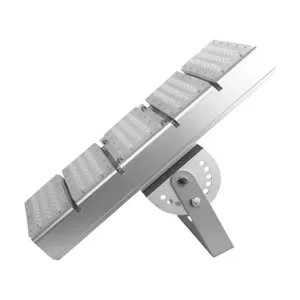
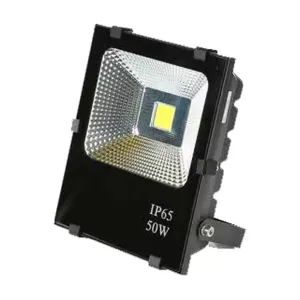
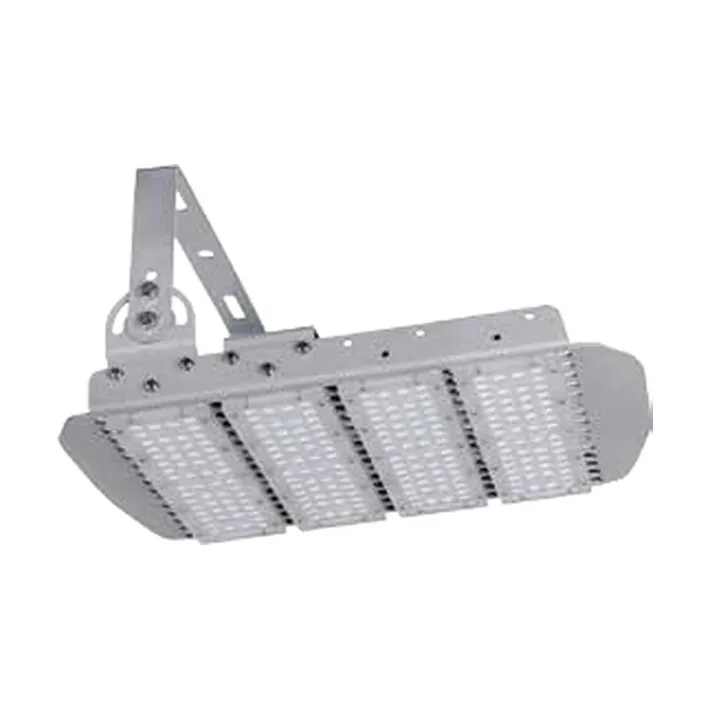
Our TLM30C modular flood light (50–300 W, over 110 lm/W, IP67) and TLZ30J slim flood light (50–200 W, IP65) cover most yard and facade sizes. When you order, tell us the dimming method you need, and we will confirm the driver type and its range in the quotation. Specify:
- Method: triac, 0-10 V, DALI or timer profile.
- Range: for example 10–100 %.
- Control device: wall dimmer, sensor, photocell, controller or BMS.
- Voltage: 220–240 V or 100–277 V drivers differ.
Dimming and sensors
Pairing a dimmable flood with a motion sensor gives the biggest savings on rarely used areas: the flood idles at 20–30 % and goes to full when someone arrives. Our motion sensor flood lights article covers detection ranges and hold times.
Troubleshooting
- Flicker at low levels: raise the minimum setting or change to a compatible dimmer.
- Buzzing: often the dimmer, not the light; try a trailing-edge type.
- Lights not dimming on 0-10 V: check polarity of the control pair and that the controller sinks current.
- Some floods brighter than others: mixed driver batches or long control runs; group floods from the same order on one circuit.
Our why do LED lights flicker article lists other causes.
What to send us
The number and wattage of floods, the dimming method or the control system you have, and the schedule you want. We will propose the driver and work out the energy saving with our calculator.
Sources
Frequently asked questions
Can any LED flood light be dimmed?
No. Only floods with a dimmable driver can be dimmed. Check the datasheet for the dimming method, such as triac, 0-10 V or DALI, and the range.
Why does my dimmable LED flood bulb flicker?
Usually because the wall dimmer was designed for incandescent loads and its minimum load is higher than the LED bulbs draw, or because the dimmer and bulb are not compatible. Use an LED-rated dimmer and check the bulb maker's compatibility list.
How much does dimming a flood light save?
It depends on the schedule. Running at 50 % for half the night cuts energy by about a quarter. In our 20-flood example that is 4,380 kWh a year.
Do dimmable floods last longer?
Dimming lowers LED and driver temperature, which generally slows lumen depreciation. The rated life on the datasheet is still quoted at full power.